
Official statement
Other statements from this video 29 ▾
- □ Does a bloated robots.txt file really hurt your SEO rankings?
- □ Does it really matter whether you submit your sitemap in robots.txt or Search Console?
- □ Do H1-H6 heading tags really still impact Google rankings?
- □ Is a strict heading tag hierarchy really necessary for SEO rankings?
- □ How long does Google actually take to fully process a domain migration?
- □ Can a site migration really boost your SEO rankings or destroy them completely?
- □ Does Googlebot really crawl from just one place when indexing your geo-targeted content?
- □ Can a noindex tag on geolocalized pages wipe your entire website from Google search results?
- □ Should you really ditch geo-redirects for a simple dynamic banner?
- □ How many location pages can you create before Google penalizes you for spam?
- □ Should you redirect mobile users to your app—and what are the hidden SEO risks?
- □ Do you really need to translate your pages word-for-word for hreflang to work effectively?
- □ Does the domain directive in your Disavow file really help you bypass Google's 2MB limit?
- □ Should you really use the Disavow tool only for purchased links?
- □ Should you noindex your internal search results pages to prevent spammers from creating backlinks?
- □ Does semantic HTML really boost your search rankings?
- □ Is AMP really a ranking factor for Google?
- □ Does removing AMP actually boost crawl on your regular pages?
- □ Should you test removing your Disavow file incrementally, or can you delete it all at once?
- □ Why do knowledge panels display differently across devices and search contexts?
- □ Does Google's synonym system really work without any human intervention?
- □ Should you really create a separate page for each location to implement Local Business schema correctly?
- □ Do you really need to mark up ALL your content with structured data?
- □ Do you really need to display all FAQ schema questions visibly on your page?
- □ Can hidden accordion content really show up in featured snippets?
- □ Why does Google deliberately choose not to index your entire website?
- □ Should you delete pages to boost your site's indexation?
- □ Does search volume of anchor text really impact the value of your internal links?
- □ Should you really add unique content to your e-commerce product pages?
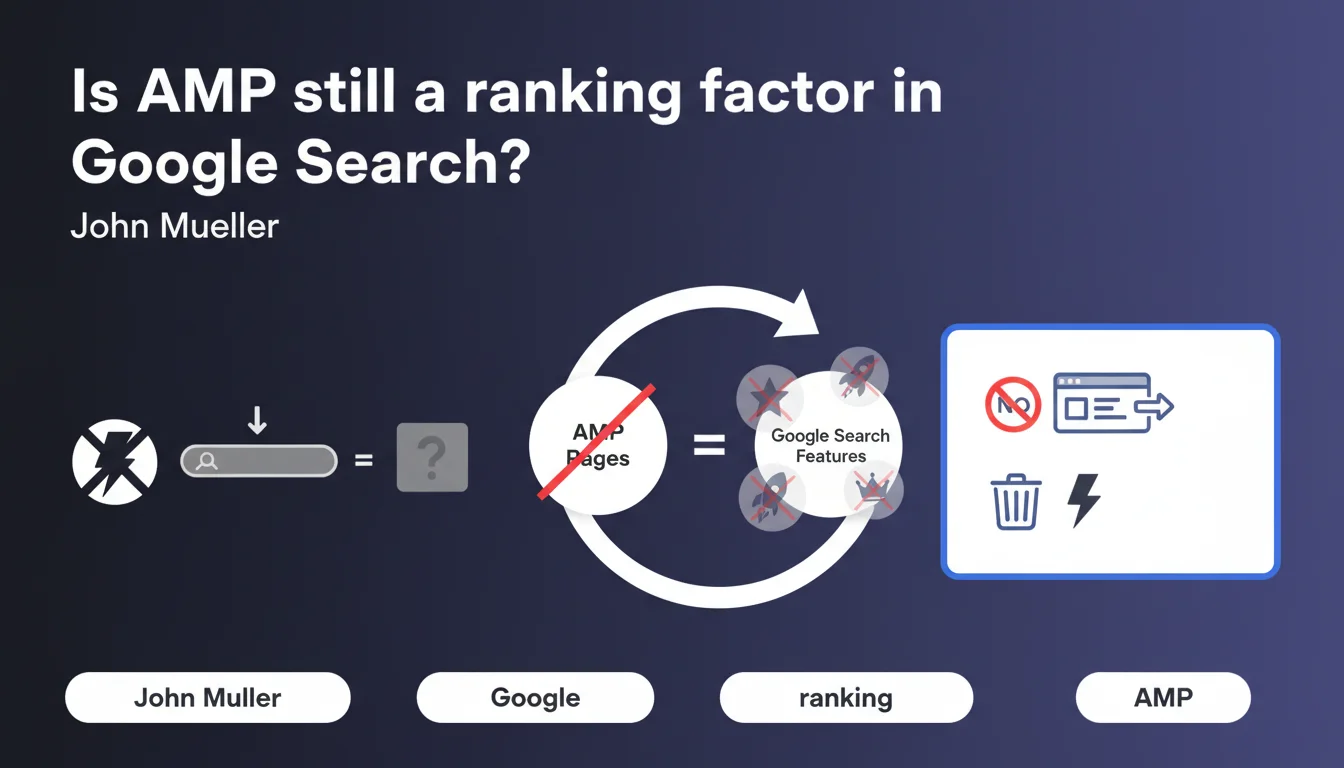
Google confirms that no search features are now exclusively reserved for AMP pages. Removing AMP from your site doesn't deprive you of any specific SEO advantages. This statement marks a turning point in Google's mobile strategy, which had long valued this format.
What you need to understand
Did AMP really enjoy exclusive SEO advantages previously?
For several years, AMP had access to privileged placements in mobile search results. The news carousel at the top of the page, in particular, was strictly reserved for AMP pages.
This premium positioning was a major competitive advantage for publishers who adopted the format. Many invested heavily in AMP solely to access this increased visibility — not out of technical conviction.
What changed in Google's position?
Google gradually opened these features to all fast pages, whether AMP or not. The news carousel now accepts any page meeting Google's performance criteria and news standards.
This evolution is part of a broader movement: the gradual abandonment of AMP as a mandatory format. Core Web Vitals took over as a universally applicable performance criterion.
What does Mueller's statement concretely mean?
Mueller officially confirms what many were already observing: AMP is no longer a technical prerequisite to access any search feature.
Key points to remember:
- No preferential treatment: AMP and non-AMP pages are evaluated on the same ranking criteria
- No penalty for removal: Removing AMP from your infrastructure causes no mechanical loss of visibility
- Performance remains key: What matters is speed and user experience, not the technical format
- Simplification possible: Maintaining two versions (AMP + standard) no longer delivers measurable SEO benefit
SEO Expert opinion
Is this statement consistent with field observations?
Yes, largely. Since the integration of Core Web Vitals as a ranking signal, we observe that well-optimized non-AMP pages perform as well — sometimes better — than poorly designed AMP equivalents.
The myth that AMP guaranteed a visibility boost has collapsed. Complete migrations from AMP to optimized standard pages showed neutral or positive results in terms of organic traffic.
What nuances should we add to this statement?
Mueller's statement is technically accurate but omits a crucial point: the transition is not without effort. An AMP page is inherently very fast — removing AMP without investing in optimizing your standard version can degrade your performance.
[To verify] Google remains vague about the exact weight of Core Web Vitals in the overall algorithm. Saying there is "nothing to lose" assumes your non-AMP version already achieves comparable scores — which is not always the case.
In what cases does AMP still have value?
If your technical stack doesn't allow you to achieve optimal mobile performance, AMP remains an effective workaround. This is especially true for sites running heavy CMS or loaded with uncontrollable third-party scripts.
Some publishers keep AMP not for SEO, but for advertising monetization: the format imposes constraints that accelerate ad loading, improving viewability and thus revenue. This is a business consideration, not SEO.
Practical impact and recommendations
Should you remove AMP from your site immediately?
Not necessarily. AMP removal should be conditioned on your ability to maintain equivalent performance on your standard pages. If you lack resources to optimize properly, keeping AMP remains a viable option.
Test first on a sample of pages. Compare Core Web Vitals metrics between AMP and non-AMP versions, then monitor traffic evolution over 4-6 weeks before generalizing.
How to successfully migrate away from AMP?
The key: reproduce AMP's technical advantages without the framework. This requires a thorough audit of your scripts, images, and third-party resources.
- Audit your current Core Web Vitals (AMP vs standard) using PageSpeed Insights and CrUX
- Optimize image loading (lazy loading, WebP/AVIF formats, responsive sizing)
- Reduce render-blocking JavaScript — defer or remove non-critical scripts
- Implement a robust caching system (CDN, service workers)
- Configure redirects properly from old AMP URLs
- Remove
rel="amphtml"tags from canonical pages - Monitor Search Console for any indexation anomalies post-migration
- Verify that structured data (JSON-LD) is properly present on standard versions
What to do if you choose to keep AMP?
If AMP remains relevant for you, ensure your two versions are perfectly synchronized. Content, meta tags, and structured data must be identical — any divergence can create contradictory signals for Google.
Continue monitoring Google's announcements about AMP. The format is declining, and complete withdrawal of support cannot be ruled out in the medium term.
❓ Frequently Asked Questions
Perdrai-je du trafic en supprimant AMP de mon site ?
Les pages AMP sont-elles encore indexées normalement par Google ?
Dois-je rediriger mes URLs AMP vers les versions standard ?
AMP peut-il encore aider pour les sites lents techniquement ?
Google prévoit-il d'abandonner complètement AMP ?
🎥 From the same video 29
Other SEO insights extracted from this same Google Search Central video · published on 14/01/2022
🎥 Watch the full video on YouTube →
💬 Comments (0)
Be the first to comment.