
Official statement
Other statements from this video 29 ▾
- □ Does a bloated robots.txt file really hurt your SEO rankings?
- □ Does it really matter whether you submit your sitemap in robots.txt or Search Console?
- □ Do H1-H6 heading tags really still impact Google rankings?
- □ Is a strict heading tag hierarchy really necessary for SEO rankings?
- □ How long does Google actually take to fully process a domain migration?
- □ Can a site migration really boost your SEO rankings or destroy them completely?
- □ Does Googlebot really crawl from just one place when indexing your geo-targeted content?
- □ Can a noindex tag on geolocalized pages wipe your entire website from Google search results?
- □ Should you really ditch geo-redirects for a simple dynamic banner?
- □ Should you redirect mobile users to your app—and what are the hidden SEO risks?
- □ Do you really need to translate your pages word-for-word for hreflang to work effectively?
- □ Does the domain directive in your Disavow file really help you bypass Google's 2MB limit?
- □ Should you really use the Disavow tool only for purchased links?
- □ Should you noindex your internal search results pages to prevent spammers from creating backlinks?
- □ Does semantic HTML really boost your search rankings?
- □ Is AMP still a ranking factor in Google Search?
- □ Is AMP really a ranking factor for Google?
- □ Does removing AMP actually boost crawl on your regular pages?
- □ Should you test removing your Disavow file incrementally, or can you delete it all at once?
- □ Why do knowledge panels display differently across devices and search contexts?
- □ Does Google's synonym system really work without any human intervention?
- □ Should you really create a separate page for each location to implement Local Business schema correctly?
- □ Do you really need to mark up ALL your content with structured data?
- □ Do you really need to display all FAQ schema questions visibly on your page?
- □ Can hidden accordion content really show up in featured snippets?
- □ Why does Google deliberately choose not to index your entire website?
- □ Should you delete pages to boost your site's indexation?
- □ Does search volume of anchor text really impact the value of your internal links?
- □ Should you really add unique content to your e-commerce product pages?
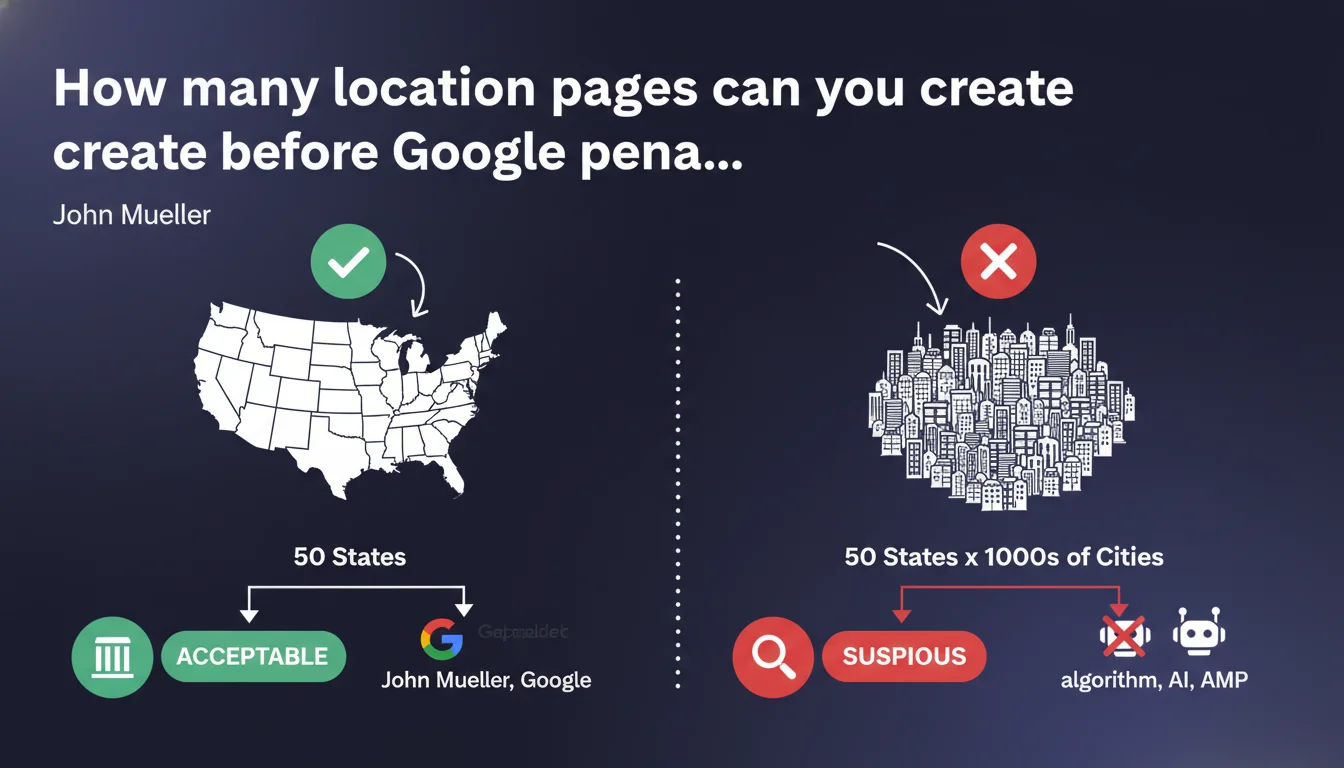
Google tolerates regional pages as long as the number remains reasonable — for example, 50 US states. Once you start creating a page for every city in each state, anti-spam algorithms are likely to flag it. The boundary lies between useful granularity and industrially-scaled duplicate content.
What you need to understand
This statement from John Mueller addresses a recurring question: how far can you push geographic targeting logic without triggering Google's anti-spam filters?
The context is straightforward. Many multi-location websites create dedicated pages for each service area — a legitimate practice when it serves the user. But the boundary with spam becomes blurry when you multiply hundreds of nearly-identical pages, changing only the city name.
What is the threshold of "reasonable quantity" according to Google?
Mueller gives a concrete example: 50 US states is acceptable. That's a figure that matches a natural administrative division, with manageable volume and clear relevance for the user.
On the other hand, if you then break down each state into dozens or hundreds of cities, you enter a gray zone. Anti-spam algorithms are designed to detect this type of strategy — especially if content varies little from one page to the next.
Why does this limit exist?
Google combats thin content at industrial scale. Creating 5,000 pages with the same template, just replacing a city name, generates noise in the index without added value.
If each page brings unique content, local testimonials, information specific to the area — no problem. The problem arises when differentiation is limited to the title and city name in a paragraph.
- 50 regional pages = acceptable if well differentiated
- Hundreds of city-by-city pages = high risk of anti-spam filter
- The key: each page must have a reason to exist for the user, not just to capture long-tail traffic
- The algorithm detects duplication patterns even with minor variations
SEO Expert opinion
Is this position consistent with what we observe in practice?
Yes, completely. We regularly see sites with hundreds of geolocalized pages getting filtered — either via manual action or via a brutal algorithmic adjustment. Sites that come out of it all have one thing in common: each page brings true differentiation.
The figure of 50 states is not a magic limit — it's an example to illustrate an order of magnitude. A French site with 13 regions will cause no problem. A site with 35,000 municipalities... that's another story.
What doesn't Google say clearly here?
The statement intentionally remains vague on the real criterion: quality of differentiation. Mueller talks about "looking suspicious," but doesn't give a precise threshold. [To verify]: is it 100 pages? 500? 1,000?
In reality, it's not so much the absolute number that matters as the signal-to-noise ratio. If you have 500 city pages with 80% identical content, you're on the radar. If you have 200 pages with truly unique content, it might get through.
In what cases does this rule not apply?
If your content is truly differentiated by zone — for example, a real estate listing site with different properties by city — then the number of pages is no longer a problem. Each page has a reason to exist.
Similarly, a local news site with articles specific to each city will never be penalized for having too many pages. The problem doesn't come from volume, but from disguised duplication.
Practical impact and recommendations
What should you concretely do with this information?
If you already manage geolocalized pages, start with a differentiation audit. Take 10 pages at random and compare them side by side. If 70% of the content is identical, that's a red flag.
Then decide: either you consolidate weak pages (for example, group several small cities under one regional page), or you enrich each page with truly unique content — local testimonials, specific data, local teams, hours, etc.
What mistakes should you absolutely avoid?
Don't launch a "1 page per city" strategy without having editorial resources to differentiate. Generating 500 pages in template mode won't work anymore — or only temporarily, before an algorithmic clean-up.
Also avoid the trap of low-grade programmatic content. Yes, you can automate certain parts, but you need a minimum of manual curation. User behavior signals (bounce rate, time on page) quickly reveal weak content.
- Audit existing pages: similarity rate between geolocalized pages
- Identify pages with less than 30% unique content → consolidate or enrich
- Check user engagement on these pages (GA4, Search Console): bounce rate, CTR, time
- If creating new regional pages: plan minimum 400-500 words unique content per page
- Integrate real local elements: testimonials, teams, events, specific data
- Monitor indexation in Search Console: watch for any massive deindexation
- Set up a local content creation process if significant volume is targeted
The limit is not an absolute number — it's the ability to produce truly differentiated content at each level of granularity. If you're unsure, stick with a broad breakdown (regions, departments) rather than multiplying nearly-identical city pages.
These strategic tradeoffs — consolidate vs. expand, automate vs. manual curation, optimal geographic granularity — require field expertise and a comprehensive site vision. If the complexity seems unmanageable internally, working with a specialist SEO agency can help structure the approach and avoid costly visibility mistakes.
❓ Frequently Asked Questions
Combien de pages régionales maximum peut-on créer sans risque ?
Peut-on créer une page par ville si le contenu est vraiment différent ?
Comment savoir si mes pages géolocalisées risquent un filtre anti-spam ?
Vaut-il mieux regrouper plusieurs villes sur une page régionale ?
Les algorithmes détectent-ils vraiment les variations minimes de contenu ?
🎥 From the same video 29
Other SEO insights extracted from this same Google Search Central video · published on 14/01/2022
🎥 Watch the full video on YouTube →
💬 Comments (0)
Be the first to comment.