
Official statement
Other statements from this video 29 ▾
- □ Does a bloated robots.txt file really hurt your SEO rankings?
- □ Does it really matter whether you submit your sitemap in robots.txt or Search Console?
- □ Do H1-H6 heading tags really still impact Google rankings?
- □ Is a strict heading tag hierarchy really necessary for SEO rankings?
- □ How long does Google actually take to fully process a domain migration?
- □ Can a site migration really boost your SEO rankings or destroy them completely?
- □ Does Googlebot really crawl from just one place when indexing your geo-targeted content?
- □ Can a noindex tag on geolocalized pages wipe your entire website from Google search results?
- □ Should you really ditch geo-redirects for a simple dynamic banner?
- □ How many location pages can you create before Google penalizes you for spam?
- □ Should you redirect mobile users to your app—and what are the hidden SEO risks?
- □ Do you really need to translate your pages word-for-word for hreflang to work effectively?
- □ Does the domain directive in your Disavow file really help you bypass Google's 2MB limit?
- □ Should you really use the Disavow tool only for purchased links?
- □ Should you noindex your internal search results pages to prevent spammers from creating backlinks?
- □ Does semantic HTML really boost your search rankings?
- □ Is AMP still a ranking factor in Google Search?
- □ Is AMP really a ranking factor for Google?
- □ Does removing AMP actually boost crawl on your regular pages?
- □ Should you test removing your Disavow file incrementally, or can you delete it all at once?
- □ Why do knowledge panels display differently across devices and search contexts?
- □ Does Google's synonym system really work without any human intervention?
- □ Should you really create a separate page for each location to implement Local Business schema correctly?
- □ Do you really need to mark up ALL your content with structured data?
- □ Do you really need to display all FAQ schema questions visibly on your page?
- □ Can hidden accordion content really show up in featured snippets?
- □ Why does Google deliberately choose not to index your entire website?
- □ Should you delete pages to boost your site's indexation?
- □ Should you really add unique content to your e-commerce product pages?
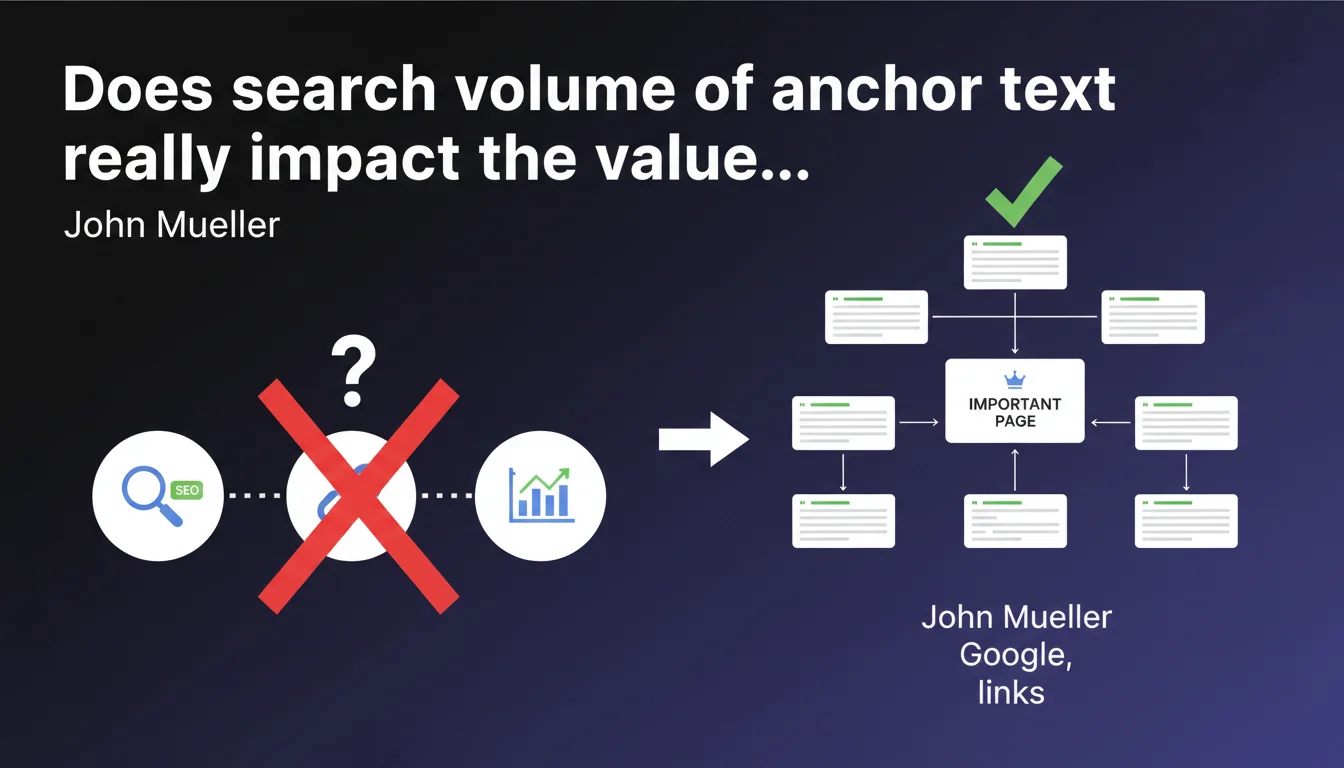
Google doesn't evaluate internal links based on the search volume of keywords used as anchor text. What matters is Google's understanding of your pages' structural importance within your site. Internal linking optimization should therefore focus on hierarchy and thematic coherence, not search volumes.
What you need to understand
Why does this distinction about search volume matter?
The confusion stems from a widespread practice: optimizing internal link anchors with high-volume keywords, assuming Google would weight them more heavily. This logic, which might apply to external backlinks, doesn't work for internal linking according to Mueller.
Google evaluates a site's internal structure based on its own crawling and understanding logic. Search volume is an external metric tied to user behavior, not to site architecture.
What actually determines internal link value then?
A page's importance is measured by its position in your site hierarchy, the frequency of links pointing to it, and the contextual relevance of those links. A page close to the homepage, linked from multiple strategic sections, carries more weight than a page buried three clicks deep.
Thematic coherence also plays a role: a contextual link from a page covering the same topic transmits more signal than a generic footer link. It's the site's topology that speaks, not keyword volumes.
Does this approach fundamentally change how you should optimize internal linking?
Yes, radically. Rather than stuffing your anchors with 10k/month search volume terms, focus on contextual clarity and balanced internal PageRank distribution. A descriptive, naturally-sounding anchor performs better than keyword-bloated anchor text.
- Search volume: not considered when evaluating internal links
- Hierarchical position: major criterion for page importance
- Thematic coherence: determines contextual link relevance
- Internal PageRank distribution: influenced by structure, not by volumes
SEO Expert opinion
Is this statement aligned with what we observe in practice?
Broadly yes — and it's actually reassuring. Technical audits have long shown that sites with well-structured internal linking (thematic hubs, contextual links, controlled depth) outperform those optimizing anchors solely for search volumes.
That said, Mueller deliberately stays vague on how Google concretely measures this "importance". Which exact signals? What's the weighting of homepage proximity versus link frequency? [To verify] — we lack numerical data to refine beyond broad principles.
Should you completely ignore optimized anchor text?
No, that would be a misinterpretation. Mueller says search volume doesn't count, not that anchor text itself is unimportant. A descriptive anchor, rich in semantic context, still helps Google understand your target page.
The distinction is this: prioritize clarity and relevance over keyword stuffing with high volumes. "Discover our SEO content strategies" beats a bare "SEO" anchor text, even if "SEO" has massive search volume.
When might this rule fall short?
On massive e-commerce sites or media platforms with thousands of pages, structure alone doesn't solve everything. You can have a strategically well-placed page but drowning in noise if hundreds of other pages receive similar internal link treatment.
In those cases, internal linking optimization becomes complex trade-off analysis between depth, frequency, thematic relevance, and link-per-page limits. Google's generic statements don't cover these edge cases — it's highly situational.
Practical impact and recommendations
What should you concretely do to optimize internal linking?
Rethink your site architecture: strategic pages should be reachable in 2-3 clicks maximum from your homepage. Use thematic hubs (pillar pages) that redistribute PageRank to coherent secondary pages.
Replace generic anchors ("click here", "learn more") with descriptive anchors that clearly explain what readers will find. No need to target a specific search volume — aim for clarity and context.
What mistakes should you avoid when revising your internal linking?
Don't fall into the opposite trap: over-optimizing anchors with exact keyword variations. Google detects artificial patterns. Vary your phrasing naturally.
Also avoid concentrating all internal links on 3-4 "money" pages at the expense of others. This creates structural imbalances that dilute overall site authority.
How do you verify your internal linking strategy is working?
Use crawl tools (Screaming Frog, Oncrawl, Botify) to map your internal PageRank distribution. Identify orphaned pages, excessive depths, pages receiving too many or too few links.
Compare this mapping against your business goals: are pages generating conversions or traffic well-fed with internal links from high-authority pages? If not, rebalance.
- Audit crawl depth: strategic pages at 2-3 clicks maximum from homepage
- Identify thematic hubs and strengthen their distribution role
- Replace generic anchors with descriptive ones (no keyword stuffing)
- Map internal PageRank distribution using a crawler tool
- Detect and fix orphaned or under-linked pages
- Avoid over-optimization: vary anchor formulations naturally
- Rebalance internal links based on business goals, not search volumes
❓ Frequently Asked Questions
Faut-il arrêter d'optimiser les ancres de liens internes ?
Comment Google évalue-t-il l'importance d'une page en interne ?
Le maillage interne influence-t-il toujours le classement ?
Quelle différence entre lien interne et backlink sur ce point ?
Combien de liens internes par page sont recommandés ?
🎥 From the same video 29
Other SEO insights extracted from this same Google Search Central video · published on 14/01/2022
🎥 Watch the full video on YouTube →
💬 Comments (0)
Be the first to comment.