
Official statement
Other statements from this video 29 ▾
- □ Does a bloated robots.txt file really hurt your SEO rankings?
- □ Does it really matter whether you submit your sitemap in robots.txt or Search Console?
- □ Do H1-H6 heading tags really still impact Google rankings?
- □ Is a strict heading tag hierarchy really necessary for SEO rankings?
- □ How long does Google actually take to fully process a domain migration?
- □ Can a site migration really boost your SEO rankings or destroy them completely?
- □ Does Googlebot really crawl from just one place when indexing your geo-targeted content?
- □ Can a noindex tag on geolocalized pages wipe your entire website from Google search results?
- □ Should you really ditch geo-redirects for a simple dynamic banner?
- □ How many location pages can you create before Google penalizes you for spam?
- □ Should you redirect mobile users to your app—and what are the hidden SEO risks?
- □ Do you really need to translate your pages word-for-word for hreflang to work effectively?
- □ Does the domain directive in your Disavow file really help you bypass Google's 2MB limit?
- □ Should you really use the Disavow tool only for purchased links?
- □ Should you noindex your internal search results pages to prevent spammers from creating backlinks?
- □ Does semantic HTML really boost your search rankings?
- □ Is AMP still a ranking factor in Google Search?
- □ Is AMP really a ranking factor for Google?
- □ Does removing AMP actually boost crawl on your regular pages?
- □ Should you test removing your Disavow file incrementally, or can you delete it all at once?
- □ Why do knowledge panels display differently across devices and search contexts?
- □ Should you really create a separate page for each location to implement Local Business schema correctly?
- □ Do you really need to mark up ALL your content with structured data?
- □ Do you really need to display all FAQ schema questions visibly on your page?
- □ Can hidden accordion content really show up in featured snippets?
- □ Why does Google deliberately choose not to index your entire website?
- □ Should you delete pages to boost your site's indexation?
- □ Does search volume of anchor text really impact the value of your internal links?
- □ Should you really add unique content to your e-commerce product pages?
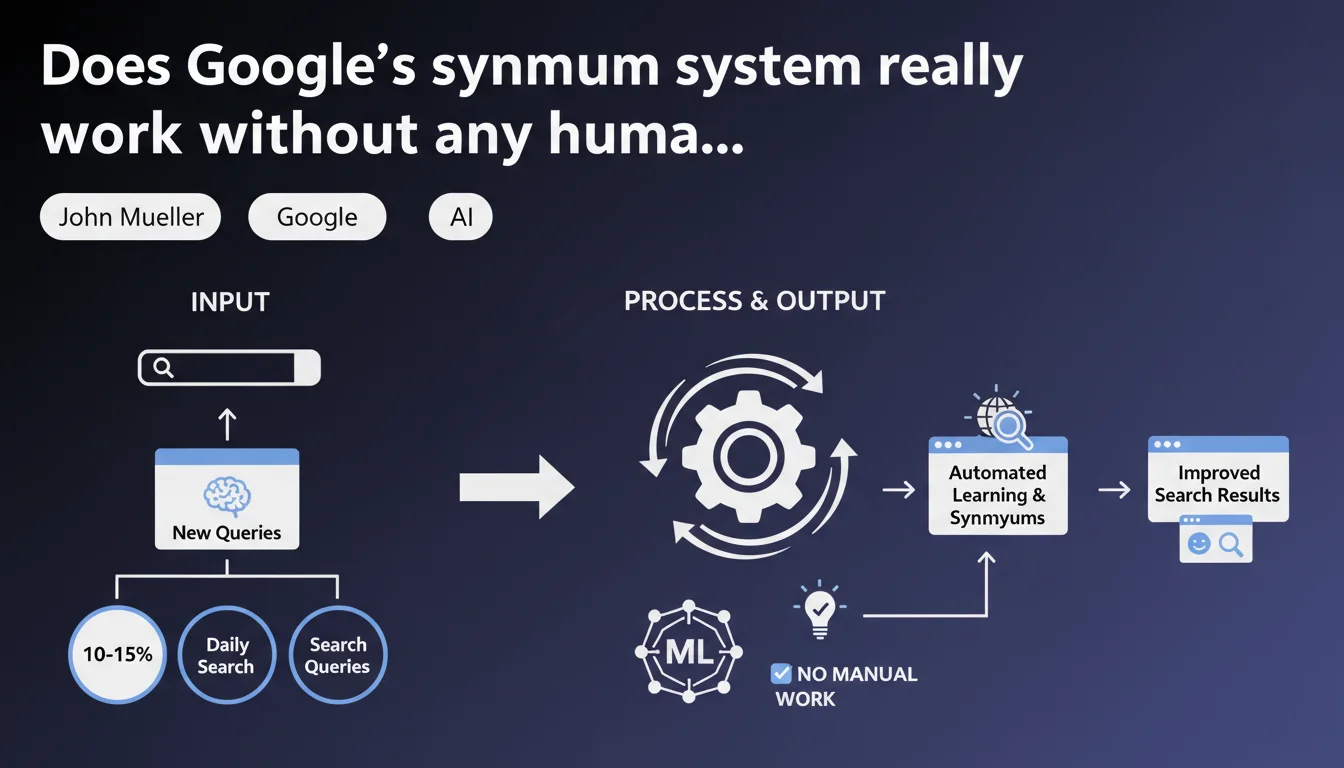
Google claims its synonym system is 100% automated with no manual list management. Why? Because 10 to 15% of daily search queries are completely new, making human intervention impossible at that scale. Machine learning handles everything.
What you need to understand
Why does Google insist on total automation?
Mueller's statement debunks a persistent myth: no, there isn't a team at Google manually compiling synonyms in Excel files. The scale of the problem makes this approach obsolete.
With 10 to 15% of completely new queries every day — meaning millions of never-before-seen combinations — no human curation could keep up. The system must learn continuously, identify semantic patterns, and apply them in real time.
How does this automated system impact query interpretation?
The engine doesn't just swap one word for another. It analyzes the search context, user history, and co-occurrences in indexed documents. A search for "car" can trigger results for "automobile", but also "vehicle", "auto", or even specific brands if context indicates it.
This flexibility explains why two users typing the same query sometimes get slightly different results: the system adjusts based on behavioral signals.
What are the limitations of this automated system?
An algorithm learns from what it observes. If a term emerges in a new context or an ultra-specialized niche, the system can take time to capture the nuance. Professionals regularly observe dubious approximations, especially with technical vocabulary or neologisms.
- The synonym system operates without human intervention
- 10 to 15% of daily queries are completely new
- Machine learning analyzes context and semantic patterns
- Results can vary by user and their history
- Niche or new terms may be misinterpreted temporarily
SEO Expert opinion
Does this statement match what we observe in practice?
Broadly speaking, yes. Tests show that Google genuinely understands semantic variations without requiring you to mechanically repeat every synonym 50 times in your text. Stuffing a page with "car, automobile, vehicle, auto" in every paragraph is completely pointless.
However — and this is where it gets tricky — we still see inconsistencies with certain terms. Obvious synonyms in one domain aren't always captured, especially if search volume is low. The system learns from massive datasets, not edge cases. [To verify] to what extent Google weights synonyms by their global usage frequency versus their contextual relevance.
What nuances should we add to this official narrative?
Mueller says "fully automated", but that doesn't rule out occasional manual tweaks on sensitive or problematic queries. We know Google intervenes manually on certain results (medical, finance, elections). It's hard to believe no engineer ever corrects a faulty interpretation that's circulating on repeat.
The other point: saying the system "learns automatically" through machine learning is vague. Does it learn only from search data? From clicks? From crawled content? From user feedback? We have no visibility into the model's training sources.
When does this system show its limitations?
With polysemous terms, first and foremost. "Mouse" can mean the animal or the computer device — Google handles this reasonably well, but not always perfectly depending on page context. SEOs in sectors with highly specialized jargon (medical, legal, technical) regularly observe approximations.
Next, with emerging concepts. When a term emerges (new product, trend, event), the system takes time to establish the associated synonym network. During this period, optimizing solely for the exact term can still make a difference.
Practical impact and recommendations
Should we still optimize for synonyms or let Google handle it?
Both. Google captures obvious variations, so there's no need to mechanically sprinkle "shoes, footwear, sneakers" everywhere. It reeks of spam and adds nothing.
However, naturally using the lexical field of your topic remains fundamental. Not to manipulate the algorithm, but to prove you understand the domain. Content rich in relevant vocabulary signals expertise — and that counts.
What errors should we avoid with this automated system?
First mistake: thinking you can get by with a single keyword per page. If you write about "electric bikes" without ever mentioning "e-bike", "electric assist", "battery", "motor", your semantic depth is zero. Google might understand the synonym, but your content remains shallow.
Second mistake: over-optimizing for synonyms Google doesn't recognize yet. Some SEO tools suggest dozens of "variations" that are actually distinct terms with their own search intent. Forcing their integration creates confusion.
How can you verify that Google correctly interprets your content?
Open Search Console and analyze the "Performance" tab. Look at which queries trigger your pages. If you optimize for "digital marketing training" and also rank for "online marketing course", "webmarketing learning", that's the system doing its job.
If you only show up for your exact keyword, two hypotheses: either your lexical field is too narrow, or the topic is so niche that Google lacks enough data to establish synonyms.
- Check Search Console for actual queries that trigger your pages
- Enrich vocabulary naturally, without keyword stuffing
- Test Google's interpretation by searching your main synonyms
- Don't force integration of terms the algorithm doesn't yet connect
- Monitor approximations in your industry jargon and adjust if needed
- Prioritize semantic depth over multiplying variants
❓ Frequently Asked Questions
Google comprend-il tous les synonymes de mon secteur d'activité ?
Dois-je quand même utiliser des variantes de mots-clés dans mes contenus ?
Comment vérifier que Google associe bien mes synonymes à ma page ?
Le système de synonymes remplace-t-il complètement l'optimisation sémantique ?
Pourquoi certains de mes synonymes ne génèrent-ils aucun trafic ?
🎥 From the same video 29
Other SEO insights extracted from this same Google Search Central video · published on 14/01/2022
🎥 Watch the full video on YouTube →
💬 Comments (0)
Be the first to comment.