
Official statement
Other statements from this video 29 ▾
- □ Does a bloated robots.txt file really hurt your SEO rankings?
- □ Does it really matter whether you submit your sitemap in robots.txt or Search Console?
- □ Do H1-H6 heading tags really still impact Google rankings?
- □ Is a strict heading tag hierarchy really necessary for SEO rankings?
- □ How long does Google actually take to fully process a domain migration?
- □ Can a site migration really boost your SEO rankings or destroy them completely?
- □ Does Googlebot really crawl from just one place when indexing your geo-targeted content?
- □ Can a noindex tag on geolocalized pages wipe your entire website from Google search results?
- □ Should you really ditch geo-redirects for a simple dynamic banner?
- □ How many location pages can you create before Google penalizes you for spam?
- □ Should you redirect mobile users to your app—and what are the hidden SEO risks?
- □ Do you really need to translate your pages word-for-word for hreflang to work effectively?
- □ Does the domain directive in your Disavow file really help you bypass Google's 2MB limit?
- □ Should you really use the Disavow tool only for purchased links?
- □ Should you noindex your internal search results pages to prevent spammers from creating backlinks?
- □ Does semantic HTML really boost your search rankings?
- □ Is AMP still a ranking factor in Google Search?
- □ Is AMP really a ranking factor for Google?
- □ Does removing AMP actually boost crawl on your regular pages?
- □ Should you test removing your Disavow file incrementally, or can you delete it all at once?
- □ Why do knowledge panels display differently across devices and search contexts?
- □ Does Google's synonym system really work without any human intervention?
- □ Should you really create a separate page for each location to implement Local Business schema correctly?
- □ Do you really need to mark up ALL your content with structured data?
- □ Do you really need to display all FAQ schema questions visibly on your page?
- □ Can hidden accordion content really show up in featured snippets?
- □ Why does Google deliberately choose not to index your entire website?
- □ Should you delete pages to boost your site's indexation?
- □ Does search volume of anchor text really impact the value of your internal links?
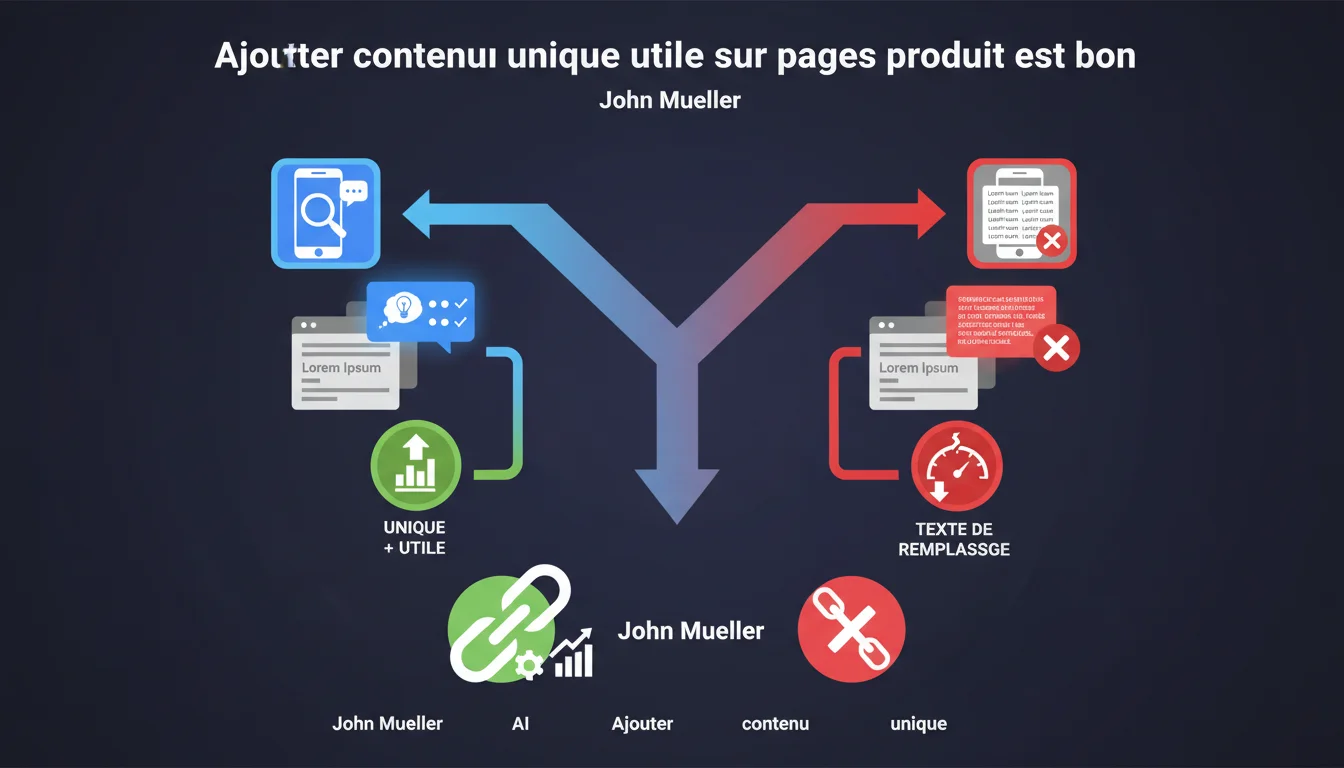
Google recommends enriching product pages with unique and useful content for the user, especially if the manufacturer's description is replicated across many sites. Simply adding generic text without real value is counterproductive and generates no ranking advantage.
What you need to understand
Why does Google emphasize unique content for product pages?
The issue of duplicate content is prevalent in e-commerce. Thousands of sites repeat the same description provided by the manufacturer, creating a total uniformity across identical products.
Google seeks to prioritize pages that provide real added value beyond just a copied and pasted technical sheet. The goal is to reward sites that genuinely assist the user in their purchasing decision.
What differentiates 'useful' content from mere filler?
Useful content addresses specific questions that buyers may have: compatibility with other products, real-use experience, maintenance tips, comparisons with alternatives. It often relies on industry expertise or authentic customer feedback.
Filler text, on the other hand, goes in circles: empty rephrasing, repetition of keywords without informative value, generic blocks added solely to inflate text volume. Google knows how to tell the difference.
Does this guideline apply to all types of products?
The relevance of this recommendation varies according to the product's level of commoditization. For a standardized spare part, enrichment may seem artificial. For an electronic device or a niche product, adding guides, tutorials, or testimonials becomes a true differentiator.
The strategy should be adapted to the competitive context and the dominant search intent for that product.
- Enriching with genuinely useful content improves positioning against competitors using the same manufacturer's description
- Generic text without value brings no SEO benefit and may even dilute relevance
- The effort to enrich must be proportional to the commercial value and potential differentiation of the product
- Google evaluates the quality of the added content, not just its existence
SEO Expert opinion
Is this statement aligned with real-world observations?
In practice, it is indeed observed that sites that intelligently enrich their product listings outperform generic catalogs. A/B tests show measurable gains in organic traffic and conversion rates.
But — and this is where it gets tricky — the definition of 'useful content' remains intentionally vague. Google provides no quantitative threshold, no precise metrics. This ambiguity allows the algorithm to adapt but complicates implementation on the SEO side. [To be verified]: the actual impact of enriched content of 200 words versus 500 words remains difficult to isolate from other ranking factors.
What pitfalls should be avoided when applying this advice?
The main risk is falling into the mass production of mediocre content. Some e-commerce businesses automatically generate 'enriched' blocks via templates or AI, without real added value. Google detects these patterns.
Another pitfall: over-investing in low-margin or low-search-volume products. Enrichment should be strategically prioritized on high-potential listings, not applied blindly to the entire catalog.
In what cases does this recommendation become counterproductive?
In some ultra-competitive markets (consumer electronics, for example), the main differentiator is not content but price, availability, customer reviews. Adding 300 words on an iPhone won’t matter if your price is 10% higher than the competition.
Similarly, for massive sites (tens of thousands of references), the editorial cost can become prohibitive. One must then balance between broad coverage and selective depth.
Practical impact and recommendations
What should you do concretely to enrich your product pages?
Start with an audit of your strategic listings: identify the products generating the most traffic or having the highest commercial potential. For these references, analyze what competitors with better rankings offer.
Then, create content that answers the unresolved questions posed by the manufacturer’s description: sizing guides, usage tips, technical comparisons, specific FAQs. Engage your sales or customer service teams to extract recurring inquiries.
Prioritize varied formats: demonstration videos, comparison tables, technical diagrams. Pure text is not the only option to differentiate a product listing.
What mistakes should be avoided at all costs?
Don’t fall into the trap of disguised keyword stuffing. An 'SEO optimized' paragraph listing variations of the target query without narrative logic will be penalized, not rewarded.
Avoid generic content that can be identically replicated on other products. If your 'enriched description' works equally well for Model A as for Model B after merely replacing the name, it has no differentiating value.
- Prioritize enrichment on the 20% of products that generate 80% of revenue
- Incorporate verifiable factual elements (precise dimensions, tested compatibilities, real user feedback)
- Use natural language, not a collection of keywords
- Test the impact on samples before scaling up
- Monitor the evolution of ranking and conversion rates on enriched pages
- Train editorial teams on E-E-A-T criteria (Experience, Expertise, Authority, Trust)
How can you measure the effectiveness of your product content strategy?
Implement segmented tracking in Google Analytics and Search Console: compare the performance of enriched listings versus standard listings. Look not only at organic traffic but also at engagement metrics (time on page, bounce rate, cart addition rate).
Use controlled A/B tests on comparable product samples. Enrichment should demonstrate a positive ROI before being generalized.
❓ Frequently Asked Questions
Le contenu unique doit-il obligatoirement être du texte ?
Combien de mots faut-il ajouter pour que ce soit considéré comme du contenu unique ?
Peut-on utiliser l'IA générative pour produire ce contenu unique ?
Si mes concurrents ont aussi enrichi leurs fiches avec du contenu unique, quel avantage ai-je ?
Faut-il enrichir toutes les pages produit ou seulement certaines ?
🎥 From the same video 29
Other SEO insights extracted from this same Google Search Central video · published on 14/01/2022
🎥 Watch the full video on YouTube →
💬 Comments (0)
Be the first to comment.