
Official statement
What you need to understand
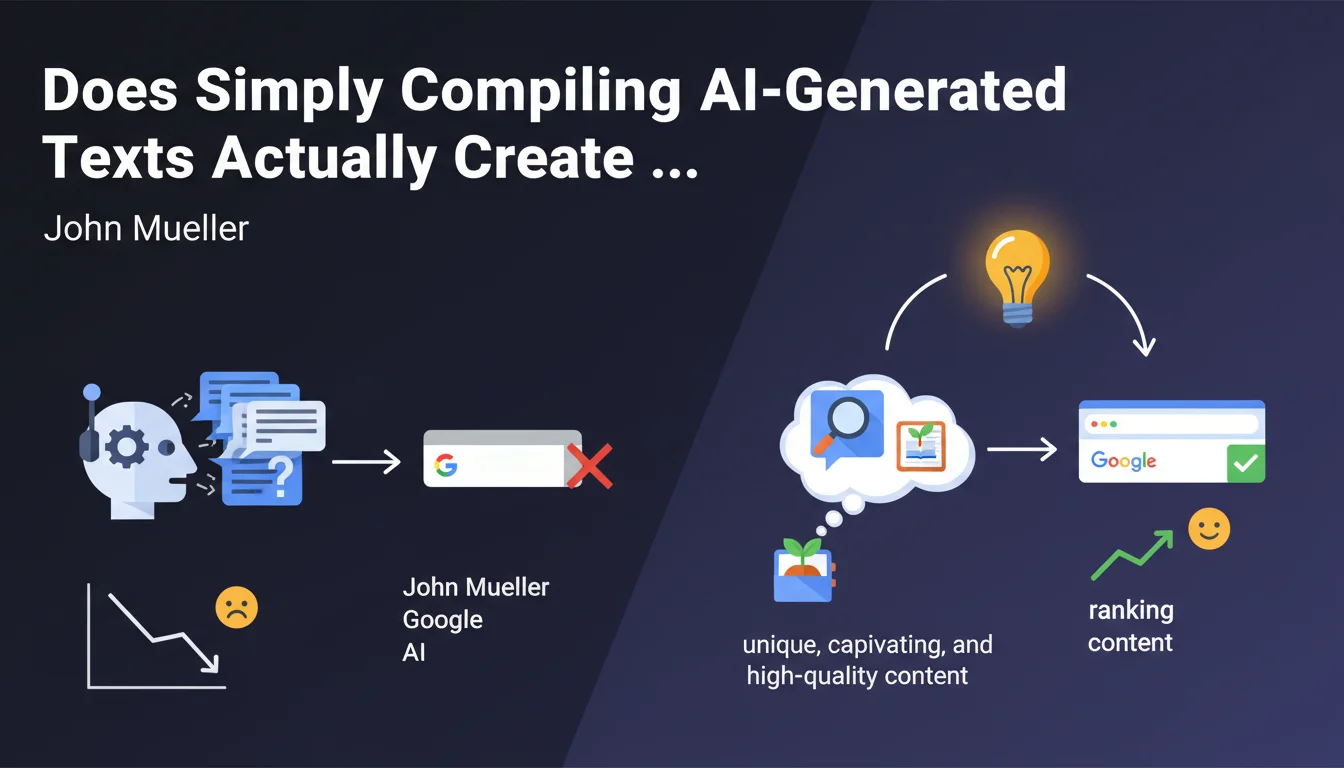
Google is taking a stance against an emerging practice: the one that consists of compiling multiple generative AI outputs hoping to create unique content. This statement comes in a context where many sites have seen their traffic plummet after massively adopting this approach.
The message is clear: mechanically assembling texts generated by ChatGPT doesn't automatically create added value. Google is looking for content that brings something new to the web, not simply a reformulation of what already exists.
This position reflects the evolution of E-E-A-T quality criteria (Experience, Expertise, Authoritativeness, Trustworthiness) where human experience and real expertise take precedence over mass production.
- AI compilation doesn't equal content uniqueness in Google's eyes
- The search engine values content that genuinely contributes to the web ecosystem
- This statement follows traffic drops observed on sites heavily using AI
- The emphasis is on quality and engagement rather than on the production method
SEO Expert opinion
This position is consistent with field observations since 2023. Sites that simply automated AI content production without strong editorial oversight have indeed suffered visibility losses, particularly after the March and November 2024 Core Updates.
However, nuance is needed: Google doesn't penalize AI per se, but low-value-added content. Sites use ChatGPT as an assistance tool (research, structuring, first draft) and perform very well, because they add a significant layer of human expertise.
The real discriminating criterion remains usefulness perceived by the user. AI-generated content that better answers search intent than mediocre human content will be favored. Conversely, compiling 5 ChatGPT outputs on the same subject without original contribution will create redundant and hollow content.
Practical impact and recommendations
Summary: Using generative AI isn't problematic in itself, but it requires a rigorous editorial strategy centered on unique added value and demonstrated expertise.
- Never publish raw AI content without substantial human review and enrichment
- Systematically integrate unique expertise elements: proprietary data, experience feedback, real case studies
- Avoid simple compilation of multiple AI outputs on the same subject without critical contribution
- Add an original perspective based on your industry experience or exclusive data
- Enrich with concrete examples, lived practical cases, figures from your activity
- Structure content to precisely answer search intents, not just the keyword
- Have industry experts review who can validate and enhance the initial AI content
- Integrate original multimedia elements: screenshots, custom infographics, demonstrative videos
- Create proprietary frameworks or methodologies that demonstrate your unique expertise
- Regularly audit your existing content to identify what lacks depth or uniqueness
Implementing an AI-assisted content strategy while maintaining E-E-A-T standards requires sharp expertise in SEO editorial production. Teams must juggle technical optimization, semantic relevance, and unique expertise contribution.
Facing the complexity of these challenges and the risks of visibility loss, support from experienced professionals can prove decisive. A specialized SEO agency will know how to establish robust editorial processes, define relevant quality indicators, and train your teams in best practices for using generative AI within a high-performing SEO framework.
💬 Comments (0)
Be the first to comment.