
Official statement
Other statements from this video 1 ▾
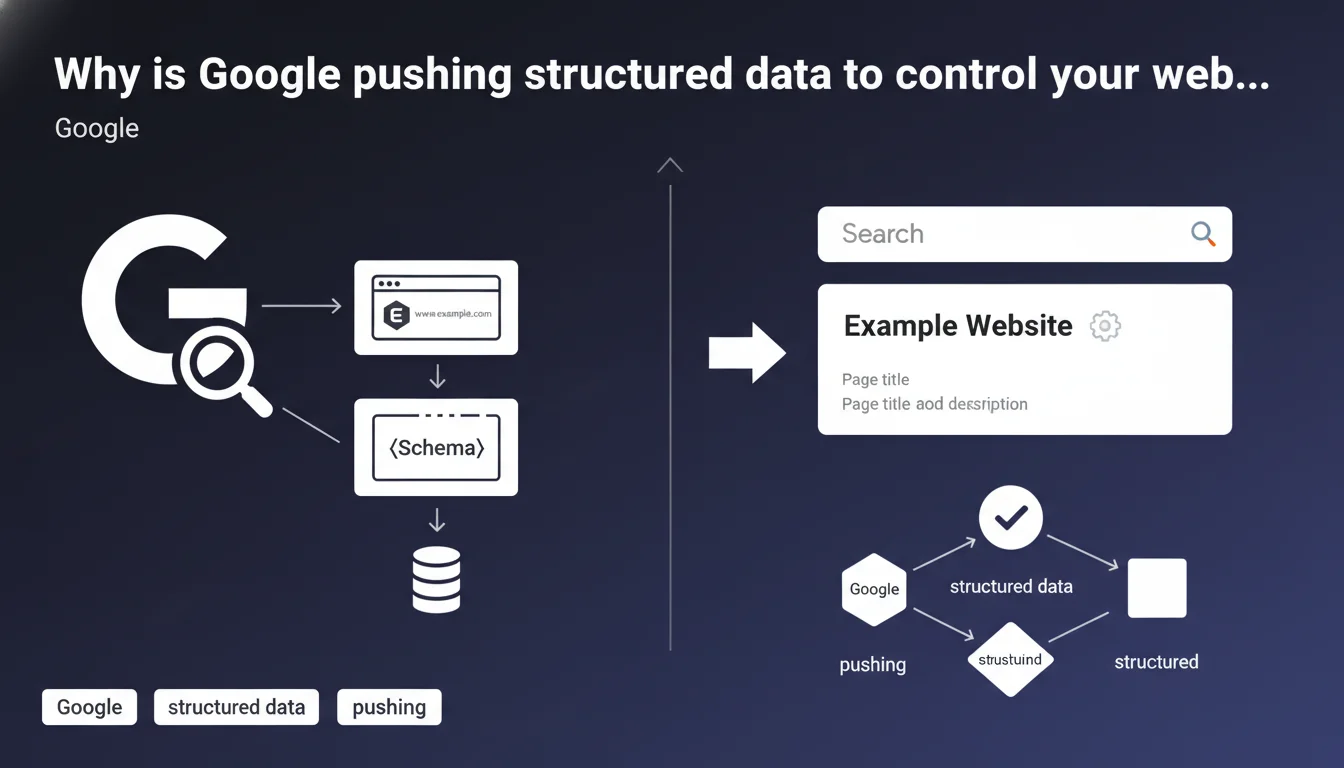
Google now explicitly recommends using structured data to define the website name displayed in SERPs. This directive aims to give webmasters direct control over how they appear, rather than letting the algorithm guess. Bottom line: if you don't mark it up, Google will choose for you — and it won't always get it right.
What you need to understand
What exactly does "controlling your website name" mean?
Google now displays your website name as a distinct element in search results, particularly in rich results and snippets. Without explicit markup, the algorithm extracts this name from various sources: title tags, mentions in your content, external link anchors.
The problem? These automatic extractions sometimes produce inconsistent or unrepresentative results for your brand. A single site can appear under multiple variations depending on the search query — far from ideal for brand consistency.
Why is Google formalizing this recommendation now?
Because displaying the website name in SERPs has become standard practice. Google has expanded the visual space dedicated to source identity, especially for mobile results and featured snippets.
Without clear direction from the webmaster, the algorithm stumbles. WebSite structured data with the "name" property solves this confusion: you explicitly state how you want to be called.
Which structured elements should you use?
Google relies on the WebSite type from the Schema.org vocabulary, with the name property. You can also specify a short variant using alternateName if your brand has a recognized acronym or nickname.
This JSON-LD markup (or Microdata, though JSON-LD is cleaner) should ideally be placed on your homepage. Google crawls, indexes, and uses this data as the reference for displaying your name across all results related to your domain.
- Required Schema.org type: WebSite
- Main property: name (your official website name)
- Optional property: alternateName (short variant or acronym)
- Recommended placement: homepage, in the or end of
- Preferred format: JSON-LD to avoid conflicts with HTML
SEO Expert opinion
Is this directive truly new or just a belated reminder?
Let's be honest: WebSite markup has existed for years. What Google is doing here is formalizing a practice that many were already applying empirically. The novelty lies in the emphasis on control — implying: without markup, you're letting the algorithm decide, and it owes you nothing.
What strikes me is the timing. Google is multiplying incentives for structured data (breadcrumbs, FAQs, products…) to reduce its dependence on pure semantic interpretation. Less ambiguity = less risk of botched display. Convenient for them, useful for us — if we play along.
In which cases does this recommendation change nothing?
If your brand is unambiguous and already well-established, Google likely retrieves the correct name without assistance. Large institutional websites or ultra-famous brands rarely see their names mangled in SERPs.
However, sites with compound names, acronyms, or those that have recently changed branding — that's where this becomes critical. [To verify]: Google says it "recommends" but doesn't clarify whether missing markup explicitly penalizes CTR or visibility. This is observation territory.
Are there risks in implementing this markup incorrectly?
Yes. If you declare a website name that doesn't match any observable reality (external mentions, anchors, site content), Google may ignore your markup. Worse: if you abuse it by attempting keyword stuffing in the name (e.g., "MySite - Expert SEO Paris Cheap"), you risk devaluation or degraded display.
The principle remains: consistency wins. If your markup says "Acme Corp" but nobody calls you that, Google will choose the most-cited variant. Structured data guides, it doesn't force.
Practical impact and recommendations
What should you do concretely on your site?
First, audit how your website name currently appears in SERPs. Run a "site:yourdomain.com" search and observe how Google names you. If it's inconsistent or incorrect, markup becomes a priority.
Second, implement JSON-LD WebSite on your homepage. Minimal code: WebSite type, url (your root domain), name (official name), and optionally alternateName if relevant. Place this script in the or just before .
What errors should you avoid during implementation?
Don't declare a made-up name or one stuffed with keywords. Google detects inconsistency with external signals (backlinks, press mentions, social media). Simplicity and loyalty to your actual branding are your best allies.
Also avoid duplicating this markup across all pages — it should appear only once, on the homepage. Internal pages don't need to redeclare the site name; structured breadcrumbs handle hierarchical navigation.
How do you verify the implementation is correct?
Use Google's Rich Results Test tool. Paste your homepage URL, verify that the WebSite type is properly detected, and confirm that the name/alternateName properties are recognized without errors.
Then monitor SERPs in the following weeks. Google doesn't update instantly — expect a few crawl cycles and propagation delay. If nothing changes after a month, [To verify]: either your markup is being ignored (inconsistency), or Google prefers its own signals.
- Audit how your website name currently displays in Google results
- Implement JSON-LD WebSite (type, url, name, alternateName) on homepage only
- Verify consistency between declared name and external mentions and actual branding
- Test the markup using Google's Rich Results Test tool
- Avoid keyword stuffing or made-up name variants
- Monitor SERP display changes after implementation
- Don't duplicate this markup on internal pages
❓ Frequently Asked Questions
Le markup WebSite est-il obligatoire pour apparaître dans les résultats Google ?
Peut-on déclarer plusieurs alternateName pour un même site ?
Faut-il répéter ce markup sur chaque page du site ?
Google garantit-il qu'il utilisera le nom déclaré dans le markup ?
Ce markup a-t-il un impact direct sur le classement SEO ?
🎥 From the same video 1
Other SEO insights extracted from this same Google Search Central video · published on 26/09/2023
🎥 Watch the full video on YouTube →
💬 Comments (0)
Be the first to comment.