
Official statement
What you need to understand
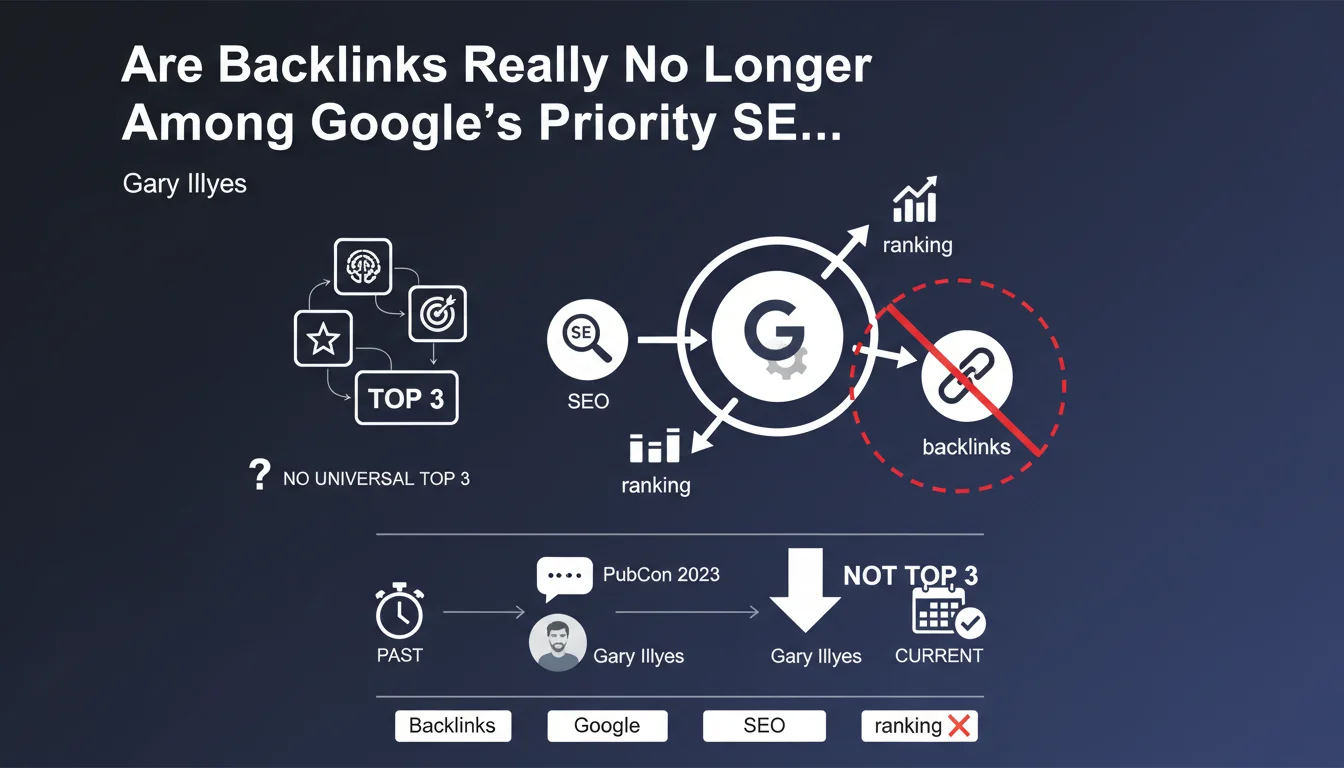
During a public appearance in 2023, Gary Illyes from Google created quite a stir by stating that backlinks didn't even rank in the top 3 ranking signals. This declaration marks a symbolic turning point compared to Google's historical discourse on the importance of inbound links.
According to him, this situation has persisted for quite some time already. Even more interesting, he specifies that there isn't really a universal top 3 applicable to all queries, suggesting that the importance of signals varies depending on the search context.
This statement must be placed within the context of Google's algorithm evolution. With the constant improvement of natural language processing, AI integration, and the growing sophistication of behavioral signals, the search engine now has a much broader palette to evaluate relevance.
- Backlinks remain a signal, but their relative weight has decreased compared to other criteria
- The importance of signals varies depending on the query type and context
- Google favors a multifactorial approach rather than a fixed hierarchy
- This evolution reflects the algorithm's growing maturity
SEO Expert opinion
This statement is consistent with field observations from recent years. We've indeed noticed that sites with modest link profiles can outperform competitors with stronger backlink portfolios, particularly on informational queries where content quality and expertise are decisive.
However, important nuances must be added. In ultra-competitive sectors or on high-stakes commercial queries, backlinks maintain significant discriminating power. Similarly, for new sites without history, inbound links remain a crucial visibility accelerator to gain credibility quickly.
This evolution primarily reflects the fact that Google now has more sophisticated means to evaluate authority and relevance: engagement signals, deep semantic analysis, intent understanding, E-E-A-T evaluation through the content itself rather than through links alone.
Practical impact and recommendations
- Maintain your link building efforts but rebalance your time budget: don't dedicate 60% of your resources to backlinks at the expense of everything else
- Prioritize content quality: invest massively in expertise, depth, and originality of your publications
- Optimize user experience: loading time, intuitive navigation, engagement signals become absolute priorities
- Work on your E-E-A-T directly within your content: demonstrate your expertise, clearly display your authors and their qualifications
- Diversify your backlink sources rather than aiming for quantity: favor contextual and thematically relevant links
- Analyze search intent for each target query and adapt your strategy accordingly
- Don't neglect technical signals: Core Web Vitals, mobile-first, structured data take on even more importance
- Monitor your engagement metrics: bounce rate, time on page, visit depth are indicators to actively optimize
In summary: adopt a more holistic and balanced SEO approach. Backlinks remain important but should no longer monopolize your resources.
The emphasis must be placed on creating real value for the user, demonstrated expertise, and an optimal experience. This new reality makes SEO strategy more complex and multidimensional.
Faced with this growing sophistication of ranking criteria, effectively orchestrating all these levers requires cross-functional expertise and constant monitoring. To structure a truly high-performing strategy that integrates all these signals coherently, support from a specialized SEO agency can prove particularly valuable, especially to identify priorities specific to your sector and allocate your resources optimally.
💬 Comments (0)
Be the first to comment.