
Official statement
What you need to understand
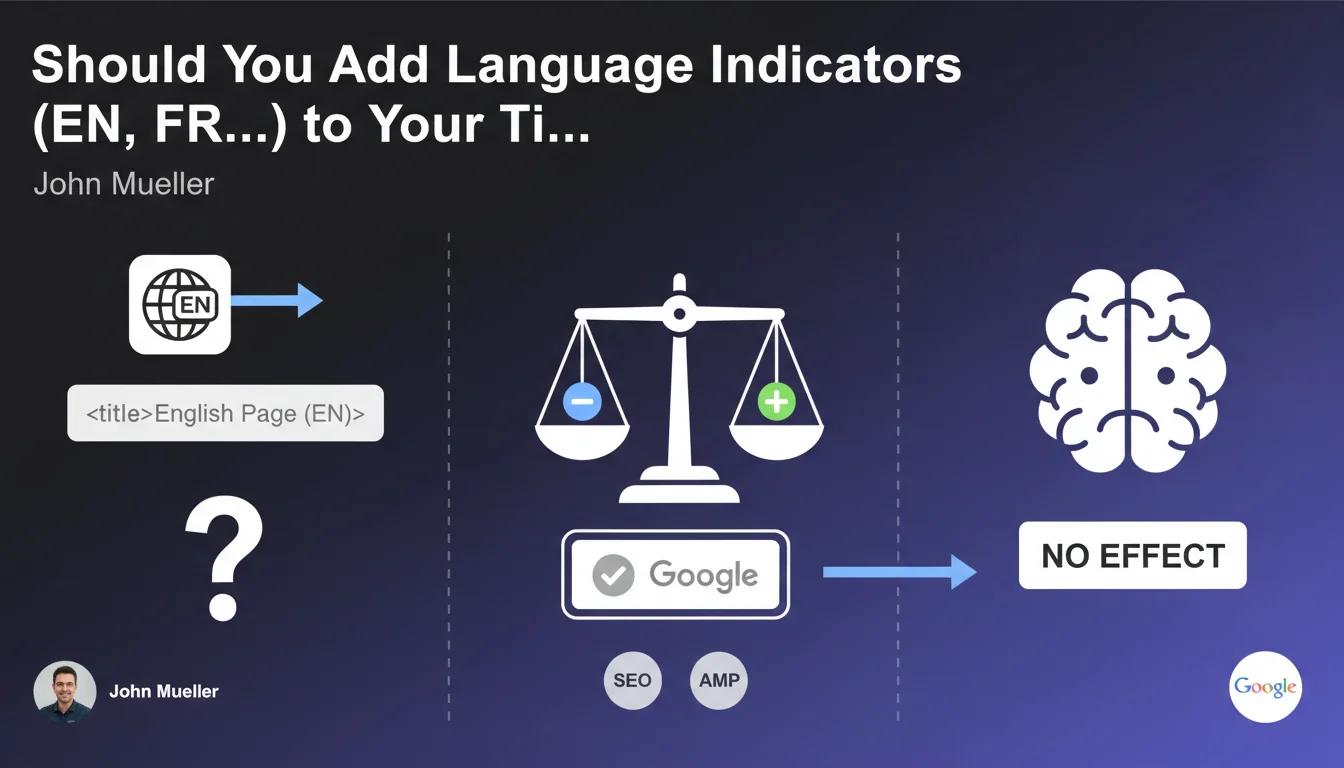
Many multilingual websites add language indicators in parentheses in their title tags, such as "(EN)" or "(FR)". This practice aims to quickly inform users about the content language before they even click.
According to Google, these indicators have no impact on search engine optimization, neither positive nor negative. The search engine doesn't use them to determine a page's language or its ranking in search results.
Google relies on other far more reliable signals to identify a content's language:
- Hreflang tags that explicitly indicate available language versions
- The lang attribute in the HTML tag
- The actual textual content of the page analyzed by algorithms
- The domain geolocation and extension (.fr, .de, .co.uk...)
In summary, if you believe these indicators improve user experience in the SERPs, you can keep them. But don't rely on them for your international SEO strategy.
SEO Expert opinion
This statement is perfectly consistent with field observations. Websites that add or remove these indicators generally don't see any ranking fluctuations. Google has evolved enough to automatically detect languages without these crutches.
Nevertheless, there is one particular case where these indicators can have an indirect SEO benefit: when they significantly improve click-through rate (CTR) in search results. If your users prefer clicking on results with clear language indication, a better CTR can indirectly influence your positions in the medium term.
In practice, most high-performing international websites don't use these indicators. They prefer to optimize every character of the title for relevance and conversion rather than for information already communicated by the URL or snippet.
Practical impact and recommendations
- Don't add language indicators in your titles if your only goal is to improve SEO: the impact will be zero
- Prioritize implementing hreflang tags: this is the technical signal that Google actually uses for language targeting
- Check the lang attribute on your main HTML tag for each language version of your site
- Test the impact on CTR if you want to add these indicators: measure whether it actually improves user behavior in your analytics
- Optimize your titles instead with relevant keywords, selling points, and calls to action rather than redundant information
- Audit your multilingual structure: ensure that each language version has its own title optimized for its target language
- Document your choice: if you decide to keep these indicators for UX reasons, make sure the team understands it's a user choice, not an SEO one
💬 Comments (0)
Be the first to comment.