
Official statement
What you need to understand
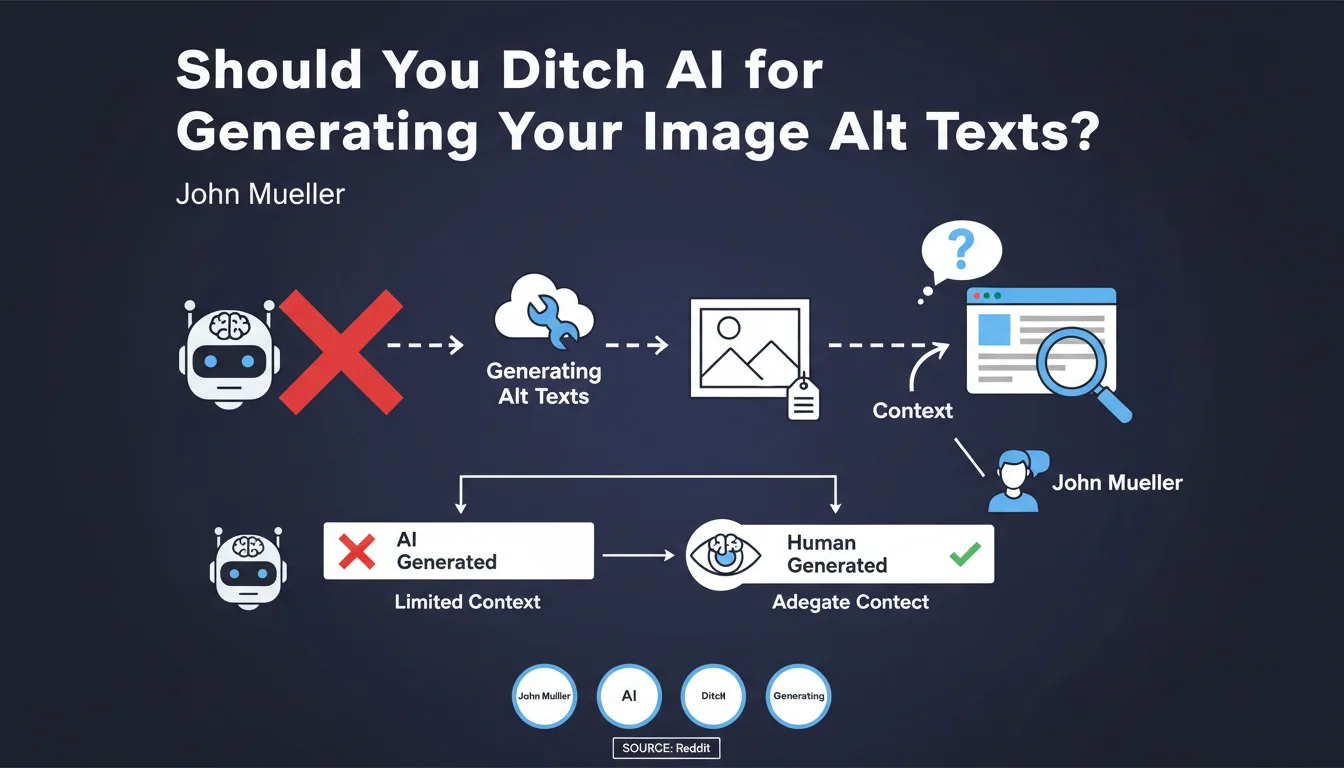
Image alt text remains a fundamental element for SEO in 2024. Google confirms that it uses both the alt attribute and surrounding textual content to understand the context and relevance of an image.
This statement highlights an often overlooked reality: generative AI cannot replace human expertise when it comes to properly contextualizing images. Automated tools lack the semantic understanding necessary to grasp the real intent and specific context of a page.
Google's position is clear: quality trumps automation. A poorly contextualized alt text, even if grammatically correct, provides no added value for SEO or accessibility.
- Alt text should be written manually to capture the exact context of the page
- Content surrounding the image plays a complementary role in Google's understanding
- AI can assist but should not replace human thinking
- Accessibility and SEO converge toward the same best practices
SEO Expert opinion
This position from Google is completely consistent with what we observe in the field. Sites that invest in contextualized and relevant alt texts do indeed achieve better results in image search, but also in overall SEO.
However, we need to nuance this: AI can serve as a starting point for large product catalogs, provided the suggestions are systematically reviewed and enriched. The real danger lies in complete automation without human oversight, which generates generic and repetitive descriptions.
An often underestimated aspect: the text around the image is just as strategic. Captions, section headings, and adjacent paragraphs create a semantic field that Google analyzes to validate consistency. An image with excellent alt text but poor textual context will lose relevance.
Practical impact and recommendations
- Audit your existing alt texts: identify strategic images and verify the quality of their alt attributes
- Create a specific editorial guide for writing alt texts, including concrete examples for your industry
- Prioritize high-traffic pages: focus your manual efforts on images from landing pages and flagship content
- Enrich the textual context around important images with descriptive captions and related paragraphs
- Avoid keyword stuffing in alts: remain natural and descriptive without over-optimization
- Train your editorial teams on the importance of context and precision for each published image
- Use AI as an assistant (not as a final solution): generate proposals then customize them manually
- Document your key images: for recurring visuals, create a library of validated alt texts
- Test the impact: measure traffic from Google Images before and after optimization
- Integrate accessibility into your process: good alt text serves both SEO AND users with disabilities
In summary: Optimizing alt texts remains a pillar of technical SEO that requires a methodical and contextualized approach. The time investment is significant, particularly for visually rich content sites.
This approach demands editorial expertise combined with strategic SEO vision, as well as coordination between technical and content teams. For organizations managing large volumes or wanting to structure this optimization professionally, support from a specialized SEO agency enables the implementation of efficient processes, tailored training, and performance monitoring that guarantee measurable return on investment.
💬 Comments (0)
Be the first to comment.