
Official statement
Other statements from this video 29 ▾
- □ Does a bloated robots.txt file really hurt your SEO rankings?
- □ Does it really matter whether you submit your sitemap in robots.txt or Search Console?
- □ Do H1-H6 heading tags really still impact Google rankings?
- □ Is a strict heading tag hierarchy really necessary for SEO rankings?
- □ How long does Google actually take to fully process a domain migration?
- □ Can a site migration really boost your SEO rankings or destroy them completely?
- □ Does Googlebot really crawl from just one place when indexing your geo-targeted content?
- □ Can a noindex tag on geolocalized pages wipe your entire website from Google search results?
- □ Should you really ditch geo-redirects for a simple dynamic banner?
- □ How many location pages can you create before Google penalizes you for spam?
- □ Should you redirect mobile users to your app—and what are the hidden SEO risks?
- □ Do you really need to translate your pages word-for-word for hreflang to work effectively?
- □ Does the domain directive in your Disavow file really help you bypass Google's 2MB limit?
- □ Should you really use the Disavow tool only for purchased links?
- □ Should you noindex your internal search results pages to prevent spammers from creating backlinks?
- □ Does semantic HTML really boost your search rankings?
- □ Is AMP still a ranking factor in Google Search?
- □ Does removing AMP actually boost crawl on your regular pages?
- □ Should you test removing your Disavow file incrementally, or can you delete it all at once?
- □ Why do knowledge panels display differently across devices and search contexts?
- □ Does Google's synonym system really work without any human intervention?
- □ Should you really create a separate page for each location to implement Local Business schema correctly?
- □ Do you really need to mark up ALL your content with structured data?
- □ Do you really need to display all FAQ schema questions visibly on your page?
- □ Can hidden accordion content really show up in featured snippets?
- □ Why does Google deliberately choose not to index your entire website?
- □ Should you delete pages to boost your site's indexation?
- □ Does search volume of anchor text really impact the value of your internal links?
- □ Should you really add unique content to your e-commerce product pages?
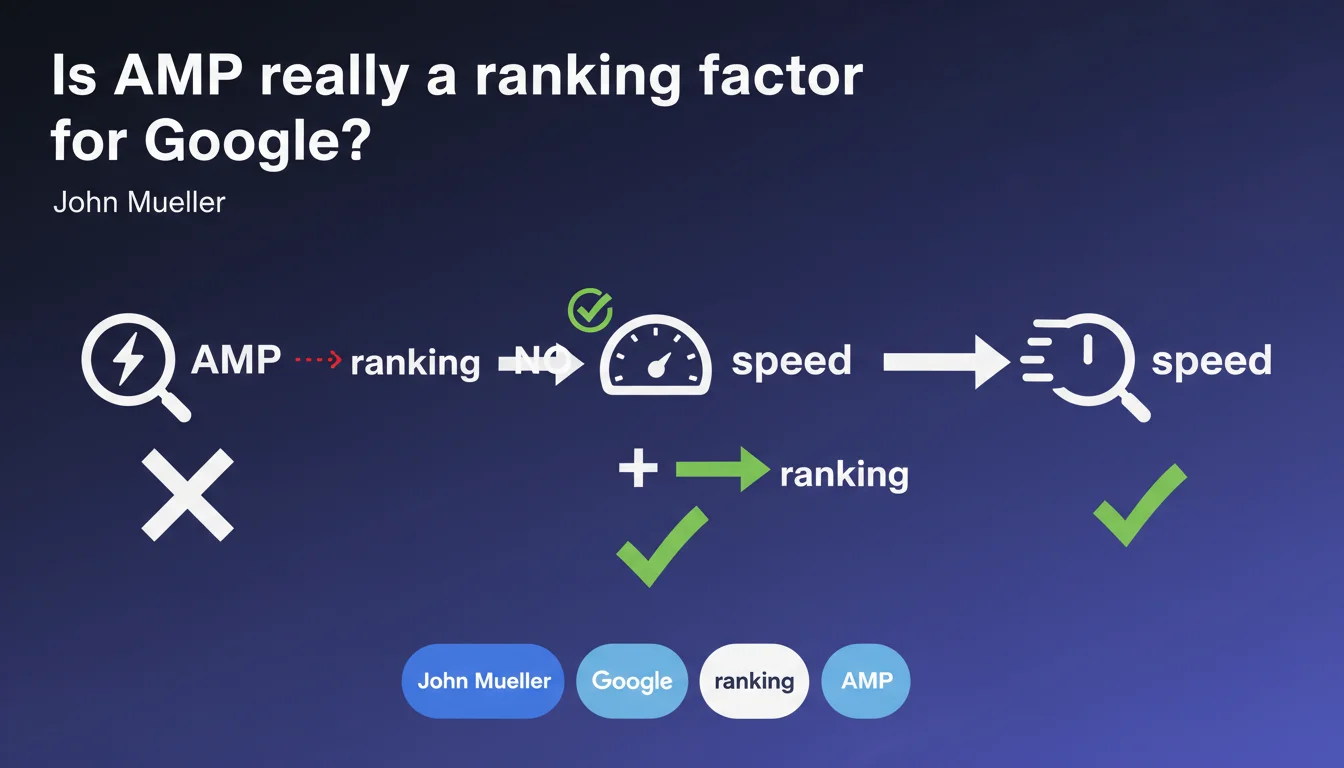
AMP is not a ranking factor according to Google. Migrating to AMP won't change your search positions. However, since AMP pages are often fast, it's the speed that matters, not the technology itself.
What you need to understand
Why does Google claim that AMP doesn't influence rankings?
John Mueller is crystal clear: AMP has never been a ranking signal. This statement puts an end to a persistent misconception in the SEO industry. Many believed that adopting AMP would guarantee a boost in the SERPs.
The confusion came from the fact that AMP was initially required to appear in the mobile news carousel — which created the illusion of an SEO advantage. Google has since abandoned this requirement.
So what's the actual relationship between AMP and performance in search results?
The nuance lies here: AMP pages are structurally optimized for speed. They typically load faster thanks to strict technical constraints (limited JavaScript, inline CSS, cached resources).
Now, page loading speed is indeed a ranking factor, particularly through Core Web Vitals. So there's an indirect advantage, not a privilege granted to the AMP technology itself.
Should you continue using AMP in 2025 and beyond?
The question now presents itself differently. If your only goal is SEO, AMP has no particular merit. A well-optimized standard HTML page will achieve the same results.
On the other hand, if you already have a functional AMP infrastructure and your pages are fast because of it, there's no point in tearing everything down. The real criterion remains performance as measured by Google.
- AMP is not a ranking signal — no direct advantage in the algorithm
- The speed of AMP pages explains their apparent performance
- Core Web Vitals are the real issue for rankings
- No need for AMP if your standard HTML pages are already fast
- The mobile news carousel no longer requires AMP since 2021
SEO Expert opinion
Is this statement consistent with what we observe in the field?
Absolutely. A/B tests conducted by several agencies show that a well-optimized standard HTML page performs as well as an equivalent AMP version. No significant difference in organic positions.
What blurred the picture for years was a deceptive correlation: sites that adopted AMP often did broader performance work. It was then difficult to distinguish the AMP effect from the pure speed effect.
What nuances should be added to this official message?
Google is intentionally simplifying. In certain contexts — media, news — AMP remains relevant for UX or ecosystem reasons, not for SEO. Cached AMP pages load nearly instantly from mobile SERPs.
But let's be honest: this UX advantage is eroding. With the general improvement of mobile web and technologies like prefetching, the gap is narrowing. AMP is losing its reason for being.
[To verify] : some still observe slightly higher click-through rates for AMP pages in mobile SERPs, probably linked to the lightning bolt icon — but that's not ranking, it's CTR. Google doesn't document this point.
In what cases might this rule not be sufficient?
If your site has massive technical debt and the dev team can't optimize Core Web Vitals, AMP can serve as a temporary workaround. You force performance through technical constraints.
But it's a band-aid. In the long run, it's better to clean up the source code, optimize JavaScript, and work on fundamentals. AMP then becomes unnecessary.
Practical impact and recommendations
Should you migrate your site to AMP to improve your SEO?
No. If your motivation is purely SEO, don't go down the AMP route. Instead, focus on optimizing the Core Web Vitals of your standard HTML pages.
The resources you would have invested in an AMP migration will be much better spent improving LCP, reducing CLS, and optimizing FID/INP. That's where performance-related ranking is decided.
If I'm already using AMP, should I get rid of everything?
Not necessarily. If your AMP pages are performing well and maintenance is under control, there's no urgent need to tear everything down. The lack of SEO advantage doesn't mean a disadvantage.
However, honestly evaluate the cost/benefit ratio. If you're maintaining two versions of each page without a clear strategic reason, you're probably wasting resources.
What concrete actions can you take to optimize speed without AMP?
Measure first. Use PageSpeed Insights and Chrome UX Report to identify your real bottlenecks. Don't start optimizing blindly.
Then tackle the quick wins: image compression (WebP), lazy loading, reducing render-blocking JavaScript, effective caching. These levers often yield 70% of gains for 30% of effort.
- Measure your current Core Web Vitals via PageSpeed Insights and Search Console
- Prioritize image optimization (WebP format, compression, lazy loading)
- Eliminate unnecessary JavaScript and defer loading of non-critical content
- Enable Gzip/Brotli compression on your server
- Implement a CDN if your audience is geographically dispersed
- Test your pages on actual mobile connections (not just WiFi)
- Monitor your metrics over time, not just a single snapshot
- If you use AMP, evaluate the real maintenance cost vs UX benefits
Speed optimization without AMP relies on solid technical fundamentals. For complex sites or teams lacking internal expertise, these projects can quickly become time-consuming and require specialized skills.
Engaging a specialized SEO agency often allows you to accelerate these optimizations with an external perspective and proven methodology, especially when it comes to balancing performance with specific business constraints.
❓ Frequently Asked Questions
AMP améliore-t-il le taux de clic dans les SERP mobiles ?
Les pages AMP sont-elles encore requises pour le carrousel d'actualités ?
Peut-on perdre des positions en supprimant AMP d'un site ?
AMP compte-t-il pour les Core Web Vitals ?
Y a-t-il encore un intérêt à utiliser AMP en dehors du SEO ?
🎥 From the same video 29
Other SEO insights extracted from this same Google Search Central video · published on 14/01/2022
🎥 Watch the full video on YouTube →
💬 Comments (0)
Be the first to comment.