
Official statement
Other statements from this video 29 ▾
- □ Does a bloated robots.txt file really hurt your SEO rankings?
- □ Does it really matter whether you submit your sitemap in robots.txt or Search Console?
- □ Do H1-H6 heading tags really still impact Google rankings?
- □ Is a strict heading tag hierarchy really necessary for SEO rankings?
- □ How long does Google actually take to fully process a domain migration?
- □ Can a site migration really boost your SEO rankings or destroy them completely?
- □ Can a noindex tag on geolocalized pages wipe your entire website from Google search results?
- □ Should you really ditch geo-redirects for a simple dynamic banner?
- □ How many location pages can you create before Google penalizes you for spam?
- □ Should you redirect mobile users to your app—and what are the hidden SEO risks?
- □ Do you really need to translate your pages word-for-word for hreflang to work effectively?
- □ Does the domain directive in your Disavow file really help you bypass Google's 2MB limit?
- □ Should you really use the Disavow tool only for purchased links?
- □ Should you noindex your internal search results pages to prevent spammers from creating backlinks?
- □ Does semantic HTML really boost your search rankings?
- □ Is AMP still a ranking factor in Google Search?
- □ Is AMP really a ranking factor for Google?
- □ Does removing AMP actually boost crawl on your regular pages?
- □ Should you test removing your Disavow file incrementally, or can you delete it all at once?
- □ Why do knowledge panels display differently across devices and search contexts?
- □ Does Google's synonym system really work without any human intervention?
- □ Should you really create a separate page for each location to implement Local Business schema correctly?
- □ Do you really need to mark up ALL your content with structured data?
- □ Do you really need to display all FAQ schema questions visibly on your page?
- □ Can hidden accordion content really show up in featured snippets?
- □ Why does Google deliberately choose not to index your entire website?
- □ Should you delete pages to boost your site's indexation?
- □ Does search volume of anchor text really impact the value of your internal links?
- □ Should you really add unique content to your e-commerce product pages?
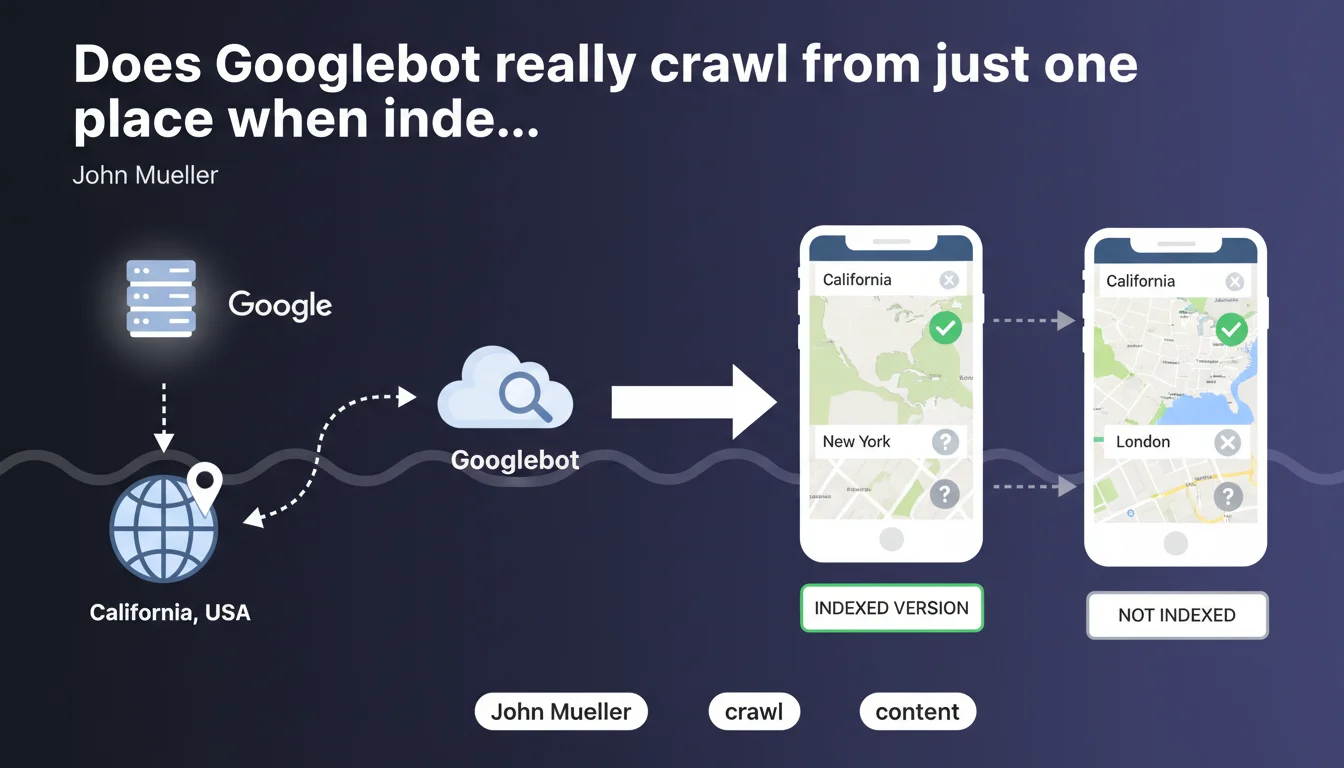
Googlebot generally crawls from a single location — likely California for most Google systems. If your content varies based on user geolocation, it's the California version that gets indexed. For international or regional sites, this reality forces you to completely rethink your geo-targeted content management strategy.
What you need to understand
From exactly where is Googlebot crawling our content?
John Mueller confirms what many suspected: Googlebot does not simulate crawls from multiple countries. It operates from a single geographic location — likely California for the vast majority of Google's systems.
In practical terms? If you serve different content based on user IP address (prices in euros vs dollars, regional product availability, local promotions), Googlebot only sees one version. And that version is the one you serve from California.
Why does this limitation create problems?
Because many sites adjust their content based on user geolocation — think of e-commerce sites, regional news platforms, booking services.
If your strategy relies on geo-targeted dynamic content without distinct indexable versions, you risk serving Google a version that doesn't match your actual target audience. The bot indexes what it sees from California, not what your French, British, or Japanese users see.
What's the difference with traditional multilingual sites?
Sites structured with subdomains or subdirectories by country (example.fr, example.com/uk/) are not impacted the same way. These distinct URLs are crawled and indexed separately.
The problem mainly affects sites that dynamically change content on the same URL based on detected location — without redirects, without different URLs. Googlebot has only one IP address, so it sees only one version.
- Googlebot crawls from a single geographic location, likely California
- Dynamically geo-localized content will only be indexed in its California version
- Multi-country structures with distinct URLs escape this problem
- Price variations, language differences, or availability based on IP will not all be indexed
SEO Expert opinion
Is this statement consistent with what we observe in practice?
Yes, largely. For years, SEO practitioners have observed that Googlebot crawls predominantly from US IP ranges. Server logs confirm it: no notable geographic diversity in bot requests.
But be careful — and this is where Mueller remains intentionally vague — he says "likely California for most of the systems." This wording leaves room for interpretation: are there exceptions? For what types of content or sites? [To verify] Google doesn't specify.
What nuances should we add to this rule?
Mueller speaks of Googlebot "for search." There are other Google bots: AdSense, AdWords, AdsBot, Google Images. This statement may not concern all of them. What about Google Discover or Google News, which have their own crawling systems?
Second nuance: the fact that Googlebot crawls from a single location doesn't prevent Google from ranking results differently based on the user's location. Ranking is geolocation-based, not crawling. This is a point many still confuse.
In what cases does this rule not really apply?
If you use hreflang and distinct URLs by country/language, you're not affected. Each URL is crawled independently, regardless of where the bot comes from.
On the other hand, if you change content on the same URL based on IP, you're directly concerned. And that's precisely where many international sites fail: they think Google "knows" they display different content based on country. No. Google indexes what it sees from California, period.
Practical impact and recommendations
What should you concretely do if your site displays geo-localized content?
First priority: identify what Googlebot actually sees. Test your site from a US IP address (VPN, proxy, US cloud server). Compare it with what your French, British, and other users see.
If the content differs significantly — prices, product availability, language — you have an indexing problem. Googlebot indexes the US version, your European users won't find what they're looking for in the results.
What mistakes must you absolutely avoid?
Never rely on server-side IP detection without distinct URLs. This is the main cause of non-indexed or poorly indexed content for international audiences.
Also avoid automatically blocking or redirecting Googlebot based on detected location. If you redirect it to a regional version, ensure that redirect is consistent with your hreflang and URL structure.
How should you restructure your international architecture to be compliant?
The safest solution: distinct URLs by country or language. Subdomains (fr.example.com), subdirectories (/fr/), or country-specific domains (.fr, .co.uk). Each URL serves a unique version, crawlable and indexable independently.
Complete this with hreflang tags to tell Google about relationships between language or regional versions. That way, even if Googlebot crawls from California, it understands that a .fr version exists for French users.
- Test your site from a US IP address to see what Googlebot actually indexes
- Identify geo-localized content that varies based on user IP
- Move to a structure with distinct URLs by country/language if not already done
- Properly implement hreflang tags for each regional version
- Verify in Search Console that all your international versions are properly indexed
- Avoid automatic redirects based solely on detected Googlebot IP
- Document in your server logs where Googlebot crawls really come from
❓ Frequently Asked Questions
Googlebot crawle-t-il depuis d'autres pays que les États-Unis ?
Si j'affiche des prix différents selon le pays de l'utilisateur, lesquels seront indexés ?
Les balises hreflang suffisent-elles si je sers du contenu géolocalisé dynamiquement ?
Comment vérifier ce que Googlebot voit réellement sur mon site ?
Cette règle s'applique-t-elle aussi à Google Images ou Google News ?
🎥 From the same video 29
Other SEO insights extracted from this same Google Search Central video · published on 14/01/2022
🎥 Watch the full video on YouTube →
💬 Comments (0)
Be the first to comment.