
Official statement
Other statements from this video 29 ▾
- □ Does a bloated robots.txt file really hurt your SEO rankings?
- □ Does it really matter whether you submit your sitemap in robots.txt or Search Console?
- □ Do H1-H6 heading tags really still impact Google rankings?
- □ Is a strict heading tag hierarchy really necessary for SEO rankings?
- □ How long does Google actually take to fully process a domain migration?
- □ Can a site migration really boost your SEO rankings or destroy them completely?
- □ Does Googlebot really crawl from just one place when indexing your geo-targeted content?
- □ Can a noindex tag on geolocalized pages wipe your entire website from Google search results?
- □ Should you really ditch geo-redirects for a simple dynamic banner?
- □ How many location pages can you create before Google penalizes you for spam?
- □ Should you redirect mobile users to your app—and what are the hidden SEO risks?
- □ Do you really need to translate your pages word-for-word for hreflang to work effectively?
- □ Does the domain directive in your Disavow file really help you bypass Google's 2MB limit?
- □ Should you really use the Disavow tool only for purchased links?
- □ Should you noindex your internal search results pages to prevent spammers from creating backlinks?
- □ Does semantic HTML really boost your search rankings?
- □ Is AMP still a ranking factor in Google Search?
- □ Is AMP really a ranking factor for Google?
- □ Does removing AMP actually boost crawl on your regular pages?
- □ Should you test removing your Disavow file incrementally, or can you delete it all at once?
- □ Why do knowledge panels display differently across devices and search contexts?
- □ Does Google's synonym system really work without any human intervention?
- □ Should you really create a separate page for each location to implement Local Business schema correctly?
- □ Do you really need to mark up ALL your content with structured data?
- □ Can hidden accordion content really show up in featured snippets?
- □ Why does Google deliberately choose not to index your entire website?
- □ Should you delete pages to boost your site's indexation?
- □ Does search volume of anchor text really impact the value of your internal links?
- □ Should you really add unique content to your e-commerce product pages?
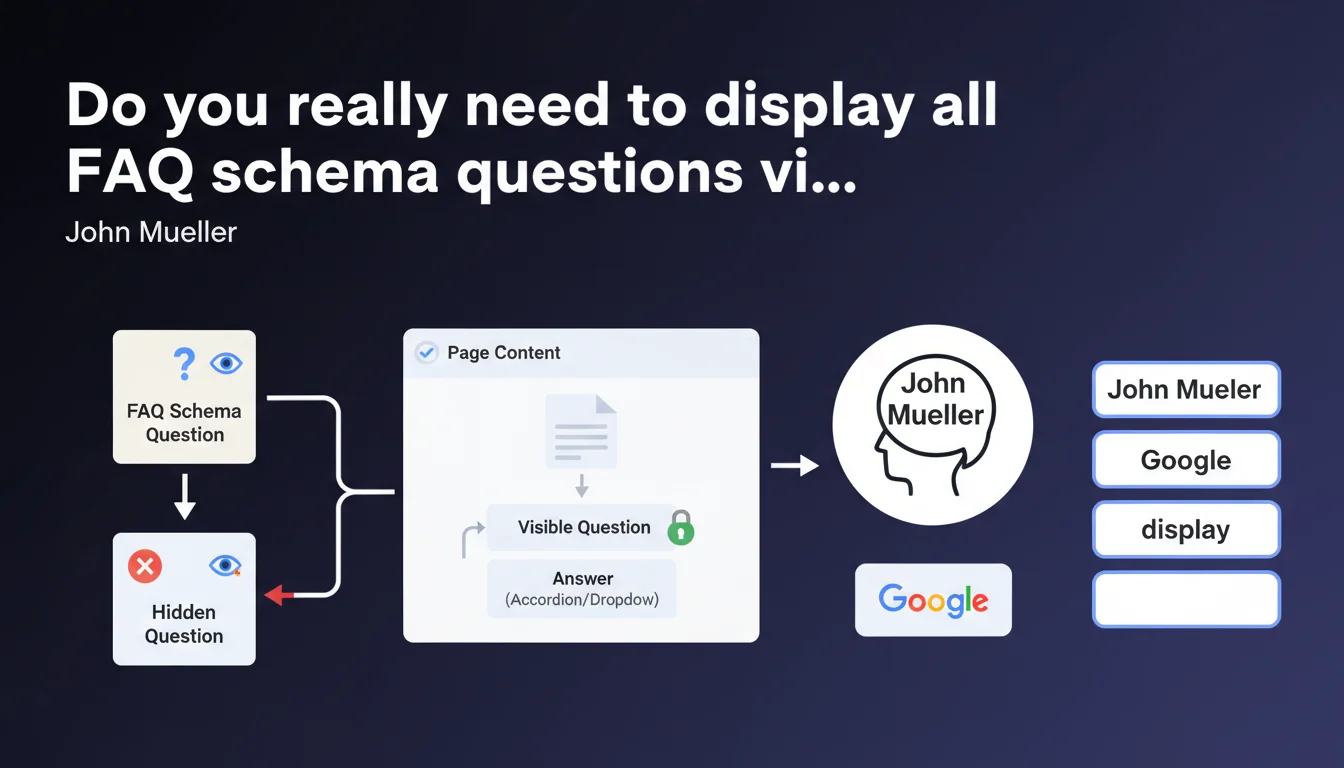
Google requires that questions marked up in FAQ schema are directly visible on the page. Answers can be hidden in accordions or dropdown menus, but the question itself must be displayed without requiring user interaction. This requirement directly impacts the structure and design of FAQ pages optimized for rich snippets.
What you need to understand
Why does Google require questions to be visible?
Google's position is clear: schema.org markup must reflect what the user actually sees. If you mark up a question in FAQ schema, it must be present in the visible DOM without requiring a click or interaction to display.
This rule is part of the fight against manipulative hidden content. Google has always been wary of techniques that involve marking up invisible content to trick the algorithm — and FAQ schema is no exception to this principle.
What's the difference between questions and answers in this directive?
That's where it gets interesting. Google makes a clear distinction: the question must be visible, but the answer can be hidden behind an accordion system or dropdown menu.
Concretely? You can structure your page with questions displayed permanently and answers that expand on click. It's even a common UX practice that doesn't conflict with Google's guidelines.
Does this rule apply to all types of FAQ?
Mueller's directive specifically targets pages that use FAQ schema markup to get rich snippets in the SERPs. If you have a FAQ section without structured markup, this constraint doesn't apply — but you also won't benefit from visibility advantages in the search results.
However, be careful: even without schema, completely hiding key questions in tabs or accordions closed by default can dilute their SEO weight. Google indexes hidden content, but values it less than immediately visible content.
- Questions marked up in FAQ schema must be displayed directly on the page
- The answer can be hidden in an accordion or dropdown menu
- This rule only concerns pages using schema.org FAQ markup
- Hidden content remains indexable but is valued less by Google
SEO Expert opinion
Is this requirement consistent with practices observed in the field?
Yes, and it's even applied quite strictly. We regularly observe removal of FAQ rich snippets on pages that hide questions in tabs or complex navigation systems.
Google likely uses automated detection that verifies the visible presence of marked-up text. If your question is in a `display:none` on page load, or requires a click to appear, you risk losing rich snippet eligibility — even if the technical markup is perfect.
What nuances should be applied to this directive?
Let's be honest: Mueller's wording leaves a gray area about what exactly constitutes "visible". A question that appears after light scrolling? A question in a lazy-loaded block? [To be verified] — Google has never provided precise guidelines on these edge cases.
Furthermore, this rule says nothing about the quality or relevance of the questions. We still see too many pages displaying artificial questions just to grab rich snippets, without providing real value. Google tolerates it for now, but it remains a risky practice long-term.
In what cases does this rule cause problems?
The main conflict arises with UX and mobile constraints. On mobile, displaying 15 expanded questions permanently creates an endless page. Designers naturally prefer accordions closed by default — which directly contradicts Google's directive.
Result? Many sites compromise by displaying questions but not answers, which remains compliant. But this sometimes creates awkward user experiences, with question lists that look like titles without context.
Practical impact and recommendations
What should you do concretely to stay compliant?
First step: audit your existing FAQ pages. Review each page using FAQ schema and verify that questions are displayed in the viewport without requiring user interaction.
If you use accordions, make sure that the accordion title contains the marked-up question, and that it's visible on load. The answer can remain hidden until click — that's acceptable.
What errors should you avoid when implementing?
Never mark up a question that doesn't exist visually on the page. It seems obvious, but we still see sites automatically generating FAQ schema from content hidden in databases or CMS systems.
Also avoid multi-tab systems where questions are distributed across different tabs. Google generally considers that only the content of the first active tab is "visible" on load — the rest is treated as hidden.
How do you verify that your implementation is correct?
- Use Google's Rich Results Test to validate technical markup
- Inspect the page with Search Console and verify the version rendered by Googlebot
- Test in private browsing without JavaScript — if questions don't display, that's a red flag
- Verify that each marked-up question matches exactly the visible text on the page
- Monitor the appearance of rich snippets in the SERPs — their disappearance may signal a compliance issue
❓ Frequently Asked Questions
Puis-je utiliser des onglets pour organiser mes FAQ tout en gardant le schema ?
Le lazy loading des questions impacte-t-il l'éligibilité au rich snippet FAQ ?
Combien de questions FAQ puis-je baliser sur une même page ?
Est-ce que cacher les réponses dans des accordéons réduit leur poids SEO ?
Que se passe-t-il si je ne respecte pas cette directive sur la visibilité ?
🎥 From the same video 29
Other SEO insights extracted from this same Google Search Central video · published on 14/01/2022
🎥 Watch the full video on YouTube →
💬 Comments (0)
Be the first to comment.