
Official statement
Other statements from this video 16 ▾
- □ Are JavaScript Web Components really crawlable by Google's bots?
- □ Does FAQ Schema Markup Really Guarantee That Your FAQ Snippets Will Show Up in Google?
- □ Should you really avoid duplicating your own content for SEO?
- □ Why does Google penalize excessive variations of the same content?
- □ Does Google really see your JavaScript content the way you do?
- □ Does your CMS really penalize your SEO compared to static HTML?
- □ Why aren't your pages getting indexed even though your site is technically flawless?
- □ Why have external user studies become essential for diagnosing quality issues that your team can no longer see?
- □ Should you really trust rel=canonical to control indexation?
- □ Are backlinks pointing to 404 pages really worthless for your SEO?
- □ Does the disavow tool really erase all traces of toxic links from Google's algorithms?
- □ Can an SSL certificate really penalize your search rankings?
- □ Does a progressive multi-domain ranking decline reveal a quality issue rather than a technical one?
- □ Do technical SEO issues really have an immediate impact on your rankings?
- □ Does blocking Google Translate really impact your search rankings?
- □ Can the meta notranslate tag really remove the 'Translate this page' link from Google search results?
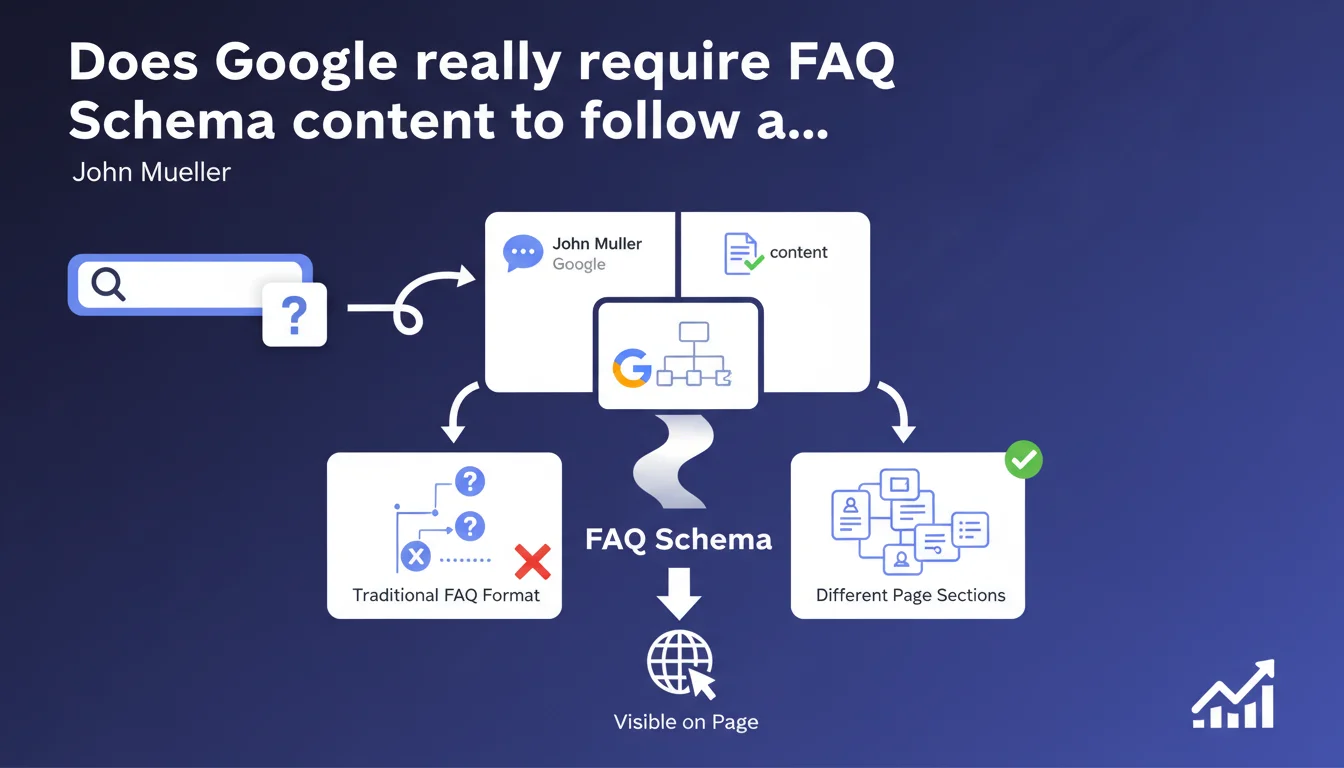
Google confirms that FAQ Schema markup requires questions and answers to be visible on the page, but without imposing a traditional FAQ format. Content can appear as blog section headings or other editorial structures. Visibility takes priority over formatting.
What you need to understand
What is the real constraint Google imposes for FAQ Schema?
Google requires that questions and answers marked up with FAQ Schema are actually visible to the user on the page. This may seem obvious, but this clarification addresses a dubious practice: some sites embed structured content that is invisible, hidden with CSS or in inaccessible areas, solely to try to obtain rich snippets.
Mueller's statement sets a clear boundary: if you mark up with FAQ Schema, the content must be accessible without manipulation (no click to reveal, no infinite scroll, no white text on white background). The search engine verifies consistency between the markup and what the user actually sees.
Must content necessarily follow a classic FAQ format?
No, and that's where Google's flexibility is surprising. Questions can appear as section headings in a blog article, structuring subheadings, or any other natural editorial form. What matters: that a question and its answer are clearly identifiable.
Concretely, an article structured with interrogative H2 headings ("How to optimize X?") followed by explanatory paragraphs can legitimately receive FAQ Schema markup. No need to overhaul the UX to stick to a rigid "Question 1 / Answer 1" presentation.
What technical implications does this directive entail?
The verification of real visibility means that Google cross-references the DOM with the structured markup. If your JSON-LD declares 10 FAQs but only 3 questions actually appear in the visible content, you risk manual action or deindexing of rich snippets.
- Mandatory visibility: marked-up content must be accessible without additional user action
- Flexible format: no traditional FAQ structure required, section headings are sufficient
- DOM/Schema consistency: the search engine cross-references the markup with the actual page rendering
- Risk of manual action: invisible content marked as FAQ exposes you to rich snippet penalties
SEO Expert opinion
Does this directive truly reflect real-world observations?
Yes, and it's one of Mueller's rare statements that perfectly aligns with field feedback. Sites that tested invisible FAQ content (accordions closed by default, tabs not displayed on load) have progressively seen their rich snippets disappear. Google really applies this rule.
However — and this is an important nuance — the notion of "visibility" remains unclear in certain edge cases. An accordion open by default but closable? A section visible after light scrolling? [Needs verification] Google doesn't document these thresholds precisely. We observe that accordions open by default seem tolerated, but nothing official.
Doesn't the flexibility on format hide a trap?
Let's be honest: Google lets you format your FAQs freely, but that doesn't guarantee you'll get rich snippets. Semantic relevance between the question, answer, and user query remains decisive. A vague heading like "How does it work?" probably won't trigger anything.
Another point — Google reserves the right to not display your FAQs even if they're perfectly compliant. Competition in the SERPs, perceived site quality, content freshness all play a role. Markup is an eligibility requirement, not a guarantee.
What risks remain with this flexible approach?
If you transform every H2 heading in your blog into an artificial "question" just to justify the Schema, you're taking a risky bet. The search engine evaluates editorial naturalness. An article structured around genuine user questions passes; SEO forcing gets noticed.
Practical impact and recommendations
How can you implement FAQ Schema without risking penalties?
First rule: verify that your content is truly visible when the page loads. Test with JavaScript disabled, on mobile, using rendering tools like Google's mobile-friendly test. If the user must click, scroll infinitely, or activate a script to see the answer, don't mark it up.
Second rule: favor a natural editorial structure. H2 or H3 headings formulated as questions, followed by explanatory paragraphs, work perfectly. No need for a specific "FAQ" UX if your article already clearly answers user questions.
What common mistakes must you absolutely avoid?
Never mark up content present only in accordions closed by default, hidden tabs, or areas revealed on click. Even though the content technically exists in the DOM, Google considers the user doesn't see it immediately.
Also avoid forcing markup on content that doesn't have an explicit question/answer structure. A standard descriptive paragraph isn't an FAQ, even if you rephrase the heading as a question. Google detects semantic inconsistencies.
How can you verify your implementation's compliance?
- Test the page with Google's Rich Results Test tool
- Verify that each marked-up question appears textually in the visible content
- Check that answers are accessible without user action (no click, no hover)
- Analyze mobile rendering: visibility on small screens is decisive
- Compare JSON-LD with actual content — zero discrepancy tolerated
- Monitor Search Console for any structured data alerts
❓ Frequently Asked Questions
Peut-on utiliser le FAQ Schema sur du contenu en accordéon ouvert par défaut ?
Les titres de sections de blog suffisent-ils pour justifier un balisage FAQ Schema ?
Que risque-t-on si on balise du contenu FAQ invisible ?
Faut-il que les questions FAQ apparaissent dans un ordre précis sur la page ?
Le FAQ Schema garantit-il l'affichage de rich snippets dans les SERP ?
🎥 From the same video 16
Other SEO insights extracted from this same Google Search Central video · published on 08/05/2022
🎥 Watch the full video on YouTube →
💬 Comments (0)
Be the first to comment.