
Official statement
What you need to understand
What does it actually mean that invalid Schema markup doesn't harm rankings?
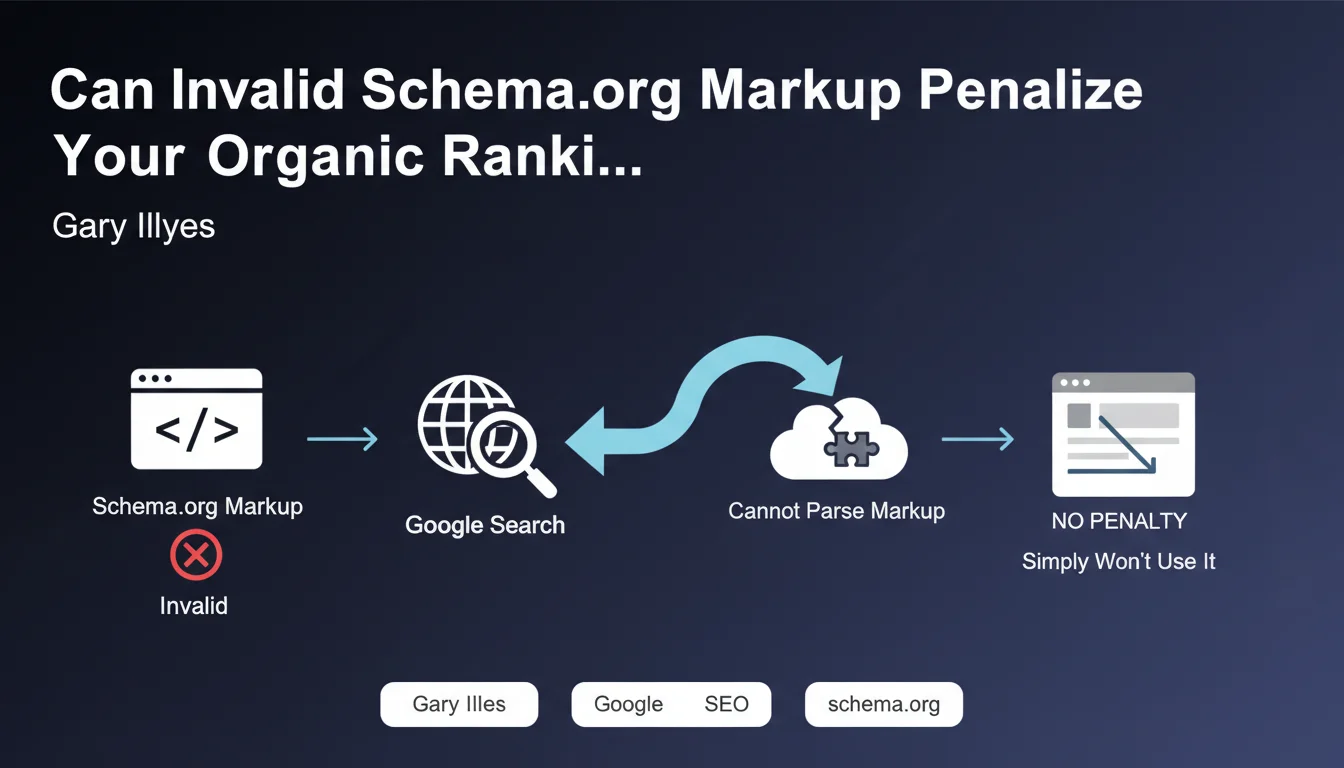
Google has clarified its position: poorly structured or invalid Schema.org markup does not trigger any algorithmic penalty. Unlike other technical errors, this type of issue does not affect your ability to be indexed or ranked in search results.
In the worst-case scenario, if Google encounters markup it cannot parse correctly, it simply ignores it. Your page continues to function normally for SEO purposes, but without benefiting from the advantages of Schema.org.
- No algorithmic penalty applied in case of markup errors
- Google ignores malformed tags rather than penalizing the site
- Organic rankings remain unchanged even with invalid Schema
- Only consequence: loss of visual enhancements in SERPs
Why does Google adopt this tolerant approach toward Schema errors?
Google understands that implementing Schema.org can be technically complex, particularly for small businesses or sites developed without advanced SEO expertise. Penalizing these errors would drastically reduce the adoption of structured data.
This policy encourages webmasters to experiment with Schema.org without fear. Google's goal is to obtain more structured data, even if imperfect, rather than discouraging its use through penalties.
What's the difference between invalid Schema and manipulation via Schema?
It's important to distinguish unintentional technical errors from deceptive use of markup. Poorly formatted Schema is an error and doesn't pose an ethical problem.
However, deliberately misleading markup (non-existent products, fake reviews, fictitious events) can lead to manual actions. Google penalizes manipulative intent, not technical incompetence.
SEO Expert opinion
Is this statement consistent with what we observe in the field?
My 15 years of experience completely confirms this official position. I've audited hundreds of sites with partially broken Schema without observing any negative impact on their organic positions. Sites continue to rank normally.
However, these same sites systematically lose their rich snippets: review stars, recipe data, expandable FAQs, highlighted events. This indirect loss of visibility can significantly affect CTR and therefore organic traffic without impacting strict positioning.
What important nuances should be added to this statement?
Google's declaration specifically concerns syntax or validation errors. It does not cover cases of spam or fraudulent markup that fall under quality guidelines.
Moreover, certain content types heavily depend on Schema for their discoverability in specialized interfaces: Google Jobs, Google News, or recipe carousels. For these verticals, failing Schema is equivalent to almost total invisibility.
In which contexts can this tolerance become problematic?
For highly competitive e-commerce sites, the absence of product rich snippets constitutes a major competitive disadvantage. Your competitors will display price, availability, and reviews directly in SERPs.
News and recipe sites also suffer a critical handicap without valid Schema. They lose access to thematic carousels and premium positions in enriched results, high-CTR areas.
Practical impact and recommendations
What should you concretely implement on your site?
Even without risk of penalty, aiming for valid Schema.org remains a priority to maximize your visibility. Start by identifying the most strategic content types for your business: products, articles, FAQs, events.
Implement markup progressively while testing each type via Google Search Console. Prioritize quality over quantity: three perfectly implemented Schema types are better than ten partially functional ones.
- Identify relevant Schema types for your industry sector
- Validate your markup with Google's Rich Results Test tool
- Regularly monitor the "Enhancements" report in Search Console
- Prioritize fixing critical errors flagged by Google
- Document your implementation to facilitate maintenance
What common mistakes must you absolutely avoid?
The most frequent error is copy-pasting Schema without adapting it to your actual content. Missing required properties or generic values trigger alerts in Search Console.
Also avoid over-marking: marking content invisible to users or marking elements not present on the page. Google detects these inconsistencies and ignores the affected markup.
Don't neglect ongoing maintenance. Schema that's valid today can become obsolete after a redesign or evolution of Schema.org specifications. Quarterly checks are essential.
How do you verify and maintain the validity of your Schema markup?
Systematically use three complementary tools: the official Schema.org validator for technical compliance, Google's Rich Results Test tool for Search compatibility, and Search Console for production monitoring.
Set up automatic alerts in Search Console to be notified of new errors. A sudden spike in errors often signals a problem following a technical update to your site.
💬 Comments (0)
Be the first to comment.