
Official statement
What you need to understand
What exactly is Google's Helpful Content System?
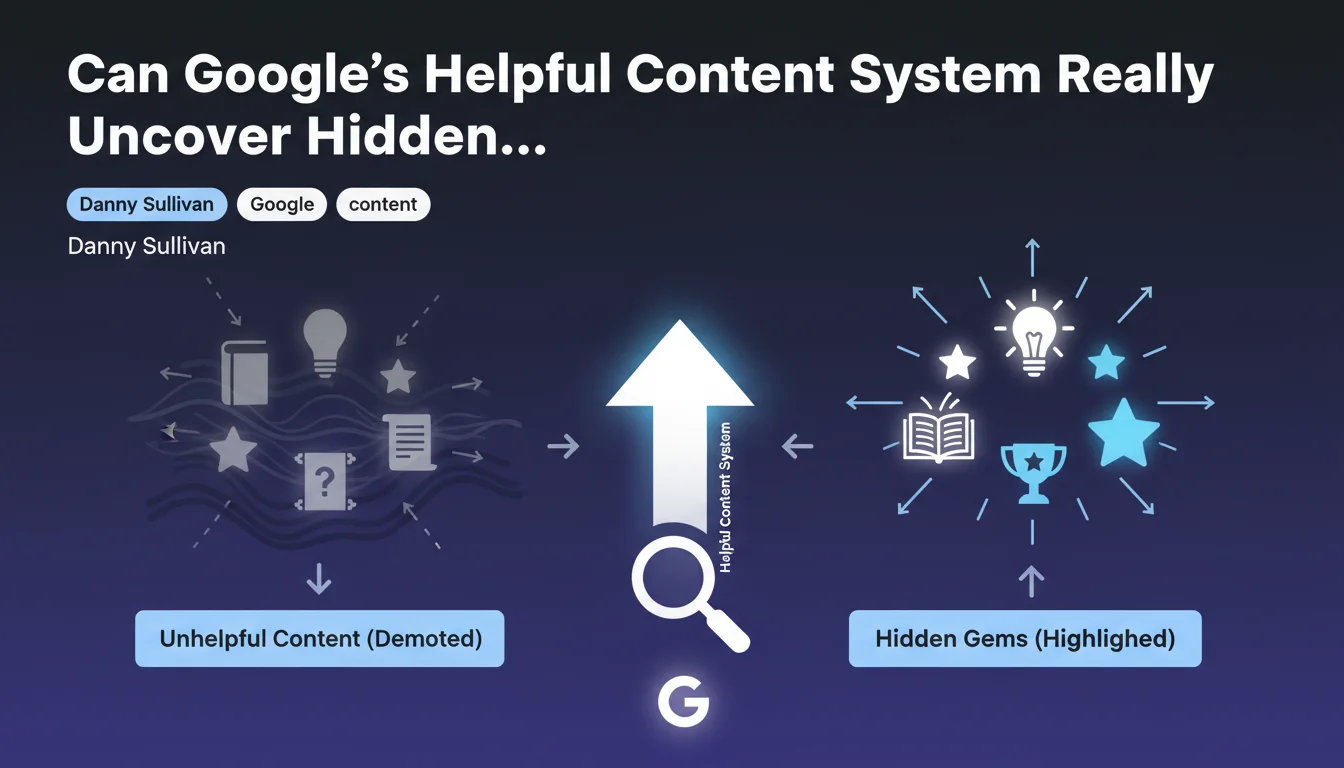
The Helpful Content System is a Google algorithm designed to evaluate the quality and real usefulness of web content. Contrary to popular belief, this system doesn't just penalize poor content.
Danny Sullivan confirmed that this system also has a promotional function. It can identify and highlight quality content that would otherwise be buried in the depths of the web, what he calls "hidden gems".
Why are people talking about "hidden gems" on the web?
Many pieces of exceptionally high-quality content remain invisible in the SERPs, often because they come from sites with low domain authority. These pages may be expertly written but lack visibility due to a lack of backlinks or brand recognition.
The Helpful Content System aims to rebalance search results by giving these deserving contents a chance. The algorithm analyzes the intrinsic value of content rather than relying solely on traditional authority signals.
What are the criteria for content considered "helpful"?
Google is looking for content created for users first, not to manipulate rankings. This includes demonstrated expertise, shared practical experience, and a complete response to search intent.
- Real expertise: content created by someone who masters the subject
- Added value: original information, personal analysis, unique insights
- Lived experience: demonstration of concrete practice on the topic covered
- Satisfied intent: complete and direct answer to the user's question
- Appropriate format: clear structure, optimal readability, smooth navigation
SEO Expert opinion
Is this statement consistent with what we're observing in the SERPs?
In practice, the results remain nuanced and imperfect. While some small niche sites have indeed gained visibility, we still see a predominance of high-authority sites, even with less in-depth content.
The algorithm seems to work particularly well on long-tail queries and specific niche topics. However, on generic and competitive queries, traditional authority factors (backlinks, domain age) continue to play a predominant role.
What nuances should we add to this promise from Google?
The term "hidden gems" is appealing but should not create false expectations. Excellent content on a new site with no trust signals will take time to emerge, regardless of algorithmic improvements.
Real-world evidence shows that the Helpful Content System works as one factor among many. It can give quality content a boost, but doesn't replace a complete SEO strategy including link building, technical optimization, and user experience.
In what cases does this system show its limitations?
In YMYL sectors (Your Money Your Life) such as health or finance, Google still massively favors established and recognized sites. A small medical blog, even excellent, will struggle to supplant institutional sites.
Similarly, on highly competitive transactional queries, commercial and authority signals often take precedence over simple content usefulness. The system shows its effectiveness mainly on informational queries where expertise and depth matter more.
Practical impact and recommendations
What should you do concretely to benefit from this update?
Focus on creating deeply useful content based on your real expertise. Document your practical experiences, share concrete cases and lived examples rather than reformulating generalities.
Structure your content so it comprehensively answers the search intent. Use rich formats: detailed tutorials, original comparative analyses, exclusive data, authentic experience feedback.
Demonstrate your E-E-A-T (Experience, Expertise, Authoritativeness, Trustworthiness) by adding qualified author bios, verifiable references, and proof of your practice on the subject.
What mistakes should you avoid to not be penalized?
Absolutely avoid mass-generated content without added value. Google is increasingly detecting texts produced solely for SEO, whether written by AI tools or low-cost outsourcing.
Don't create pages targeting keywords for which you have no real legitimacy. An e-commerce site publishing dozens of off-topic informational articles will be detected and potentially penalized.
- Don't publish content whose sole purpose is to generate SEO traffic
- Avoid generic texts that add nothing new to the subject
- Delete or improve old low-quality content that dilutes site authority
- Don't copy or massively paraphrase existing content
- Avoid "catch-all" pages that attempt to target too many queries without depth
How can you optimize your content strategy in this new context?
Prioritize quality over quantity. It's better to publish 2 exceptional and in-depth monthly articles than 20 superficial pieces of content. Invest in research, original data, and unique angles.
Develop a niche strategy where you can demonstrate indisputable expertise. Cover these topics in depth with comprehensive content that becomes references in your field.
Implement a regular audit process to identify and improve or delete weak content. A site with 50 excellent articles will perform better than a site with 200 articles of which 150 are mediocre.
- Audit all your existing content with a strict quality grid
- Identify your areas of real expertise and focus your efforts there
- Create content based on your documented practical experience
- Structure each piece of content to fully satisfy search intent
- Integrate E-E-A-T elements: author bios, sources, proof of expertise
- Measure user satisfaction: time on page, bounce rate, engagement
- Regularly update your best content to maintain its relevance
💬 Comments (0)
Be the first to comment.