
Official statement
Other statements from this video 10 ▾
- □ Why does Google force you to juggle three separate performance reports in Search Console?
- □ Are you really missing a significant chunk of your traffic by not filtering by search type in Search Console?
- □ Are your key pages missing from Google's search results? Here's how to fix your indexation issues
- □ Is internal navigation really enough to guarantee that your strategic pages get indexed?
- □ Does a low CTR really mean your search snippets are failing to attract clicks?
- □ Why aren't your Google News metrics showing up in Search Console?
- □ Why doesn't Google Search Console show search queries in the Google News report?
- □ Why isn't the Discover report showing up in your Search Console?
- □ Why does Google recommend analyzing your SEO performance over at least 16 months?
- □ Does the Most Recent Date option really allow you to detect trends in real time?
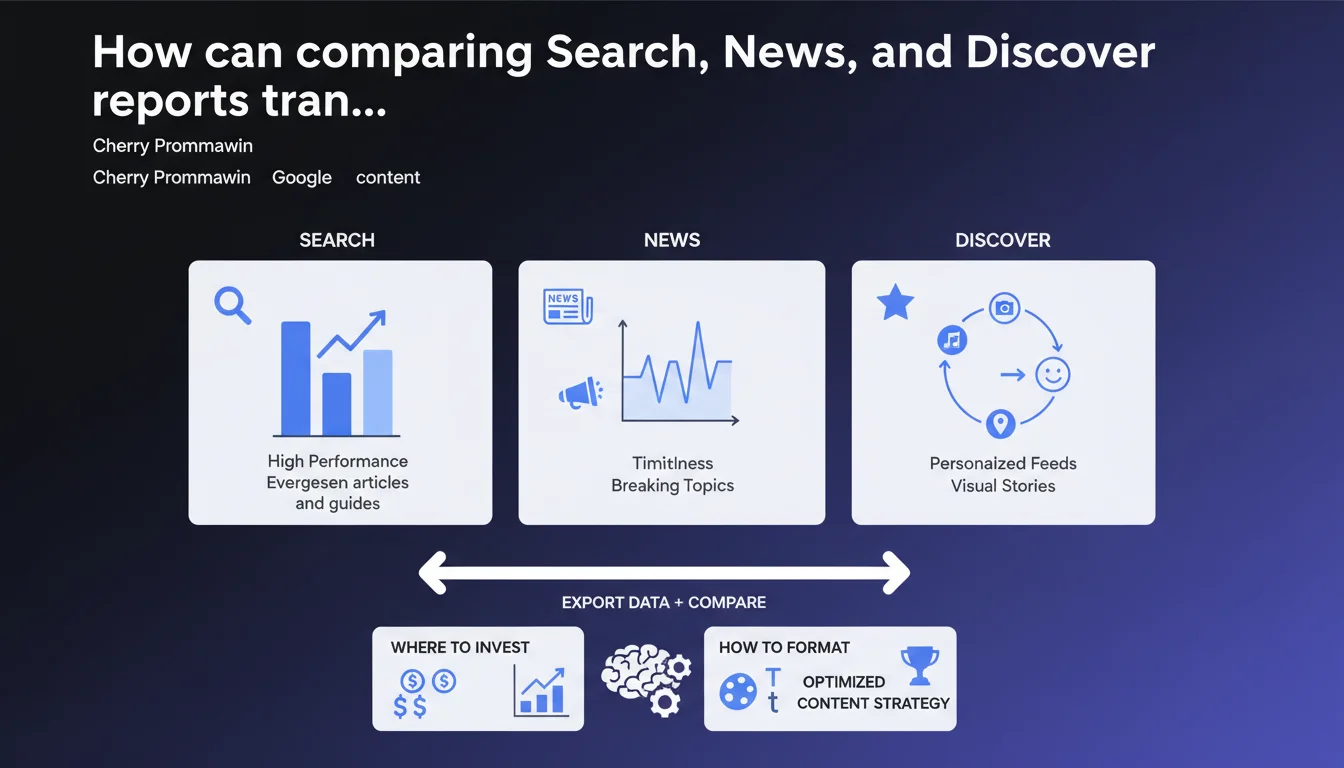
Google recommends exporting and cross-referencing data from Search Console, Google News, and Discover reports to identify formats and topics that perform on each surface. The goal: tailor your editorial strategy based on what actually works on each platform rather than applying a one-size-fits-all approach.
What you need to understand
Which Google surfaces should you analyze separately?
Google provides three distinct environments: traditional search (Search), Google News, and Discover. Each surface has its own visibility criteria and display mechanics.
Content that performs well in organic search won't necessarily succeed in Discover, where behavioral signals and engagement take priority. Similarly, articles that emerge in Google News follow specific editorial criteria — newsworthiness, freshness, reliability — that differ from traditional ranking factors.
Why does Google insist on comparing your data?
Because too many sites apply a monolithic content strategy. They produce the same format for all surfaces without accounting for each platform's specific requirements.
By exporting and cross-referencing metrics (impressions, clicks, CTR, average position), you identify which topics perform better on each surface. This allows you to adjust tone, format, structure — and invest where the return is measurable.
What's the operational purpose of this analysis?
The idea is to segment your editorial production based on target surfaces. An article optimized for Discover emphasizes visuals, emotional headlines, and freshness. Content designed for Search prioritizes depth, keywords, and semantic structure.
Google is telling you: stop guessing, look at your data. If a content type generates 80% of your impressions on Discover but nothing in Search, that's a clear signal to redirect your resources.
- Export data from Search Console, Google News, and Discover regularly.
- Compare performance by content type, format, and topic.
- Adapt your editorial strategy based on what actually performs on each surface.
- Don't treat Search, News, and Discover as a single channel: they are three distinct ecosystems.
SEO Expert opinion
Is this recommendation applicable to all websites?
Let's be honest: this approach requires sufficient data volume. If your site generates fewer than several thousand monthly impressions across all surfaces combined, your analysis granularity will be limited. You risk drawing conclusions from samples that are too small.
Another point — and this is where it gets tricky for many: not all sites are eligible for Google News, and Discover remains a fickle surface, largely dependent on engagement and brand recognition signals. If you don't appear in Discover, this comparative analysis loses much of its value.
What nuances should you add to this statement?
Google presents this approach as methodological common sense, but in practice, exporting and cross-referencing data remains time-consuming. Search Console doesn't facilitate multi-surface bulk exports — you need to use the API or third-party tools to automate.
Moreover, the statement says nothing about relevance thresholds. From what impression volume is a trend reliable? What minimum observation period? These questions remain unanswered. [To verify]: Google provides no data on statistical criteria to respect when validating a trend.
In which cases doesn't this strategy apply?
If your site is purely transactional (pure e-commerce, SaaS), Discover and News probably won't be relevant levers. These surfaces favor editorial content, news, and topics of general interest — not product sheets or landing pages.
Similarly, if your SEO strategy relies on low-volume long-tail queries, comparative analysis loses its value: you'll never generate enough traffic on Discover or News to draw actionable insights. Focus on Search instead, plain and simple.
Practical impact and recommendations
What do you need to do concretely to cross-reference this data?
First step: regularly export reports from Search Console for each of the three surfaces. Ideally, automate this process via the API or an aggregation tool (Data Studio, Looker, or equivalent).
Next, segment your URLs by content type (in-depth articles, news, how-to guides, videos, etc.). Cross-reference metrics — impressions, clicks, CTR, position — by surface and by type. Identify significant gaps.
What mistakes should you avoid in this analysis?
Don't compare periods that are too short: one week of data isn't enough. Aim for at least three rolling months to smooth out seasonal and event-driven variations.
Also avoid over-interpreting micro-variations. If a content type generates 5% more clicks on Discover, but from a total volume of 200 impressions, that's not a reliable signal. Focus on massive and recurring trends.
How do you adjust your editorial strategy based on results?
If Discover outperforms on certain topics, invest in impactful visuals, emotional headlines, frequent updates. If News dominates, strengthen freshness, reactivity, and cited sources.
For Search, prioritize semantic depth, sub-section structure, long-tail keywords. Don't try to optimize everything everywhere: it's a waste of time. Segment your production based on target surfaces.
- Export Search Console reports for Search, News, and Discover monthly.
- Segment your content by type and topic.
- Compare metrics over at least three rolling months.
- Identify formats that outperform on each surface.
- Adapt your editorial calendar based on these insights.
- Automate export and analysis to save time.
- Don't draw conclusions from samples under several thousand impressions.
❓ Frequently Asked Questions
Faut-il analyser Search, News et Discover séparément même si mon site ne génère du trafic que sur Search ?
Quel volume d'impressions minimum faut-il pour que cette analyse soit fiable ?
Comment exporter les données de Discover dans Search Console ?
Dois-je créer des contenus spécifiques pour chaque surface ou adapter les existants ?
À quelle fréquence dois-je comparer ces données ?
🎥 From the same video 10
Other SEO insights extracted from this same Google Search Central video · published on 23/05/2023
🎥 Watch the full video on YouTube →
💬 Comments (0)
Be the first to comment.