
Official statement
Other statements from this video 10 ▾
- □ Pourquoi Google impose-t-il trois rapports de performance distincts dans Search Console ?
- □ Faut-il vraiment filtrer vos données par type de recherche dans Search Console ?
- □ Comment identifier et résoudre les problèmes d'indexation sur vos pages stratégiques ?
- □ La navigation interne suffit-elle vraiment à garantir l'indexation de vos pages stratégiques ?
- □ Un CTR faible signifie-t-il vraiment que vos snippets manquent d'attractivité ?
- □ Pourquoi vos données Google News ne remontent-elles pas dans la Search Console ?
- □ Pourquoi le rapport Discover n'apparaît-il pas dans votre Search Console ?
- □ Pourquoi Google recommande-t-il une analyse SEO sur 16 mois minimum ?
- □ L'option Most Recent Date permet-elle vraiment de détecter les tendances en temps réel ?
- □ Pourquoi comparer Search, News et Discover change votre stratégie de contenu ?
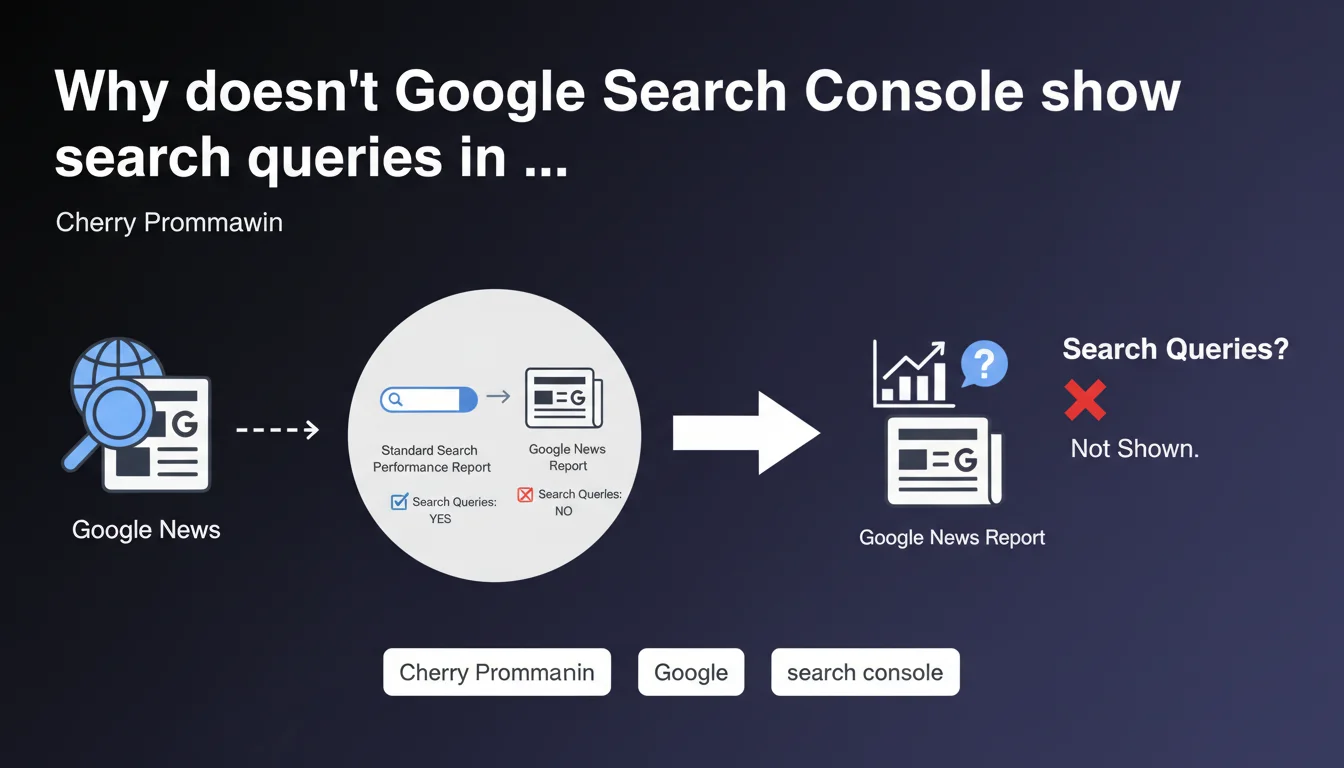
The Google News report in Search Console does not provide access to search queries or search appearances, unlike the standard Search Performance report. This limitation deprives publishers of essential data to optimize their visibility in Google News. Google provides no technical justification for this restriction.
What you need to understand
What is the concrete difference between the two reports?
The standard Search Performance report in Search Console displays all queries that generate impressions and clicks, as well as search appearances (featured snippets, image packs, videos, etc.). It's the foundation of any serious SEO analysis.
The Google News report, on the other hand, is limited to raw traffic metrics — clicks, impressions, CTR, average position. It's impossible to identify which queries triggered your articles in Google News, or in what format they appear. Almost total opacity.
Why is this limitation problematic for publishers?
Without access to search queries, you're flying blind. You know an article is performing in Google News, but you don't know which keywords drove it. Impossible to identify semantic opportunities, adjust your headlines, or understand which editorial angles generate the most visibility.
The absence of search appearances makes the problem worse. You don't know if your articles appear in top stories, carousels, or elsewhere. This opacity prevents any fine-tuning of your editorial strategy for Google News.
Is this restriction new or documented?
Google has never really communicated about this limitation — it's simply been observed by Search Console users. No official documentation explains why this data is hidden specifically for Google News when it's available everywhere else.
This announcement from Cherry Prommawin officially documents an existing situation without providing technical justification or a timeline for improvement. The mystery remains.
- The Google News report shows neither queries nor search appearances
- Only aggregated metrics (clicks, impressions, CTR, position) are available
- No official justification from Google for this limitation
- Direct impact on publishers' ability to optimize
SEO Expert opinion
Is this opacity consistent with Google's strategy?
Let's be honest: this restriction smells like a deliberate attempt to compartmentalize data. Google has always treated Google News as a separate ecosystem with its own rules, its own crawl, its own editorial logic. But depriving publishers of search queries goes beyond simple technical segmentation.
It's all the more frustrating because this data obviously exists — Google knows perfectly well which queries trigger certain articles in News. The choice not to share it is therefore purely arbitrary. [To verify]: some observers suspect that Google wants to preserve the editorial integrity of News by preventing SEO over-optimization of headlines — but nothing is documented.
What are the consequences for editorial strategies?
In practice, you're forced to cross-reference multiple sources. If an article generates traffic in the Google News report, you have to go check the standard Search Performance report to see if certain generic queries match. Tedious and imprecise.
Result: many publishers run their Google News strategy by gut feel or through third-party tools (which also have their limitations). The lack of granular data favors large players with the resources to invest in proprietary tracking and semantic analysis solutions.
Are there reliable workarounds?
Some publishers use UTM parameters on their RSS feeds to track the origin of News traffic in Google Analytics. This lets you recover some context, but you'll never have the exact search queries — just confirmation that the click came from News.
Others rely on tools like Parse.ly or Chartbeat, which analyze the performance of headlines and content. But again, it's reverse engineering — you're guessing probable queries without certainty. [To verify]: no official Google API provides access to this missing data.
Practical impact and recommendations
What should you do concretely with this limitation?
First, accept that you'll never manage Google News with the same precision as classic search. It's frustrating, but that's the imposed framework. Focus on what remains observable: aggregated metrics by article, section, and time period.
Identify the editorial patterns that work: subject types, headline formats, article lengths, publication times. If certain angles consistently generate more impressions, that's an actionable signal even without exact queries.
Cross your Search Console data with your analytics. If an article explodes in the Google News report, go check your GA4 or analytics tool to see if you identify specific referrers or user behaviors characteristic of News traffic (bounce rate, time on page, user journey).
How do you compensate for the lack of data on search appearances?
It's impossible to know if your articles appear in top stories, carousels, or classic results in Google News. But you can test manually: search for topics you cover, identify where your competitors appear, note which formats win.
Some publishers maintain a log of manually observed positions or use rank tracking tools adapted for News. It's DIY, but it's more reliable than navigating in the dark.
What errors should you avoid in this context?
Don't over-interpret aggregated metrics. A high CTR doesn't necessarily mean your headline is optimal — maybe you're just appearing on highly qualified queries you're unaware of. Stay humble in your conclusions.
Also avoid neglecting the standard Search Performance report. If your articles appear in Top Stories in classic Google search, that data is accessible and ultra-valuable. Don't put all your eggs in the Google News basket.
- Analyze editorial patterns that perform well based on available aggregated metrics
- Cross Search Console data with your analytics to identify correlations
- Manually test search appearances for your key topics
- Use UTM parameters in your RSS feeds to track the origin of traffic
- Don't over-interpret metrics — stay aware of the limitations imposed by Google
- Maintain competitive monitoring manually or through adapted third-party tools
❓ Frequently Asked Questions
Les requêtes de recherche sont-elles masquées uniquement dans le rapport Google News ou aussi ailleurs ?
Existe-t-il une API Google qui permettrait de récupérer ces données manquantes ?
Google a-t-il expliqué pourquoi ces données sont masquées ?
Les outils SEO tiers peuvent-ils contourner cette limitation ?
Cette limitation concerne-t-elle aussi l'application Google News et le flux RSS ?
🎥 From the same video 10
Other SEO insights extracted from this same Google Search Central video · published on 23/05/2023
🎥 Watch the full video on YouTube →
💬 Comments (0)
Be the first to comment.