
Official statement
Other statements from this video 10 ▾
- □ Pourquoi Google impose-t-il trois rapports de performance distincts dans Search Console ?
- □ Faut-il vraiment filtrer vos données par type de recherche dans Search Console ?
- □ Comment identifier et résoudre les problèmes d'indexation sur vos pages stratégiques ?
- □ La navigation interne suffit-elle vraiment à garantir l'indexation de vos pages stratégiques ?
- □ Pourquoi vos données Google News ne remontent-elles pas dans la Search Console ?
- □ Pourquoi Google Search Console masque-t-il les données de requêtes dans le rapport Google News ?
- □ Pourquoi le rapport Discover n'apparaît-il pas dans votre Search Console ?
- □ Pourquoi Google recommande-t-il une analyse SEO sur 16 mois minimum ?
- □ L'option Most Recent Date permet-elle vraiment de détecter les tendances en temps réel ?
- □ Pourquoi comparer Search, News et Discover change votre stratégie de contenu ?
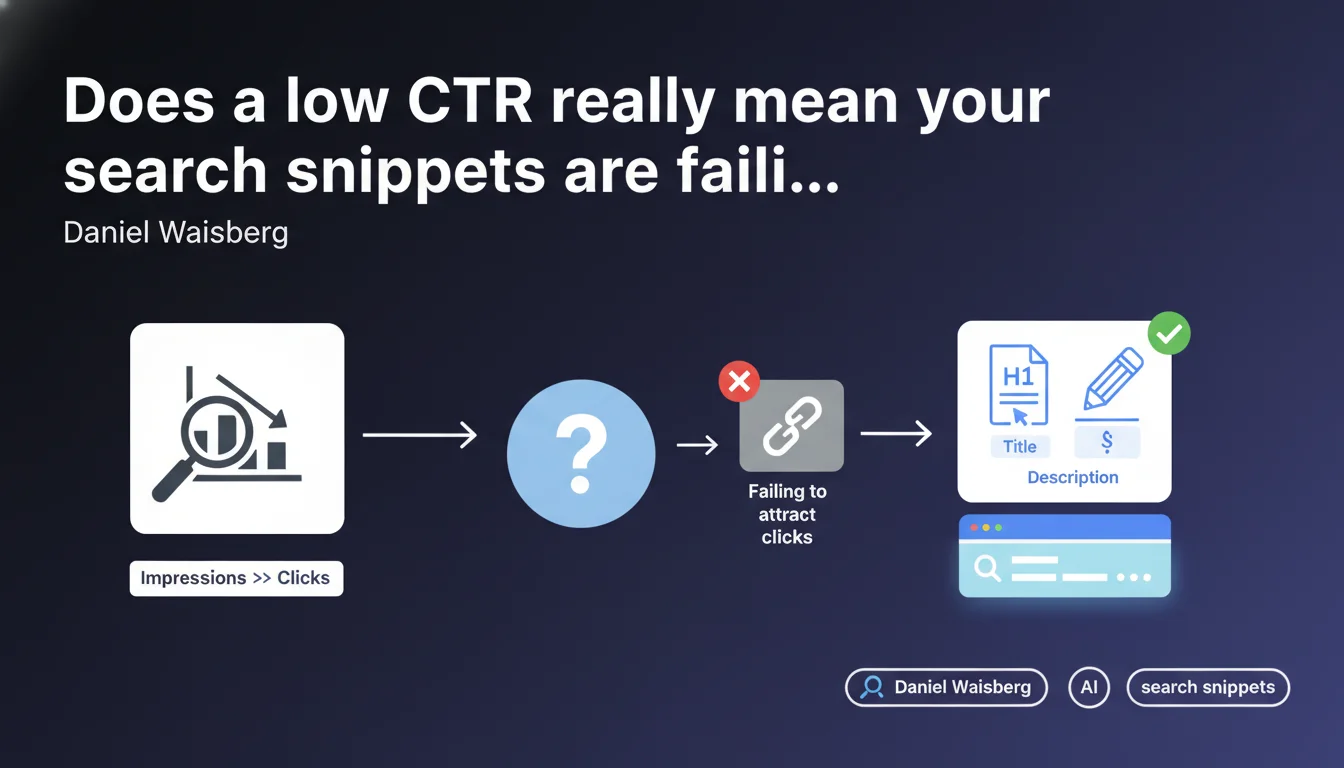
Google claims that a low CTR on a query with high impressions indicates unattractive snippets. The official recommendation: improve titles and descriptions to capture more clicks. Simple in theory, but this approach deserves to be nuanced depending on search context.
What you need to understand
Daniel Waisberg from Google offers a straightforward diagnosis: when your pages accumulate impressions without landing clicks, it's because your snippets don't compel action. The proposed remedy? Rework your title and meta description tags to make them more compelling.
This logic relies on a direct equation: impression without click = failed snippet. Google assumes the problem lies in the presentation of your result, not in its relevance or position.
Why does Google emphasize snippet attractiveness?
Because a user who doesn't click extends their search session. They'll try other results, go back and modify their query, sometimes abandon altogether. For Google, a low CTR can signal a gap between what the snippet promises and what the user is actually searching for.
By optimizing your snippets, you reduce this gap. The user more quickly identifies that your page answers their need, clicks, and — ideally — doesn't return to the SERP. This is a better experience for them, and a positive signal for Google.
What counts as a "significantly low" CTR according to Google?
Google provides no specific threshold. Waisberg mentions impressions "significantly higher" than clicks, but without specifying a ratio. Is a 2% CTR bad? 0.5%? It depends on position, query type, presence of featured snippets, or ads.
This lack of benchmark forces you to rely on benchmarks in your industry and compare your pages against each other. A low CTR in position 8 is expected; in position 3, that's another story.
- A low CTR with high impressions signals an unattractive snippet, according to Google.
- The recommended solution: rework titles and descriptions.
- Google provides no specific threshold to define a "low" CTR.
- Context (position, query type, SERP features) massively influences expected CTR.
- An attractive snippet reduces pogo-sticking and improves user experience.
SEO Expert opinion
Does this claim hold up in real-world conditions?
Partially. A poorly written or generic snippet can certainly kill your CTR, even in a good position. But assuming that all low CTR stems from a failed snippet ignores countless other factors: position (obvious), presence of PAA or carousels monopolizing attention, seasonality of the query, or the actual intent behind the search.
A 1% CTR in position 9 doesn't indicate a failed snippet — it indicates a failed position. Conversely, a 5% CTR in position 1 on a brand query isn't impressive. [To verify] Waisberg doesn't clarify whether this CTR analysis should always be adjusted based on position, which would be the bare minimum.
Will Google rewrite your snippet regardless?
Yes, often. And that's where things get tricky. You can perfect a flawless meta description, and Google will still replace it with a content excerpt it deems more relevant to the query. For years, Google has dynamically adapted snippets based on search context.
Result: your optimization work can be circumvented. Waisberg's recommendation remains valid — a good title and description increase the chances of being displayed — but it's never guaranteed. Better to also polish the visible content on your pages, because that's often where Google will pull from.
Should you really focus only on the snippet?
No. Low CTR can also signal a strategic positioning problem. If you rank on an informational query with a product page, your snippet can be brilliant, but it won't match the intent. The user is looking for a definition, you're offering a purchase — they scroll.
Before rewriting snippets en masse, ask yourself: should I rank for this query? If yes, at what position? If no, the problem isn't the snippet, it's the targeting. [To verify] Google never specifies to what extent low CTR can also signal that you're targeting queries poorly.
Practical impact and recommendations
How do you identify pages with weak snippets?
Head to Google Search Console, Performance tab. Filter by page, then sort by impressions in descending order. Spot pages accumulating high impressions but few clicks. Note the average position: if it's below 5, low CTR may be normal.
For each suspect page, look at the queries generating impressions. Do they match the intent of your content? If yes, move to the next step. If no, you have a targeting problem, not a snippet problem.
What mistakes should you avoid when rewriting snippets?
First mistake: clickbait. Promising the world in the title then disappointing afterward skyrockets bounce rate and damages experience. Google can detect this pattern and lower your ranking. Be appealing, but honest.
Second mistake: ignoring length. A truncated title loses its punch. Stay under 60 characters (roughly 600 pixels). For meta description, aim for 150-160 characters — enough to seduce, not enough to bury the message.
Third mistake: neglecting page content. If Google rewrites your snippet with a poor text excerpt, it's because your content lacks clarity or structure. Use lists, clear definitions, direct answers — anything Google can extract cleanly.
What concrete steps should you take to improve snippets?
- Identify in GSC the pages with low CTR and good position (top 5).
- Analyze the primary queries: do they match your page's intent?
- Rewrite your titles: keyword at the start, clear promise, no stuffing.
- Write meta descriptions focused on user benefit, with a subtle CTA.
- Structure your content to facilitate dynamic extraction (lists, short paragraphs, direct answers).
- Test emotional or question-based titles if your industry allows it.
- Monitor CTR evolution over 2-3 weeks after each change.
- Don't forget structured data for FAQ or HowTo when relevant — they enrich the snippet.
Improving your snippets can boost CTR, but it's only part of the equation. Position, intent, content quality, brand authority — everything matters. Don't just rework your tags: analyze why Google positions you there, and whether this query really deserves targeting.
These optimizations, though strategic, require careful analysis and regular adjustments. When traffic stakes are high, it may be worthwhile to engage a specialized SEO agency to orchestrate these initiatives and maximize impact without wasting time on trial and error.
❓ Frequently Asked Questions
Un CTR faible pénalise-t-il directement mon ranking ?
Google utilise-t-il toujours ma meta description ?
Quel CTR minimum viser en position 3 ou 4 ?
Faut-il optimiser les snippets de toutes mes pages ?
Les emojis dans les titles améliorent-ils le CTR ?
🎥 From the same video 10
Other SEO insights extracted from this same Google Search Central video · published on 23/05/2023
🎥 Watch the full video on YouTube →
💬 Comments (0)
Be the first to comment.