
Official statement
Other statements from this video 10 ▾
- □ Faut-il vraiment filtrer vos données par type de recherche dans Search Console ?
- □ Comment identifier et résoudre les problèmes d'indexation sur vos pages stratégiques ?
- □ La navigation interne suffit-elle vraiment à garantir l'indexation de vos pages stratégiques ?
- □ Un CTR faible signifie-t-il vraiment que vos snippets manquent d'attractivité ?
- □ Pourquoi vos données Google News ne remontent-elles pas dans la Search Console ?
- □ Pourquoi Google Search Console masque-t-il les données de requêtes dans le rapport Google News ?
- □ Pourquoi le rapport Discover n'apparaît-il pas dans votre Search Console ?
- □ Pourquoi Google recommande-t-il une analyse SEO sur 16 mois minimum ?
- □ L'option Most Recent Date permet-elle vraiment de détecter les tendances en temps réel ?
- □ Pourquoi comparer Search, News et Discover change votre stratégie de contenu ?
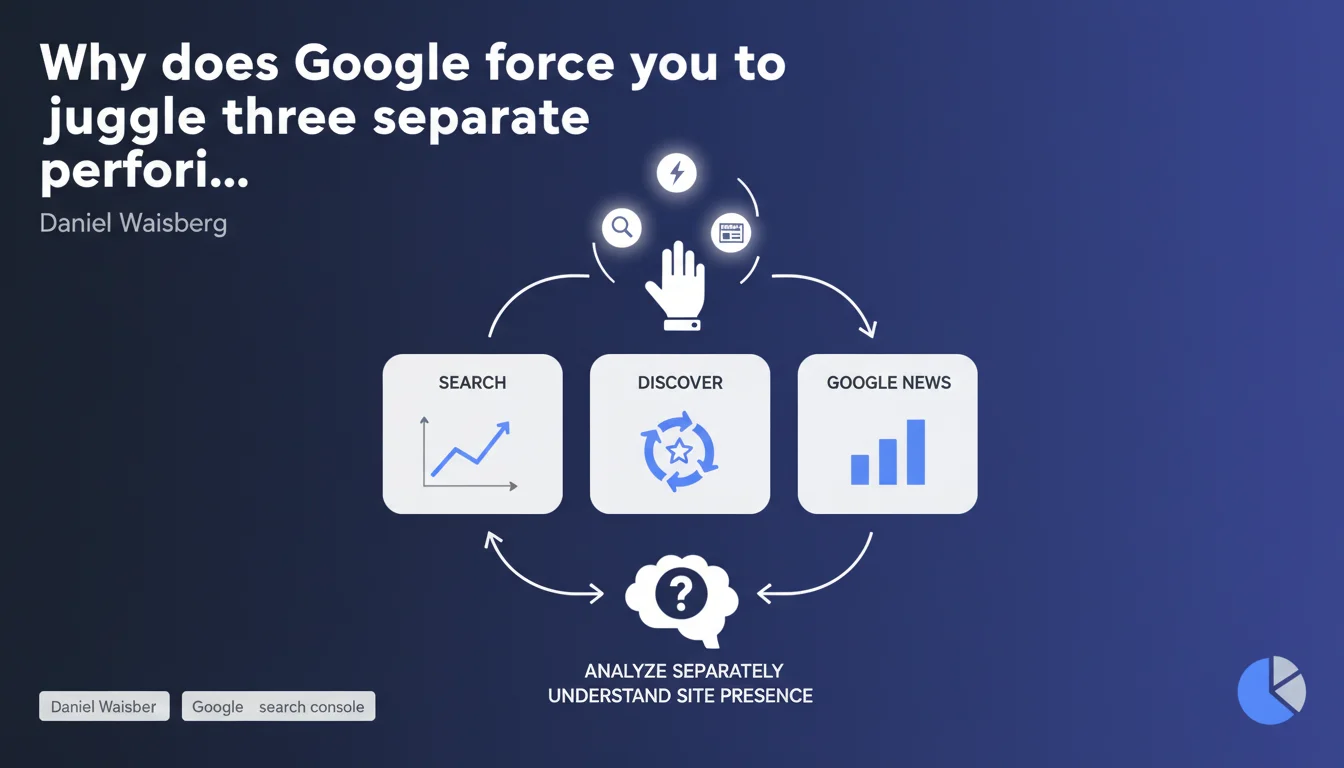
Search Console now splits performance data into three distinct reports: Search, Discover, and Google News. Each surface displays different metrics that must be analyzed independently. This fragmentation demands a differentiated strategic approach for each Google acquisition channel.
What you need to understand
Why did Google segment performance data in the first place?
Google no longer presents a unified view of a site's performance. Search Console now distinguishes three separate, airtight reports: classic search results (Search), the Discover feed, and Google News. Each one exposes data that belongs exclusively to it.
This separation reflects a technical reality: these three surfaces operate with different algorithms, distinct ranking criteria, and radically opposite user behaviors. Mixing this data together would make no analytical sense — a click from Discover doesn't carry the same value as a click from an organic search query.
What are the concrete differences between these three reports?
The Search report displays performance on classic queries: impressions, clicks, average position, CTR. This is the familiar SEO playground — the one you monitor daily.
Discover works differently: no queries, no rankings. Google pushes content based on the estimated interests of each user. Metrics are limited to impressions and clicks. Performance here depends far more on freshness, editorial angle, and engagement than on traditional semantic work.
Google News follows its own editorial logic, with reinforced E-E-A-T criteria and ultra-short timeframes. An article can explode in a few hours then disappear — the data reflects this volatility.
How do you analyze this data without getting lost?
Each report answers distinct strategic objectives. Stop looking for a global metric that no longer exists. Analysis must be compartmentalized: semantic optimization for Search, engaging content strategy for Discover, editorial responsiveness for News.
- Search: classic analysis by keywords, rankings, landing pages — the domain of technical and semantic SEO
- Discover: focus on trending topics, compelling headlines, quality images — push logic rather than pull
- Google News: freshness, editorial authority, responsiveness to breaking news — a game of speed and credibility
- Each surface requires a specific action plan — it's impossible to apply the same recipe everywhere
- Relevant KPIs vary from one report to the next — don't compare Discover impressions with Search rankings
SEO Expert opinion
Does this report separation truly reflect what happens in the real world?
Yes, and it's actually quite healthy. For years, we mixed traffic sources that had nothing to do with each other. A Discover click has never had the same intent as an active search — confusing them in a single report created analytical noise.
On the ground, media sites understood this long ago: their Discover and Search strategies are managed by different teams with different goals. This separation in Search Console simply codifies this operational reality.
What limitations should we point out?
Google still doesn't give you the keys to understanding why content performs on Discover. [To be verified] The precise criteria remain murky: user interest algorithm, freshness weight, engagement thresholds — all of this remains a black box.
Same issue with News: the E-E-A-T signals that determine inclusion in Google News are never spelled out. You know you need to be credible, fast, well-structured — but the exact thresholds? A mystery. This opacity makes optimization empirical, based on trial-and-learning rather than certainties.
And that's where it gets tricky: these three reports fragment your analysis without providing the actionable indicators to move the needle on each surface. You have three dashboards, but still not a complete operating manual.
In what cases does this separate-reports logic cause real problems?
For sites generating traffic across all three surfaces simultaneously, analysis quickly becomes a nightmare. It's impossible to easily cross-reference the data: no consolidated view, no direct comparison between Search and Discover for the same page.
Result: you have to export, reprocess, and manually reconcile — or tap into the Search Console API to build your own dashboards. Effective, but time-consuming. SEO teams without solid technical resources get trapped in siloed analysis.
Practical impact and recommendations
What should you actually do with these three reports?
First, stop lumping everything together in a single Google Analytics dashboard. Segment your Google traffic sources: classic organic search, Discover, Google News. Analyze each channel with its own success metrics.
For Search, stick with your usual approach: track rankings, analyze semantics, optimize for featured snippets. This is familiar territory — nothing fundamentally changes here.
For Discover, focus on high-viral-potential content: trending topics, original angles, striking visuals. Optimize for engagement rather than keyword intent — your headline should make people want to click, not just contain keywords.
For Google News, responsiveness is king. Publish fast, structure properly (Article schema markup, AMP if relevant), and build editorial authority. Credibility matters more than content volume.
What mistakes must you avoid at all costs?
Don't judge your site's overall performance by looking only at the Search report. You'd miss significant traffic if your content performs on Discover or News without you realizing it.
Also avoid over-optimizing for Discover at the expense of Search — or vice versa. Each surface has its own rules. A sensationalist headline might explode on Discover but trash your credibility on classic informational queries. Find balance, or create different versions for different distribution channels.
Last classic mistake: ignoring Discover data because it seems erratic. Yes, Discover is volatile — but that volatility contains insights. Sudden spikes reveal which topics and angles work: capitalize on them.
How do you verify your multi-surface strategy is actually working?
- Check all three Search Console reports weekly — not just Search
- Compare how the same content performs across surfaces to identify winning formats
- Monitor Discover fluctuations: a spike reveals a high-performing editorial angle to replicate
- Verify your Google News-eligible content meets technical requirements (structured data, speed, editorial structure)
- Segment your KPIs by surface: bounce rate, time on page, pages per session vary dramatically by traffic source
- Test different headline and visual formats for Discover — this is empirical trial-and-learning, not exact science
- Document what works on each surface to build your own internal playbook
❓ Frequently Asked Questions
Les données des trois rapports peuvent-elles se recouper pour une même page ?
Faut-il créer des contenus différents pour chaque surface Google ?
Comment savoir si mon site est éligible à Discover et Google News ?
Les positions moyennes dans le rapport Search ont-elles encore du sens ?
Peut-on exporter et fusionner les données des trois rapports ?
🎥 From the same video 10
Other SEO insights extracted from this same Google Search Central video · published on 23/05/2023
🎥 Watch the full video on YouTube →
💬 Comments (0)
Be the first to comment.