
Official statement
Other statements from this video 10 ▾
- □ Pourquoi Google impose-t-il trois rapports de performance distincts dans Search Console ?
- □ Faut-il vraiment filtrer vos données par type de recherche dans Search Console ?
- □ Comment identifier et résoudre les problèmes d'indexation sur vos pages stratégiques ?
- □ Un CTR faible signifie-t-il vraiment que vos snippets manquent d'attractivité ?
- □ Pourquoi vos données Google News ne remontent-elles pas dans la Search Console ?
- □ Pourquoi Google Search Console masque-t-il les données de requêtes dans le rapport Google News ?
- □ Pourquoi le rapport Discover n'apparaît-il pas dans votre Search Console ?
- □ Pourquoi Google recommande-t-il une analyse SEO sur 16 mois minimum ?
- □ L'option Most Recent Date permet-elle vraiment de détecter les tendances en temps réel ?
- □ Pourquoi comparer Search, News et Discover change votre stratégie de contenu ?
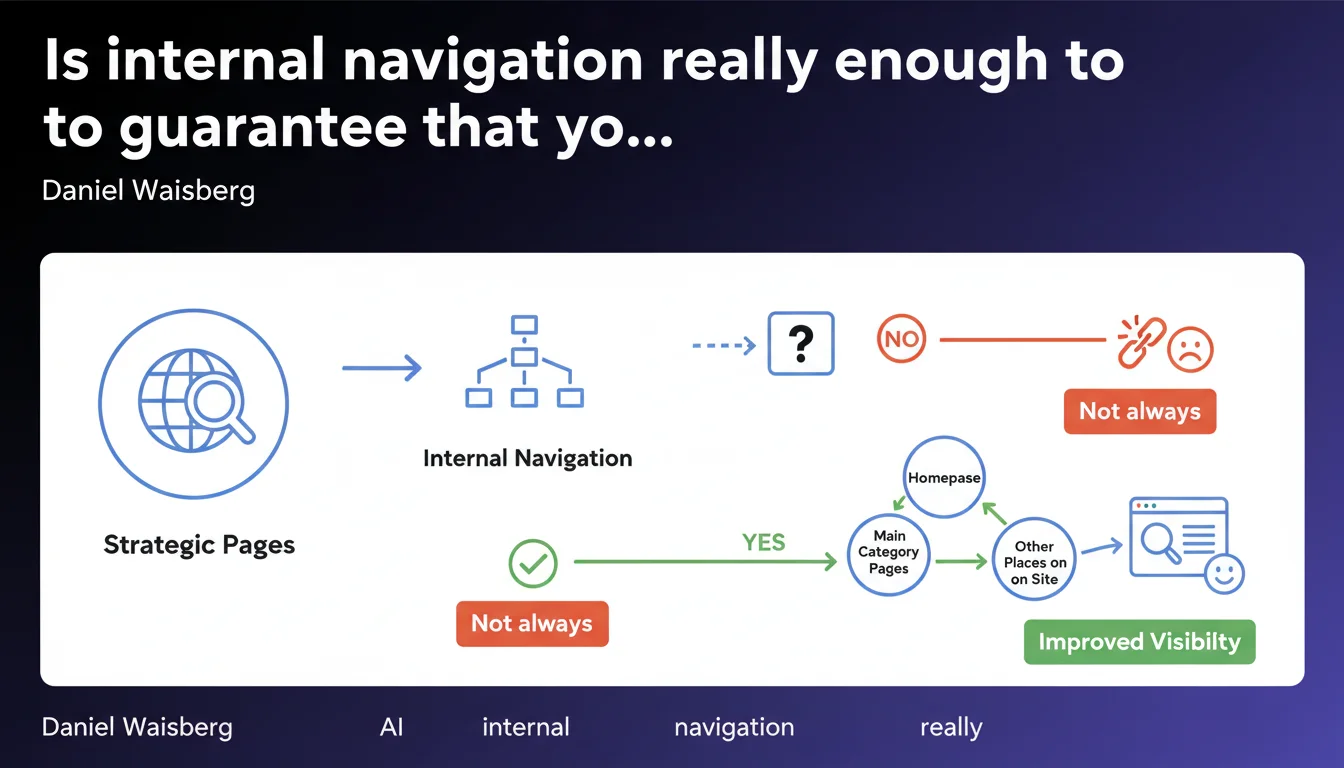
Google is hammering home a fundamental truth: important pages must be accessible through your site's navigation or linked from major entry points like the homepage or primary category pages. Without solid internal links, even a high-quality page risks staying invisible to crawling and indexing. It's a structural lever that's far too often overlooked in favor of on-page optimization.
What you need to understand
Why does Google stress navigation for page discovery?
Googlebot discovers pages by following internal links. If a page is only accessible after 5 clicks or through a form, it risks never being crawled, even if its content is excellent.
Google is emphasizing navigation structure as a critical entry point here. Strategic pages — flagship products, pillar content, landing pages — must be accessible from the homepage, main categories, or the menu. This signals relevance and priority to the search engine.
What makes navigation effective for SEO?
Effective navigation relies on minimum click depth: every important page should be reachable in 3 clicks maximum from the root. This requires a clear hierarchy, well-thought-out categories, and structured internal linking.
Menus, breadcrumbs, contextual links, and "recommended products" blocks all play a role. But be careful — too many links dilute internal PageRank. The challenge is to prioritize without saturation.
Which pages are at risk of flying under the radar?
Orphan pages — with no internal incoming links — are the first victims. Then come those buried in excessively deep directory structures, accessible only through internal search or dynamic filters.
Paginated content, out-of-stock product pages, old blog articles not being refreshed... all this content can disappear from Google's radar due to a lack of recent and strategic incoming links.
- Important pages must be linked from strong entry points: homepage, categories, menu.
- Click depth directly influences crawl frequency and indexation.
- Orphan or buried pages risk never being discovered by Googlebot.
- Structured internal linking is as important as on-page optimization.
SEO Expert opinion
Is this statement consistent with real-world practices?
Absolutely. We regularly observe sites with premium, well-optimized content that are totally invisible in the index simply because they receive no internal links from frequently crawled pages.
Google is merely repeating what should be obvious: without a path of links, there's no discovery. But in practice, many sites generate pages on the fly (filters, product variants, archives) without ever linking to them in a stable way. The result — they exist, but stay out of the index.
What nuances should we add to this advice?
Linking a page from the homepage or a category doesn't guarantee indexation if it adds no value. Google may crawl it and decide not to index it because the content is weak, duplicated, or irrelevant. Structure facilitates discovery, but quality determines indexation.
Another point — some sites have thousands of pages. Not all deserve to be 2 clicks from the homepage. The goal is to rank pages intelligently: which pages drive traffic, conversions, backlinks? Those should be prioritized in navigation.
When does this rule not fully apply?
On very large sites (e-commerce with massive catalogs, classified ad portals), it's impossible to link all pages from the main navigation. There, internal linking must be intelligent and scalable: pagination, crawlable filters, automated contextual link blocks.
XML sitemaps help partially, but they never replace good internal linking. Google uses them as a safety net, not a primary discovery source. If a page appears only in the sitemap and nowhere else, it will be crawled… but without a priority signal.
Practical impact and recommendations
What concrete steps should you take to optimize discoverability of strategic pages?
Start by identifying your high-impact pages: those generating revenue, qualified traffic, or targeting strategic keywords. Then check their click depth from the homepage. If they're more than 3 clicks away, that's a problem.
Next, integrate them into primary navigation, thematic menus, recommendation blocks, or pillar content. Use breadcrumbs, contextual links in articles, cross-links between complementary products or services. The internal linking should be both structural and semantic.
What mistakes should you absolutely avoid?
Don't create pages without a path of links. Avoid hermetic silo structures where each category remains isolated. Don't drown your important links in bloated footers or unreadable dropdown menus.
Another trap — links in JavaScript not accessible to crawlers. If your navigation relies on client-side rendering without HTML fallback, Googlebot may miss it. Always test with Search Console and the URL inspection tool.
How do you verify your site respects this principle?
Use a crawler (Screaming Frog, Oncrawl, Botify) to map the click depth of every URL. Export strategic pages and verify their accessibility from the root. Identify orphans by cross-referencing crawl data and server logs.
Check the "Coverage" report in Search Console to spot pages that are discovered but not indexed. If they lack internal links, that's often the cause. Revive them through related content blocks, related articles, or menu additions.
- Map click depth for all strategic pages.
- Identify and fix orphan pages (no internal incoming links).
- Integrate priority content into main navigation or key categories.
- Create semantic internal linking between complementary pages.
- Verify link accessibility for Googlebot (not JavaScript-only).
- Cross-reference crawl data with server logs to spot uncrawled areas.
- Use Search Console to find discovered but unindexed pages.
❓ Frequently Asked Questions
Une page sans lien interne peut-elle être indexée si elle est dans le sitemap XML ?
Combien de liens internes faut-il pointer vers une page stratégique ?
Les pages orphelines sont-elles automatiquement désindexées ?
Faut-il lier toutes les pages depuis la home pour maximiser l'indexation ?
Les liens en footer ou sidebar comptent-ils autant que les liens dans le contenu principal ?
🎥 From the same video 10
Other SEO insights extracted from this same Google Search Central video · published on 23/05/2023
🎥 Watch the full video on YouTube →
💬 Comments (0)
Be the first to comment.