
Official statement
Other statements from this video 16 ▾
- □ Is Google's SEO Starter Guide really the best foundation to learn search engine optimization from scratch?
- □ Should you really define goals and conversions before optimizing your SEO?
- □ Should you really tailor your SEO strategy to your audience before optimizing technically?
- □ Are popular CMS platforms like WordPress really enough for serious technical SEO?
- □ Is searching your domain name on Google really enough to verify your site's technical health?
- □ Should you really be asking your customers to shape your SEO strategy?
- □ Should small businesses really give up on generic search queries?
- □ Can small websites really test freely without major SEO risks?
- □ Why does Martin Splitt place such strong emphasis on installing Search Console and measurement tools?
- □ How long does it really take for a content change to show up in Google search results?
- □ Is it really safe to search for your own website on Google without getting penalized?
- □ Why can't you rely on staging environments to validate your SEO improvements?
- □ Should you only hire an SEO expert once you can actually measure the ROI?
- □ Are all #1 ranking guarantees really SEO scams?
- □ Are Google's Search Essentials really the ultimate SEO rulebook you need to follow?
- □ Is your website still essential in the age of generative AI?
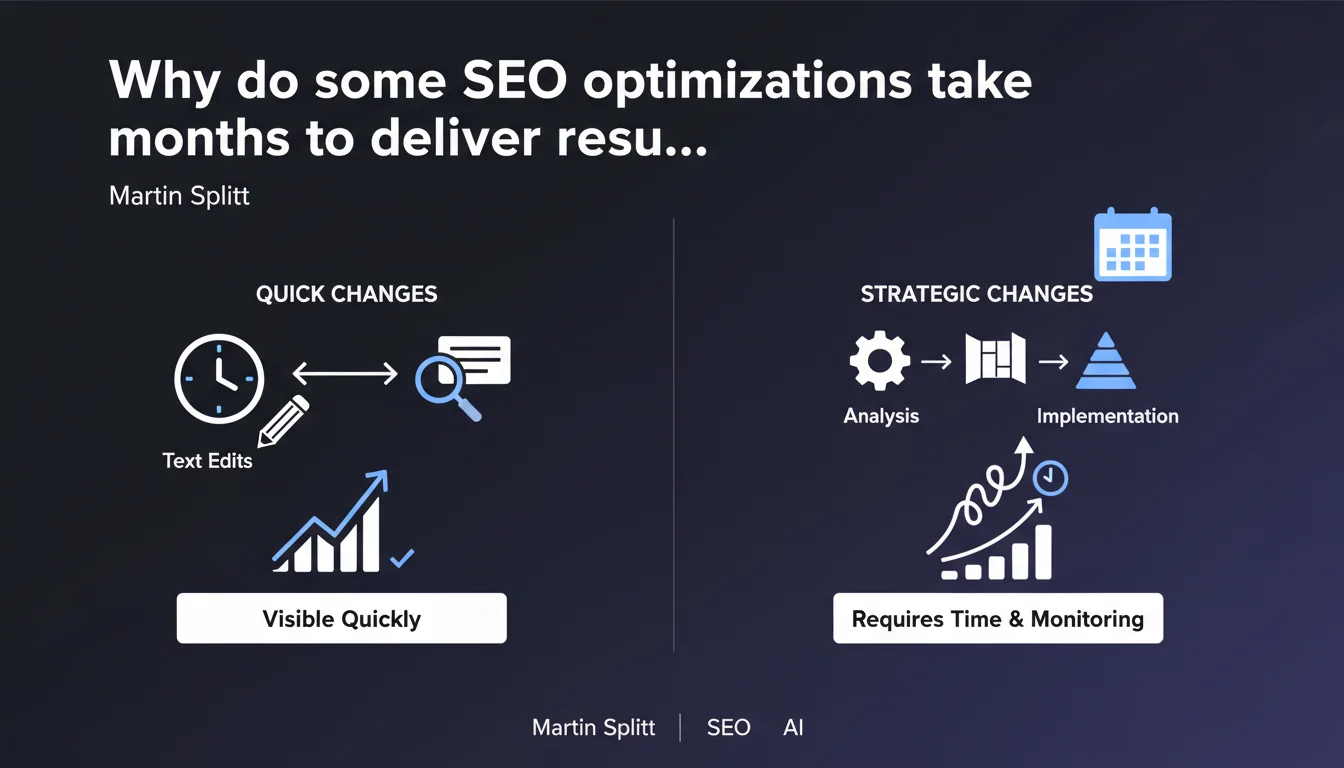
Google confirms that not all SEO changes deliver impact at the same speed. Minor modifications (text, tags) are crawled and evaluated quickly, while major structural changes require multiple crawl cycles and analysis periods. The ability to track and justify these delays to clients becomes a key SEO competency criterion.
What you need to understand
Why does Google make this distinction between simple and strategic changes?
Martin Splitt's statement is nothing new for practitioners, but it formalizes a ground reality: the search engine doesn't process all signals at the same speed. A title or meta description change can be taken into account within days if the page is frequently crawled. An internal linking overhaul, HTTPS migration, or site structure restructuring requires Google to recrawl hundreds of pages, re-evaluate links, and recalculate distributed authority.
What complicates matters? Google provides no specific timeframe. "Some time" is vague. For a site crawled daily, "some time" can mean 2-3 weeks. For a site with low crawl budget, it could be 3-6 months. And if the change affects topicality or E-E-A-T, the engine must also observe user behavior over time.
What does "monitor and regularly explain progress" mean concretely?
Splitt raises the bar on client communication — and this is where many SEO professionals fail. Tracking rankings isn't enough. You need to monitor crawl activity (Search Console, server logs), indexation (coverage rate, canonicalization), behavioral signals (CTR, time on page), and correlate all of this with applied modifications.
Good SEO reporting on a strategic project shows intermediate milestones: "18% more pages crawled this week", "increase in internal linking detected by GSC", "first uptick in long-tail query rankings in the new section". If you only have flat ranking curves for 2 months, the client loses confidence — even if it's normal.
- Light content changes (text, tags) are quickly crawled and evaluated, especially on pages already well-monitored by Google.
- Structural changes (linking, site architecture, technical migration) require multiple crawl cycles and site-wide re-evaluation.
- Monitoring goes beyond rankings: server logs, indexation rate, CTR, and user signals are essential to justify timeframes.
- Google provides no precise timeframe — "some time" varies greatly depending on crawl budget and change nature.
SEO Expert opinion
Is this statement consistent with what we observe in practice?
Yes, absolutely. Practitioners have known for a long time that changing a meta description takes 48 hours, overhauling a thematic silo takes 4 months. What's interesting is that Splitt verbalizes this officially — it carries weight when dealing with clients who get impatient after 3 weeks with no movement.
That said, the statement remains deliberately vague on thresholds. "Some time" for Google means how much? 2 weeks? 6 months? It depends on what exactly — crawl budget, domain authority, update frequency? Splitt doesn't say. [To verify]: Google has never published a clear framework for average timeframes by modification type.
In what cases doesn't this rule apply?
The "simple vs strategic" distinction has its limits. A massive title change across 10,000 pages might seem "simple" technically, but if it radically shifts perceived topicality, Google will take time to re-evaluate. Conversely, a well-executed HTTPS migration with proper redirects can show results in 2-3 weeks if the site is already healthy.
Another edge case: sites with very low crawl budget. Even a "simple" change can stagnate if Google only returns once a month. And if you touch orphaned pages or very deep sections of the architecture, it doesn't matter what type of change — it will take time because the bot simply doesn't see them.
What does this statement tell us about Google's communication strategy?
Splitt emphasizes the SEO's responsibility to explain delays, not Google's responsibility to reduce them or clarify them. It's a form of liability shift: "if your client is impatient, it's because you communicate poorly, not because our engine is slow or opaque".
Let's be honest — that's partly true, but it also avoids acknowledging that Google provides no reliable tool to estimate these timeframes. No crawl budget scoring, no indexation forecast, no indicative timeline. The SEO must improvise with Search Console, logs, and experience. It would be simpler if Google were transparent.
Practical impact and recommendations
How to anticipate delays based on modification type?
Build a matrix of typical timeframes based on your project history. For example: title/meta change = 1-2 weeks, internal linking overhaul = 1-3 months, domain migration = 3-6 months. Adjust based on the site's crawl budget (check crawl frequency in Search Console, server logs).
For major projects, break deployments into phases. Don't flip 5000 pages at once — deploy in batches of 500, observe Google's reaction, adjust. This also lets you show intermediate results to the client and quickly correct course if something goes wrong.
What KPIs should you track to justify delays to clients?
Rankings alone aren't enough — they're the final output, not intermediate signals. Set up a multi-layer dashboard: crawl (pages crawled per day, crawl budget evolution), indexation (coverage rate, 4xx/5xx errors, canonicalization), engagement (organic CTR, time on page, bounce rate by segment).
Present this data in narrative format. "This week, Google crawled 18% more pages, showing the new internal linking is starting to be detected. We should see ranking impact in 3-4 weeks." That's more reassuring than a flat ranking chart with "be patient, it's coming".
- Establish a typical timeframe matrix based on your project history and the site's crawl budget
- Deploy major modifications in batches rather than all at once to track progressive impact
- Continuously track crawl activity (server logs, Search Console) and indexation (coverage rate, canonicalization)
- Monitor behavioral signals (CTR, time on page) to anticipate ranking movements
- Build narrative reporting that connects changes detected by Google to implemented actions
- Define clear intermediate milestones with the client to prevent frustration over timeframes
❓ Frequently Asked Questions
Combien de temps faut-il attendre avant de juger qu'un changement SEO ne fonctionne pas ?
Comment savoir si Google a bien pris en compte mes modifications ?
Est-ce que forcer un recrawl via Search Console accélère l'impact d'un changement stratégique ?
Pourquoi mes positions stagnent alors que Search Console montre une hausse du crawl ?
Faut-il privilégier les petits changements rapides ou les gros chantiers stratégiques ?
🎥 From the same video 16
Other SEO insights extracted from this same Google Search Central video · published on 10/07/2025
🎥 Watch the full video on YouTube →
💬 Comments (0)
Be the first to comment.