
Official statement
Other statements from this video 16 ▾
- □ Is Google's SEO Starter Guide really the best foundation to learn search engine optimization from scratch?
- □ Should you really define goals and conversions before optimizing your SEO?
- □ Should you really tailor your SEO strategy to your audience before optimizing technically?
- □ Are popular CMS platforms like WordPress really enough for serious technical SEO?
- □ Is searching your domain name on Google really enough to verify your site's technical health?
- □ Should you really be asking your customers to shape your SEO strategy?
- □ Should small businesses really give up on generic search queries?
- □ Can small websites really test freely without major SEO risks?
- □ Why does Martin Splitt place such strong emphasis on installing Search Console and measurement tools?
- □ How long does it really take for a content change to show up in Google search results?
- □ Is it really safe to search for your own website on Google without getting penalized?
- □ Why can't you rely on staging environments to validate your SEO improvements?
- □ Should you only hire an SEO expert once you can actually measure the ROI?
- □ Are Google's Search Essentials really the ultimate SEO rulebook you need to follow?
- □ Why do some SEO optimizations take months to deliver results?
- □ Is your website still essential in the age of generative AI?
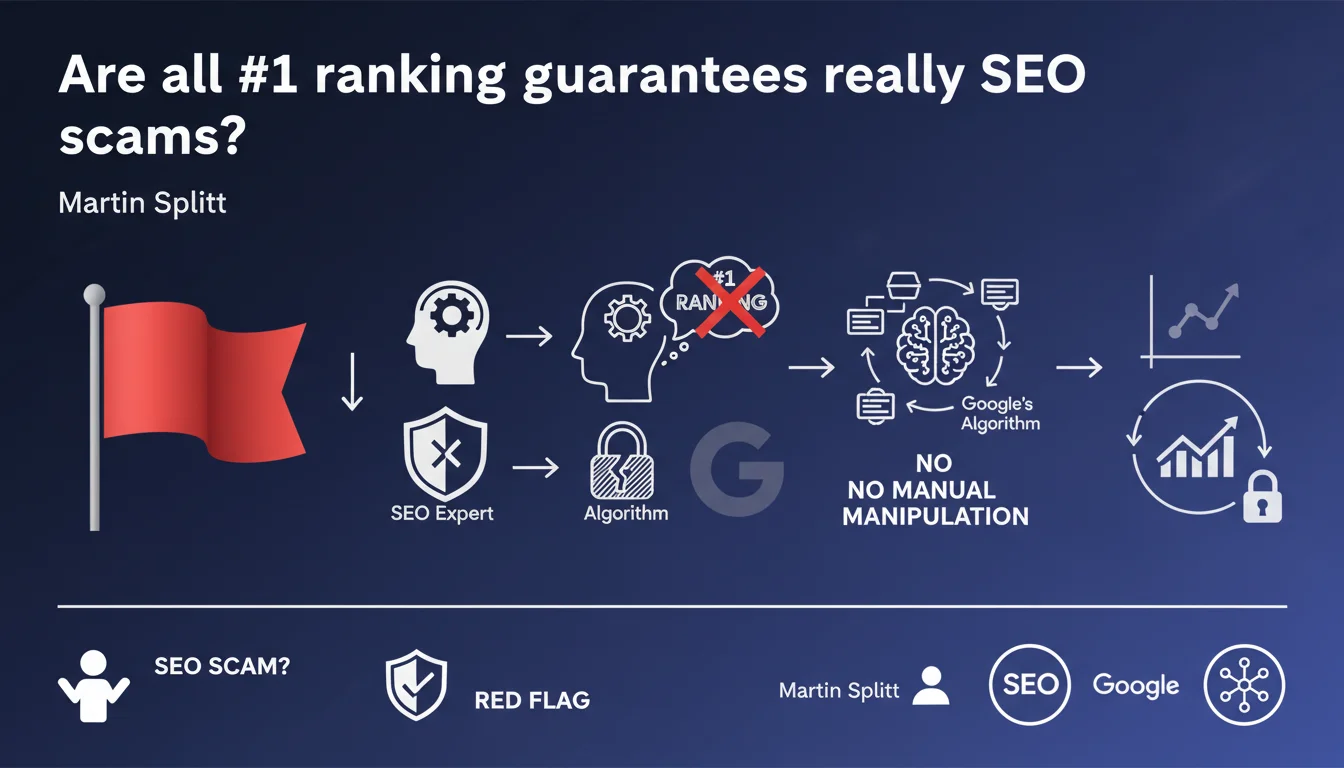
Google, through Martin Splitt's voice, consistently emphasizes that no SEO provider can guarantee a specific ranking or manually manipulate positions. Any promise of first page or top 3 placement is a major red flag. However, this statement deserves some practical nuances that Google deliberately omits.
What you need to understand
Why does Google insist so much on the impossibility of guaranteeing a ranking?
The official answer is clear: Google's algorithm integrates over 200 ranking factors, continuously evolves through daily updates, and no one — not even internal engineers — can predict with certainty the final position of a page for a given query.
This stance protects Google against accusations of manual manipulation and discourages abusive practices. But it also serves to absolve the search engine: if no one can guarantee a result, Google cannot be held responsible for sudden fluctuations or unjustified penalties.
What does "manually manipulating rankings" actually mean?
Google is referring here to old black hat practices: massive link buying, keyword stuffing, private blog networks, cloaking. These techniques have indeed lost effectiveness with successive updates (Penguin, Panda, Core Updates).
But be careful — the absence of direct manual manipulation doesn't mean SEO is a gamble. Optimization levers exist, are documented, and produce measurable results. Simply put, their exact impact remains probabilistic, not deterministic.
What are the real red flags of a dubious SEO provider?
- Promise of exact position ("top 3 guaranteed on 'car insurance'") without prior audit or competitive analysis
- Unrealistic timelines ("first page in 15 days") on competitive queries
- Derisory rates for complex services — quality SEO requires time and expertise
- Refusal to be transparent about techniques used or activity reports
- Contractual guarantees of results without realistic performance clauses or detailed methodology
SEO Expert opinion
Is this statement completely honest or are there cases where results are predictable?
Let's be frank: Google deliberately oversimplifies. On low-competition long-tail queries, with a technically sound site and quality content, an experienced SEO professional can actually predict favorable rankings with reduced error margins.
Promises become toxic on ultra-competitive queries where dozens of sites already benefit from established authority, massive link profiles, and advanced optimization. In this context, guaranteeing first place is either incompetence or dishonesty.
The real red flag isn't projecting improvement — it's the complete absence of conditionality. A serious expert says: "We're targeting top 5 on this query within 6 months, provided algorithmic stability and full implementation of recommendations." Not: "I guarantee you position 1."
What practical nuances are missing from this official statement?
Google fails to clarify that certain SEO levers produce near-systematic effects: fixing critical technical errors, optimizing loading speed, resolving duplicate content, improving information architecture. These actions don't guarantee a position, but nearly always improve overall performance.
Another blind spot: branded queries. If you're working on SEO for a company's own name, you can legitimately target first position — that's not manipulation, it's consistency. [To verify] Google never distinguishes this category in its public statements, which creates unnecessary confusion.
In what contexts does this rule not really apply?
Ultra-specialized niches with virtually no competition — a local tradesperson on a very precise geolocated query can reasonably target first place if their Google Business profile is optimized and their site is technically flawless.
Local SEO strategies on Google Maps follow more predictable rules than classical organic SEO. An experienced provider can make relatively reliable projections there, though the term "guarantee" remains abusive.
Practical impact and recommendations
How do you evaluate an SEO provider without falling for false promises?
Demand a complete technical audit before any result promise. A serious professional starts by analyzing the current state: indexation, crawlability, speed, architecture, link profile, any penalty history.
Request a documented strategy with realistic objectives, justified timelines, and measurable KPIs (organic traffic, average positioning on a keyword basket, conversion rate). Avoid vague discourse or promises without methodology.
Favor providers who speak in terms of probabilities and ranges: "We're targeting top 10 on these 20 strategic queries within 4 to 6 months, with progressive improvement of organic traffic by 30 to 50%." That's far more credible than "top 3 guaranteed in 3 months."
What mistakes should you avoid when selecting an SEO agency or consultant?
- Never sign a contract with result guarantees without exit clauses or transparent methodology
- Beware of rates that are too low — effective SEO requires specialized skills and time
- Refuse any provider who doesn't regularly communicate on actions taken and their impacts
- Avoid agencies that promise identical results to all clients, without customization
- Require verifiable references and documented case studies, not anonymous testimonials
What should you concretely do to maximize your ranking chances without falling into illusory promises?
Focus on SEO fundamentals: technical optimization (Core Web Vitals, mobile-first, crawl budget), producing high-value content aligned with search intent, gradually building a natural and diversified link profile.
Set up regular monitoring via Search Console and position tracking tools (SEMrush, Ahrefs, Ranxplorer). Measure evolution of organic traffic, impressions, CTR, and average positioning — not just the position of a handful of keywords.
Adopt a long-term vision. Sites dominating competitive SERPs got there after 18 to 36 months of continuous work, not in a few weeks. Any promise of quick results on a saturated query should raise your suspicion.
❓ Frequently Asked Questions
Un consultant SEO peut-il quand même estimer une progression probable de classement ?
Existe-t-il des cas où une première position est quasi certaine ?
Comment distinguer une projection réaliste d'une promesse mensongère ?
Que faire si un prestataire actuel ne produit aucun résultat et invoque cette déclaration de Google pour se justifier ?
Les outils de prédiction de classement sont-ils fiables ?
🎥 From the same video 16
Other SEO insights extracted from this same Google Search Central video · published on 10/07/2025
🎥 Watch the full video on YouTube →
💬 Comments (0)
Be the first to comment.