
Official statement
Other statements from this video 16 ▾
- □ Faut-il vraiment définir objectifs et conversions avant d'optimiser son SEO ?
- □ Faut-il vraiment adapter sa stratégie SEO à l'audience avant d'optimiser techniquement ?
- □ Les CMS courants comme WordPress suffisent-ils vraiment pour le SEO technique ?
- □ Faut-il vraiment tester l'indexation d'un site en cherchant son nom de domaine sur Google ?
- □ Faut-il vraiment interroger vos clients pour bâtir votre stratégie SEO ?
- □ Faut-il vraiment renoncer aux requêtes génériques quand on est une petite entreprise ?
- □ Les petits sites peuvent-ils vraiment tester librement sans risque SEO ?
- □ Pourquoi Martin Splitt insiste-t-il autant sur l'installation de Search Console et d'outils de mesure ?
- □ Combien de temps faut-il vraiment pour qu'une modification de contenu soit visible dans Google ?
- □ Peut-on vraiment rechercher son propre site sur Google sans risque ?
- □ Pourquoi les environnements de staging sont-ils inefficaces pour tester vos optimisations SEO ?
- □ Faut-il embaucher un expert SEO uniquement quand on peut mesurer son ROI ?
- □ Les promesses de classement #1 sont-elles toutes des arnaques SEO ?
- □ Les Search Essentials de Google sont-elles vraiment le mode d'emploi du SEO ?
- □ Pourquoi certaines optimisations SEO prennent-elles des mois à produire des résultats ?
- □ Votre site web est-il toujours indispensable à l'ère de l'IA générative ?
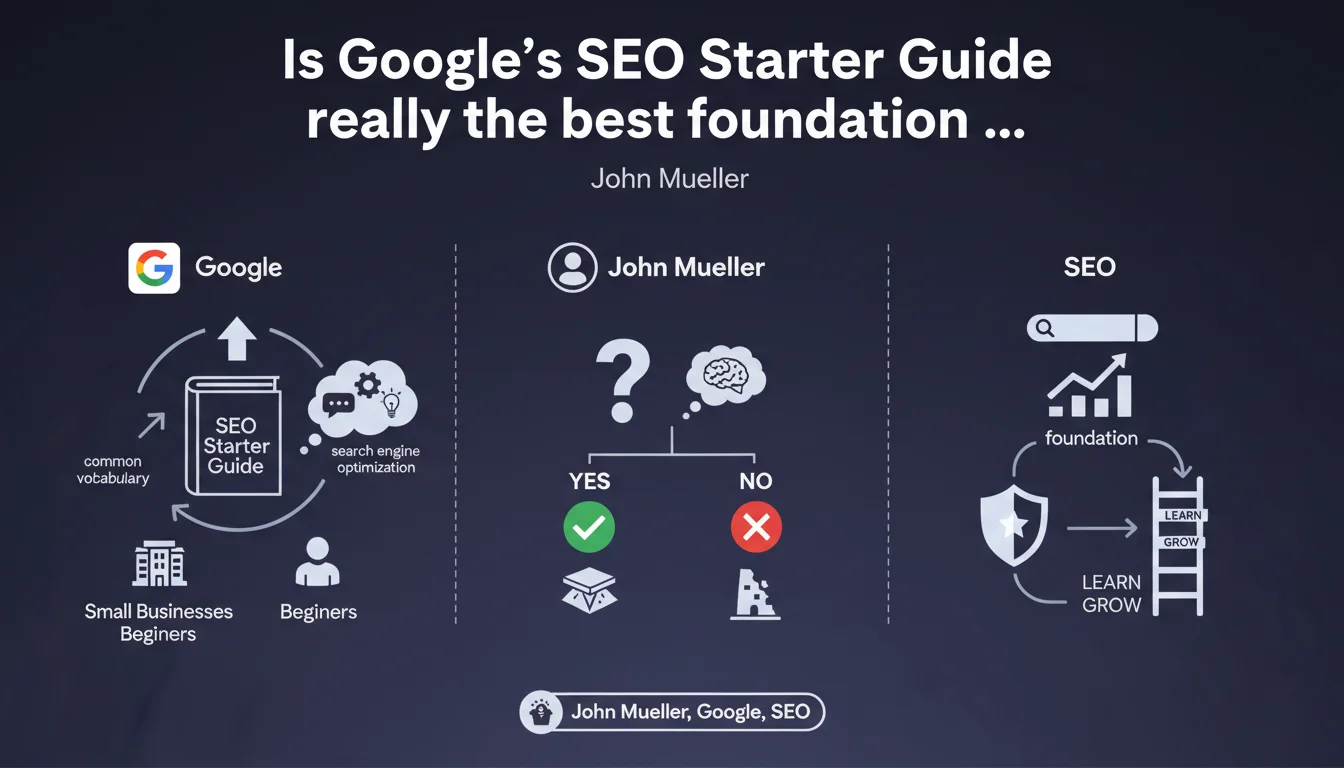
Google officially recommends its SEO Starter Guide as a training foundation to establish common vocabulary, especially for small businesses and beginners. This position confirms that Google favors a standardized approach to SEO learning rather than a multiplicity of external sources.
What you need to understand
Why does Google insist on its own guide rather than other resources?
Mueller's recommendation is not trivial. By directing readers toward the SEO Starter Guide, Google seeks to control the narrative around best practices. Too much SEO content perpetuates myths or outdated techniques — sometimes even contradicting official guidelines.
The guide establishes a common vocabulary that Google uses in its technical documentation. When Mueller discusses "crawl," "indexation," or "quality content," he references the definitions from the Starter Guide. This shared foundation simplifies communication between webmasters and Google teams.
Is this recommendation really intended for professional SEO specialists?
No, and that's the key nuance. Mueller explicitly targets small businesses and beginners. For a seasoned practitioner, the Starter Guide remains superficial. It covers fundamentals — title tags, meta descriptions, URL structure — but doesn't address advanced crawl budget issues, content cannibalization, or JavaScript optimization.
A professional will find greater value in technical documentation (Search Central), Search Console reports, or public interventions by Google teams at conferences. The Starter Guide mainly serves to align the uninitiated.
What are the risks of training based solely on this guide?
Relying exclusively on the Starter Guide creates a reductive view of SEO. Google presents an idealized version of search optimization: "create good content, optimize your tags, everything will work out." Real-world scenarios are far more complex — technical issues, CMS constraints, aggressive competition, limited budgets.
The guide overlooks certain critical topics: managing e-commerce facets, optimizing complex multilingual sites, migration strategies without traffic loss. These gray areas require expertise that extends well beyond the scope of the official document.
- The Starter Guide establishes the foundation of common SEO vocabulary
- Primary audience: small businesses and beginners, not experienced practitioners
- Major limitation: absence of advanced use cases and complex technical challenges
- Essential complement: Search Central documentation and field experience feedback
SEO Expert opinion
Does this statement truly reflect the complexity of the SEO profession?
Let's be honest: no. Mueller adopts a cautious and institutional stance. Recommending the Starter Guide as a "starting point" is politically safe for Google — it avoids endorsing third-party content that might contradict their official positions.
In practice, a competent SEO professional relies on multiple sources: community experience, case studies, field experimentation, technical monitoring. The Starter Guide provides a theoretical foundation, but it's the confrontation with real-world challenges that builds expertise. [To verify]: Google never quantifies the actual impact of strictly applying the guide on rankings.
In what cases is this recommendation insufficient?
As soon as a site goes beyond the stage of a basic informational website, the Starter Guide shows its limitations. On an e-commerce site with 50,000 products, crawl budget and pagination issues become critical — topics barely covered in the guide.
The same applies to high-volume media sites, SaaS platforms with user-generated content, or international sites with complex geographic targeting. These scenarios demand technical trade-offs that the guide doesn't address. And that's where it gets tricky: Google maintains deliberately generalist documentation to avoid tying its own hands.
Should you ignore other SEO resources in favor of the official guide?
Absolutely not. The SEO community has produced empirical analyses that Google will never officially publish — correlation testing, studies on Core Update impacts, algorithm decryption through reverse engineering. This research fills the gaps left by official communication.
The danger would be falling into Google-centric dogmatism. Official recommendations reflect what Google wants to encourage, not necessarily what works best. Some greyhat techniques continue to perform despite official messaging. An expert must cross-reference sources, test, and validate independently.
Practical impact and recommendations
What should you concretely do with this recommendation?
For beginners and small organizations, starting with the Starter Guide remains relevant. It establishes the basics without overwhelming: essential HTML tags, logical site structure, useful content principles. It's an excellent filter for eliminating gross errors.
For professionals, use it as a communication reference. When advising a client or training an internal team, the Starter Guide provides vocabulary validated by Google. This facilitates discussions and legitimizes your technical recommendations.
What mistakes should you avoid in applying this advice?
Don't treat the guide as an exhaustive checklist. Checking every item in the Starter Guide doesn't guarantee good rankings — it's a prerequisite, not a strategy. Well-ranking sites go far beyond basic recommendations.
Also avoid neglecting uncovered aspects: server performance, JavaScript architecture, advanced internal linking strategy, semantic optimization. These dimensions require skills that the guide doesn't develop. Training exclusively via the official document creates dangerous blind spots.
How do you verify that your SEO approach goes beyond the Starter Guide level?
Ask yourself these questions: do you effectively manage crawl budget on sites with more than 10,000 pages? Do you have a content strategy based on semantic analysis and search intent? Do you master the subtleties of JavaScript SEO and server-side rendering?
If the answer is no, you're probably still at the Starter Guide level. Nothing catastrophic — but it means there's significant room for improvement. The gap between "applying the guide" and "excelling at SEO" is enormous.
- Read the SEO Starter Guide in its entirety to master official vocabulary
- Identify sections applicable to your site type (e-commerce, blog, SaaS)
- Supplement with Search Central documentation for advanced technical topics
- Test and validate recommendations via Google Search Console
- Cross-reference with community case studies to confront theory and practice
- Train your internal teams using the guide as a common pedagogical foundation
- Regularly reassess your knowledge against algorithmic developments
❓ Frequently Asked Questions
Le SEO Starter Guide de Google est-il suffisant pour optimiser un site e-commerce ?
À quelle fréquence Google met-il à jour son SEO Starter Guide ?
Un professionnel SEO expérimenté doit-il relire le Starter Guide ?
Le Starter Guide aborde-t-il le SEO pour JavaScript et le rendu côté serveur ?
Peut-on se fier uniquement aux recommandations officielles de Google pour son SEO ?
🎥 From the same video 16
Other SEO insights extracted from this same Google Search Central video · published on 10/07/2025
🎥 Watch the full video on YouTube →
💬 Comments (0)
Be the first to comment.