
Official statement
Other statements from this video 16 ▾
- □ Le SEO Starter Guide de Google est-il vraiment le meilleur point de départ pour apprendre le référencement ?
- □ Faut-il vraiment définir objectifs et conversions avant d'optimiser son SEO ?
- □ Faut-il vraiment adapter sa stratégie SEO à l'audience avant d'optimiser techniquement ?
- □ Les CMS courants comme WordPress suffisent-ils vraiment pour le SEO technique ?
- □ Faut-il vraiment tester l'indexation d'un site en cherchant son nom de domaine sur Google ?
- □ Faut-il vraiment interroger vos clients pour bâtir votre stratégie SEO ?
- □ Faut-il vraiment renoncer aux requêtes génériques quand on est une petite entreprise ?
- □ Les petits sites peuvent-ils vraiment tester librement sans risque SEO ?
- □ Pourquoi Martin Splitt insiste-t-il autant sur l'installation de Search Console et d'outils de mesure ?
- □ Combien de temps faut-il vraiment pour qu'une modification de contenu soit visible dans Google ?
- □ Peut-on vraiment rechercher son propre site sur Google sans risque ?
- □ Pourquoi les environnements de staging sont-ils inefficaces pour tester vos optimisations SEO ?
- □ Faut-il embaucher un expert SEO uniquement quand on peut mesurer son ROI ?
- □ Les promesses de classement #1 sont-elles toutes des arnaques SEO ?
- □ Pourquoi certaines optimisations SEO prennent-elles des mois à produire des résultats ?
- □ Votre site web est-il toujours indispensable à l'ère de l'IA générative ?
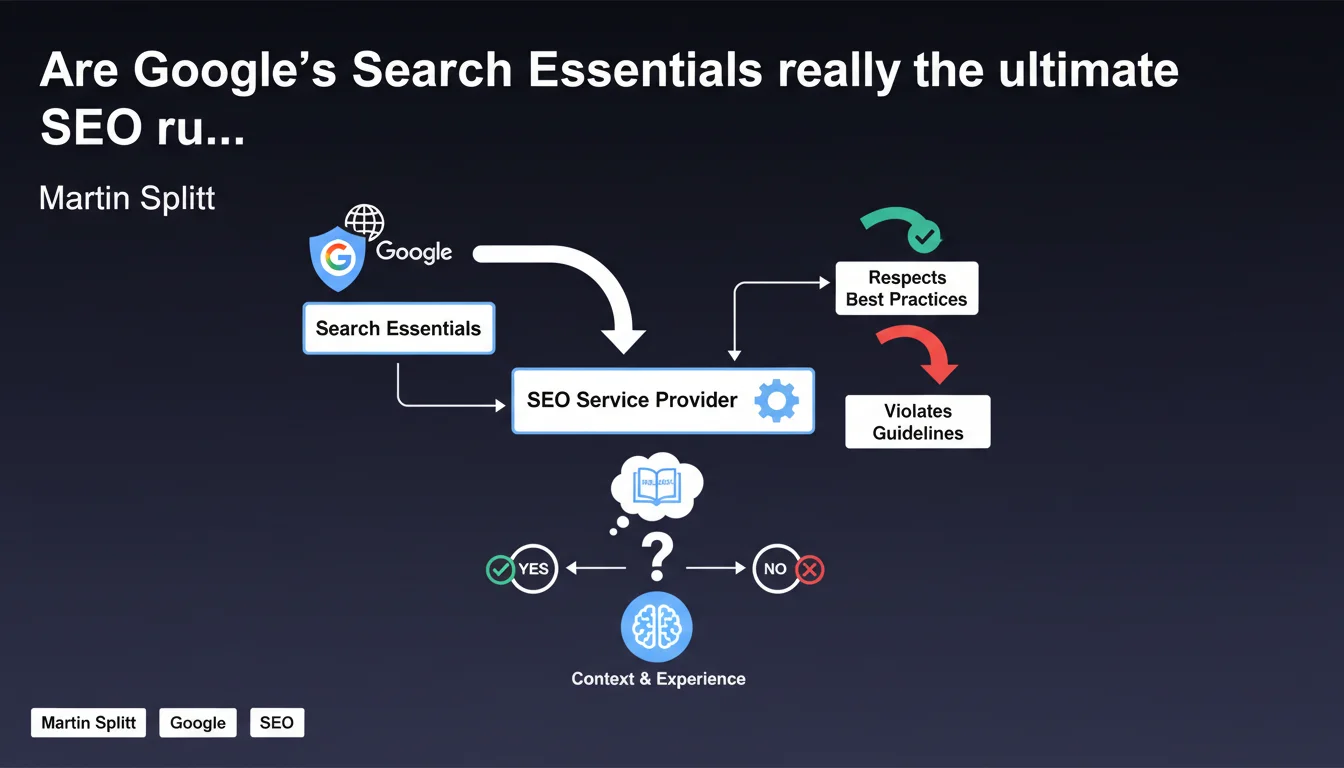
Google rebrands its former webmaster guidelines into "Search Essentials" and makes it the official reference for SEO best practices. The idea: these rules define what should and shouldn't be done, and help evaluate whether a service provider respects the standards. In concrete terms, it has become essential to avoid penalties — but also a document sometimes too vague to address edge cases.
What you need to understand
Why did Google rebrand its webmaster guidelines?
The name change from "Webmaster Guidelines" to "Search Essentials" is more than just a cosmetic operation. Google wants to move away from outdated vocabulary (webmaster, seriously?) and clarify that these rules are no longer just for historical developers, but for all web actors: publishers, SEO professionals, agencies, marketers.
It's also a way to centralize a sometimes scattered discourse. Rather than repeating "read our guidelines" in every blog post or YouTube video, Google now establishes a single reference foundation. If you don't know the Search Essentials, you're starting with a handicap.
What do these Search Essentials actually contain?
They're divided into three main categories: technical requirements (Googlebot must be able to access and index the content), quality requirements (no spam, content useful for humans) and requirements related to manual actions (everything involving deliberate spam).
The document clearly distinguishes what is mandatory (minimum conditions for indexing) from what is recommended (best practices for performance). This distinction is crucial — and often misunderstood. Meeting requirements doesn't guarantee good rankings, but failing to meet them can exclude you from results.
How to use these guidelines to evaluate an SEO service provider?
Google suggests that knowing Search Essentials helps ensure a service provider plays by the rules. That's true — but incomplete. A service provider can scrupulously respect these rules and still deliver mediocre work. Conversely, some points are so vague that they leave room for interpretation.
The key is to verify that the service provider never considers circumventing these rules (link farms, cloaking, automated content without added value, etc.). If someone proposes a strategy that flirts with the prohibited, run away.
- Technical requirements: Googlebot must be able to crawl and index the content without obstruction.
- Quality requirements: Content must serve users, not just manipulate rankings.
- Anti-spam requirements: No deliberate techniques to deceive the algorithm.
- Key distinction: Respecting the rules ≠ performing in search results.
- Service provider evaluation: Search Essentials are a minimum filter, not a complete specification.
SEO Expert opinion
Is this statement really useful for experienced SEO practitioners?
Let's be honest: if you've been working in SEO for more than three years, you already know 90% of what Search Essentials contain. Classic prohibitions (cloaking, bought links, auto-generated content without value) are in the DNA of the profession. This document mainly serves as an official reference when a client or manager asks "but is that allowed?".
The real value is that it lets you say: "Here's what Google officially says." It avoids endless debates with decision-makers who read a dubious LinkedIn article. But in terms of innovation or strategic revelation? Zero.
Where does the document become too vague to be actionable?
Google deliberately remains evasive on gray areas. Take automated content: the document prohibits content generated without added value, but what exactly is "without added value"? Is an auto-generated price comparison tool okay or not? A product sheet written by AI then reviewed by a human, does that pass?
Same thing with links: Google says "no links to manipulate PageRank," but where does manipulation begin? A sponsored link correctly marked nofollow but highly contextual in a quality article — is it still manipulation if the commercial intent is obvious?
[To verify] The document carefully avoids concrete examples. Result: we have to guess, test, observe what passes or fails. It's not a user manual — it's a safeguard.
Do service providers really respect these rules?
In most cases, yes — out of pragmatism rather than ethics. Manual penalties are rare but devastating. Few professionals take the risk of breaking clear prohibitions (keyword stuffing, hidden text, deceptive redirects).
But there's always a fringe that tests the limits. PBNs (private blog networks), buying backlinks disguised as "partnerships," light content spinning… It all still exists. And sometimes it works — until it doesn't. The problem is that a service provider breaking these rules can generate spectacular short-term results, and that's tempting for some clients.
Practical impact and recommendations
What should you actually do after reading Search Essentials?
First step: audit your site against technical requirements. Can Googlebot access all your strategic pages? Are your robots.txt files or meta robots tags blocking critical resources (CSS, JS)? Is your site crawlable efficiently?
Next, verify the intrinsic quality of your content. Not in Google's vague sense, but concretely: do your pages answer a clear user intent? Do they provide information you won't find elsewhere, or is it pure SEO recycling?
Finally, inspect your link profile. If you've historically bought backlinks or participated in massive exchanges, now is the time to clean up. Use the Disavow Tool if necessary — but sparingly. Google says it already ignores most bad links, so blanket disavowing can do more harm than good.
What mistakes should you absolutely avoid?
Don't confuse respecting rules with SEO performance. Respecting Search Essentials prevents penalties, but doesn't guarantee good rankings. A technically perfect site with mediocre content will never break through.
Another common mistake: believing that "if Google doesn't explicitly forbid it, it's allowed." Google can't list all spam variants — it sets principles. If your strategy is to find loopholes in the wording of rules, you're playing a risky game.
Finally, don't neglect manual actions. They're rare, sure, but they can destroy a business. Regularly check Search Console to verify that no manual action has been triggered.
How do I verify that my site complies with Search Essentials?
Use Google Search Console as your main dashboard. Check the "Coverage" tab to identify non-indexed or blocked pages. Consult the "Page Experience" report for Core Web Vitals signals and mobile-first.
For content and links, analysis is more qualitative. Ask yourself: "If Google disappeared tomorrow, would I create this content this way?" If the answer is no, you're optimizing for the algorithm, not the user — and that's precisely what Google wants to prevent.
- Audit technical accessibility (robots.txt, meta robots, crawlability)
- Verify that content answers a real user intent
- Clean up link profile if necessary (Disavow Tool with caution)
- Regularly consult Search Console (coverage, manual actions, experience)
- Never confuse compliance with SEO performance
- Avoid strategies that seek loopholes in rules
- Ask yourself: "Would I do this if Google didn't exist?"
❓ Frequently Asked Questions
Les Search Essentials remplacent-elles complètement les anciennes Webmaster Guidelines ?
Respecter les Search Essentials garantit-il un bon classement ?
Comment savoir si mon prestataire SEO respecte ces règles ?
Que faire si mon site a déjà été pénalisé pour non-respect de ces règles ?
Le contenu généré par IA est-il conforme aux Search Essentials ?
🎥 From the same video 16
Other SEO insights extracted from this same Google Search Central video · published on 10/07/2025
🎥 Watch the full video on YouTube →
💬 Comments (0)
Be the first to comment.