
Official statement
Other statements from this video 16 ▾
- □ Is Google's SEO Starter Guide really the best foundation to learn search engine optimization from scratch?
- □ Should you really define goals and conversions before optimizing your SEO?
- □ Should you really tailor your SEO strategy to your audience before optimizing technically?
- □ Are popular CMS platforms like WordPress really enough for serious technical SEO?
- □ Is searching your domain name on Google really enough to verify your site's technical health?
- □ Should you really be asking your customers to shape your SEO strategy?
- □ Should small businesses really give up on generic search queries?
- □ Why does Martin Splitt place such strong emphasis on installing Search Console and measurement tools?
- □ How long does it really take for a content change to show up in Google search results?
- □ Is it really safe to search for your own website on Google without getting penalized?
- □ Why can't you rely on staging environments to validate your SEO improvements?
- □ Should you only hire an SEO expert once you can actually measure the ROI?
- □ Are all #1 ranking guarantees really SEO scams?
- □ Are Google's Search Essentials really the ultimate SEO rulebook you need to follow?
- □ Why do some SEO optimizations take months to deliver results?
- □ Is your website still essential in the age of generative AI?
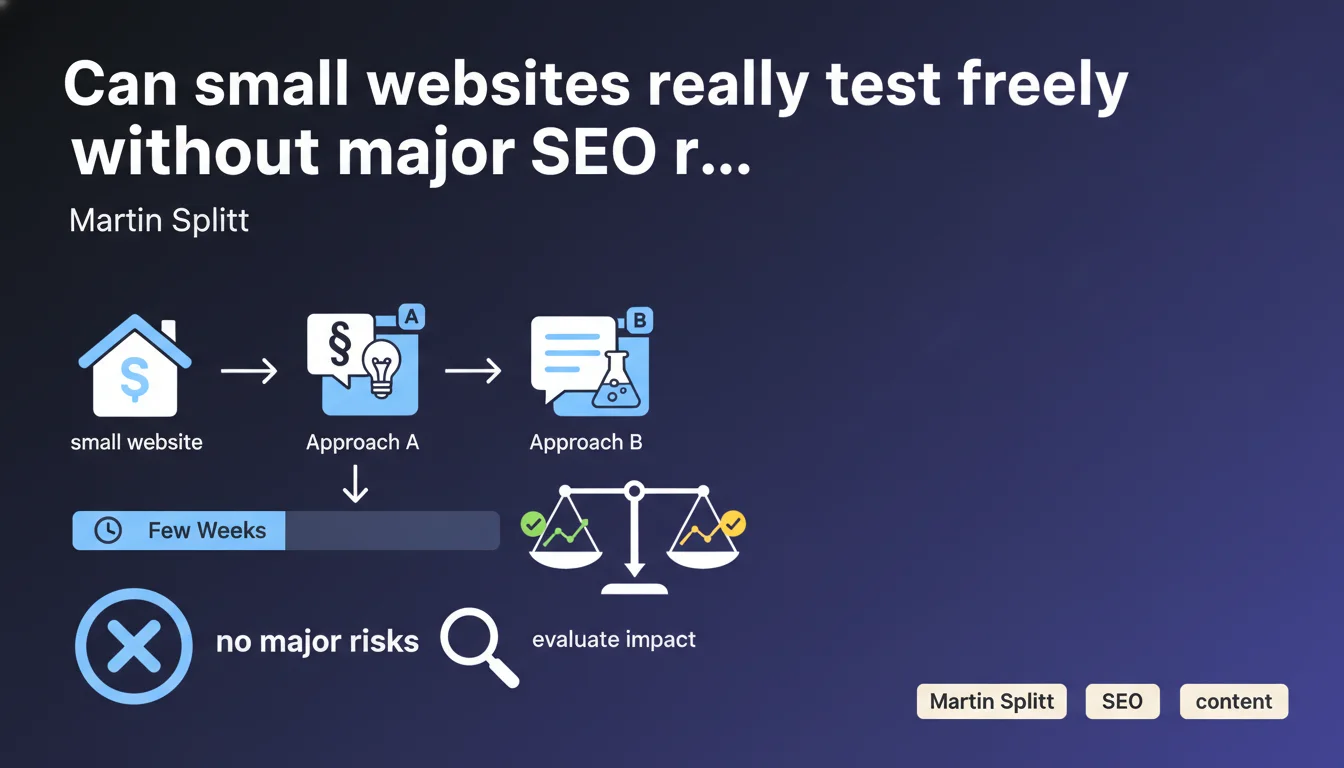
Martin Splitt states that small businesses can experiment with different content approaches without fearing major penalties. Tests can run for a few weeks to measure impact. Google therefore encourages experimentation for small-sized websites.
What you need to understand
Why does Google encourage small websites to experiment?
This statement reflects a stated willingness to democratize SEO and reassure small website owners. Martin Splitt reminds us that Google's algorithms are designed to tolerate content variations, especially when the site doesn't yet have massive authority.
Concretely? Small organizations can test different editorial angles, content formats, or page structures without triggering algorithmic penalties. The idea: encourage learning through practice rather than paralysis through fear.
What is a "small website" according to this statement?
Google doesn't provide a numerical definition — as is often the case. It's reasonable to assume this refers to websites with a limited page volume (a few hundred max), modest traffic, and few backlinks.
For these players, natural ranking fluctuations are already frequent. A failed test won't therefore have the same consequences as on a high-traffic e-commerce site or established media outlet.
How long should a reasonable test last?
Splitt mentions "a few weeks" — intentionally vague phrasing. In practice, you should expect 2 to 4 weeks minimum for Google to recrawl, reindex, and reassess the modifications.
Caution: a test that's too short can give misleading signals, especially if the modified pages have infrequent crawl rates. Organic traffic variations take time to stabilize.
- Small websites have more room for error to test without major risk
- Experiments must last a minimum of a few weeks to be measurable
- No precise definition of what a "small website" is — interpretation left to webmasters
- The objective is to encourage learning through action rather than paralysis
SEO Expert opinion
Is this blank check really without danger?
Let's be honest: the phrasing "without major risk" remains carefully vague. Splitt doesn't say "without any risk," he says "without major risk." Important nuance.
A failed test can still cause a temporary drop in visibility, especially if you touch structural elements (title tags, H1, internal linking). On a small site that already generates little traffic, even a 30% loss can be painful.
What are the unspoken limits of this statement?
Google doesn't specify what constitutes a "testable" change versus a potentially penalizing one. Testing a new editorial tone? OK. Massively duplicating content or keyword stuffing? Risky.
Another blind spot: the statement completely ignores the question of recovery time. If a test fails, how long does it take to return to the initial level? No data. [To verify]
How to interpret the silence on "large" sites?
Splitt explicitly targets "small businesses." By implication, this suggests that high-traffic or high-authority sites have less room for error. One hypothesis: Google monitors changes on already-established domains more actively.
For a site generating millions of sessions, a poorly calibrated test can degrade user experience at scale — and therefore justify a faster algorithmic response. But again, zero numerical data from Google.
Practical impact and recommendations
What tests can be realistically conducted without excessive risk?
For a small website, the safest experiments concern format and editorial angle: testing FAQs, adding videos, restructuring an existing article, changing brand tone.
You can also test internal linking variations: adding contextual links, creating thematic clusters, reinforcing certain pillar pages. The impact can be measured over 3-4 weeks minimum.
What mistakes should you avoid despite this "freedom"?
Don't confuse "low-risk testing" with "anything goes." Avoid simultaneous massive changes: if you change everything at once (title, structure, content, linking), it's impossible to identify what actually works.
Another trap: testing without measurement. A test without GSC/GA4 tracking is useless. Note the deployment date, track impressions, clicks, positions on key queries. Without this, you're flying blind.
- Isolate one variable at a time to measure the real impact of each change
- Document every test with start date, pages involved, observed metrics
- Wait minimum 3 weeks before drawing definitive conclusions
- Verify that tested pages are properly recrawled and reindexed via GSC
- Prepare a rollback plan if results are negative after 4 weeks
- Exclude YMYL pages from this experimental approach
❓ Frequently Asked Questions
Un test SEO raté peut-il déclencher une pénalité manuelle ?
Combien de temps faut-il pour que Google réévalue un contenu modifié ?
Cette liberté de test s'applique-t-elle aux sites e-commerce de petite taille ?
Faut-il prévenir Google avant de lancer un test SEO ?
Un petit site qui teste beaucoup risque-t-il d'être considéré comme instable ?
🎥 From the same video 16
Other SEO insights extracted from this same Google Search Central video · published on 10/07/2025
🎥 Watch the full video on YouTube →
💬 Comments (0)
Be the first to comment.