
Official statement
Other statements from this video 16 ▾
- □ Le SEO Starter Guide de Google est-il vraiment le meilleur point de départ pour apprendre le référencement ?
- □ Faut-il vraiment définir objectifs et conversions avant d'optimiser son SEO ?
- □ Les CMS courants comme WordPress suffisent-ils vraiment pour le SEO technique ?
- □ Faut-il vraiment tester l'indexation d'un site en cherchant son nom de domaine sur Google ?
- □ Faut-il vraiment interroger vos clients pour bâtir votre stratégie SEO ?
- □ Faut-il vraiment renoncer aux requêtes génériques quand on est une petite entreprise ?
- □ Les petits sites peuvent-ils vraiment tester librement sans risque SEO ?
- □ Pourquoi Martin Splitt insiste-t-il autant sur l'installation de Search Console et d'outils de mesure ?
- □ Combien de temps faut-il vraiment pour qu'une modification de contenu soit visible dans Google ?
- □ Peut-on vraiment rechercher son propre site sur Google sans risque ?
- □ Pourquoi les environnements de staging sont-ils inefficaces pour tester vos optimisations SEO ?
- □ Faut-il embaucher un expert SEO uniquement quand on peut mesurer son ROI ?
- □ Les promesses de classement #1 sont-elles toutes des arnaques SEO ?
- □ Les Search Essentials de Google sont-elles vraiment le mode d'emploi du SEO ?
- □ Pourquoi certaines optimisations SEO prennent-elles des mois à produire des résultats ?
- □ Votre site web est-il toujours indispensable à l'ère de l'IA générative ?
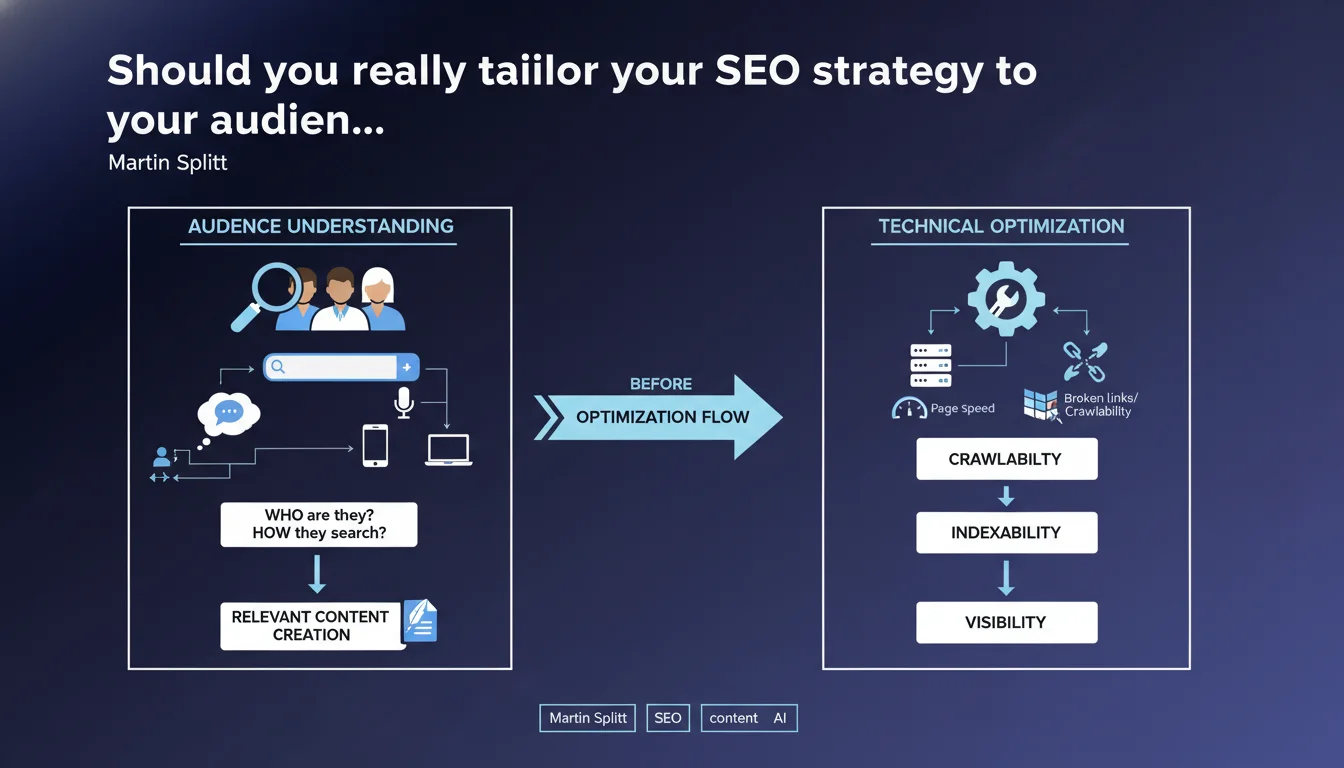
Martin Splitt reminds us that understanding your audience and their search behaviors is a prerequisite before any optimization work. In practice: creating relevant content first requires knowing who is searching for what, how, and at what stage of their customer journey. Without this foundation, technical optimization becomes pointless.
What you need to understand
Why does Google insist so much on understanding your audience?
This statement is nothing revolutionary — it reformulates a principle as old as SEO itself. But it comes back regularly in official statements for one simple reason: too many websites optimize for phantom queries that don't correspond to any real intent.
Google wants you to start from the user, not from keyword tools. The algorithm seeks to match an intent with an answer. If your content doesn't answer a real question asked by real people, it will be useless — even if it's technically perfect.
What does this concretely change in content creation?
Starting from your audience means first identifying the stages of the customer journey: informational search, comparison, purchase decision. Each stage generates different queries, with different expectations.
Content that is "relevant" according to Google isn't the content that targets the right keyword, but the content that answers at the right time with the right format. A blog article won't convert a user in the purchase phase — and conversely, a product page won't rank on a broad informational query.
What's the connection between this approach and visibility in the SERPs?
Google doesn't say "create good content and you'll rank." It says "be visible at the right moment." Important distinction: even excellent content can be invisible if it doesn't match the search context.
This ties into behavioral signals: if a user clicks, goes back, and clicks elsewhere, it means your content didn't match their intent. Understanding your audience means reducing this pogo-sticking rate by better anticipating what the user is really looking for.
- Your audience defines intent — and intent determines the type of content to produce
- The same keyword can cover multiple intents depending on the user's profile
- Relevance is measured by the content's ability to answer the expressed need without friction
- Being visible "at the right moment" involves mapping content to stages of the customer journey
SEO Expert opinion
Is this statement consistent with what we observe in the field?
Yes, but it remains vague on one crucial point: how does Google evaluate relevance in relation to the target audience? We know it analyzes behavioral signals, but we don't know precisely what weight it gives to each metric.
In practice, the sites that rank best aren't always those that understand their audience best — they're often those that optimize the most measurable signals (CTR, dwell time, backlinks). The question remains: does Google really detect the quality of the audience-content match, or does it just rely on proxies?
What nuances should we add to this advice?
Understanding your audience is good. But in SEO, you also have to contend with the reality of competition and existing SERPs. Sometimes your audience is looking for one thing, but Google systematically displays something else — because the dominant sites have shaped the intent.
Classic example: a commercial query flooded with affiliate comparison sites. You could have the best understanding of customer needs, but if you don't have the SEO power to break through that wall, you'll remain invisible. [To verify] to what extent audience relevance compensates for a domain authority deficit.
In what cases is this approach insufficient?
When your target audience uses terms that Google doesn't yet understand — or misinterprets. Technical niches, industry jargon, new concepts: Google needs search volume to refine its interpretations.
In these cases, starting solely from audience understanding can lead you into a dead end: you create ultra-relevant content for 50 people a month, but Google doesn't have enough behavioral data to validate that you're the right answer. You'll then need to take a detour through more voluminous related queries.
Practical impact and recommendations
What concretely needs to be done to apply this advice?
First step: map out personas and their search journeys. No need to deploy heavy-duty qualitative research — often, analyzing your Search Console + Analytics data is enough to identify major query typologies and their contexts.
Second step: cross-reference this data with actual SERPs. For each query cluster, verify what type of content Google already displays. If you're targeting a technical B2B audience but Google only shows consumer content, you'll need to adjust your approach — or accept not ranking on these terms.
What mistakes should you absolutely avoid?
Don't assume that your internal audience (the one you know) matches your SEO audience (the one searching on Google). The two can be radically different. You might sell to CFOs, but marketing managers are the ones searching on Google.
Another common mistake: creating hyper-personalized content for a micro-audience without checking search volume. Result: perfect content for 10 people a year. In SEO, you need a balance between relevance and volume — otherwise you're optimizing for nothing.
How do you verify that your strategy is aligned with your audience?
Analyze the actual queries that drive traffic (Search Console). If 80% of your traffic comes from queries you hadn't anticipated, it means your understanding of the audience was flawed. Use this data to readjust your content strategy.
Also monitor bounce rate and time spent by page type. High bounce rates on a page targeting commercial intent often signals a mismatch between what the user was looking for and what you're offering. Google picks up on these signals — and adjusts your visibility accordingly.
- Map out personas and their search intentions by customer journey stage
- Analyze actual SERPs for each query cluster you're targeting
- Cross-reference Search Console data with on-site behaviors (Analytics)
- Identify gaps between marketing audience and SEO audience
- Verify that search volume justifies dedicated content creation
- Monitor behavioral signals (bounce rate, dwell time) to adjust continuously
- Test different content formats based on identified journey stages
❓ Frequently Asked Questions
Comment identifier les intentions de recherche de mon audience sans outils payants ?
Est-ce que cibler une micro-audience peut quand même générer du trafic SEO ?
Faut-il créer un contenu différent pour chaque étape du parcours client ?
Comment savoir si mon audience interne correspond à mon audience SEO ?
Google peut-il vraiment détecter si mon contenu correspond à l'audience cible ?
🎥 From the same video 16
Other SEO insights extracted from this same Google Search Central video · published on 10/07/2025
🎥 Watch the full video on YouTube →
💬 Comments (0)
Be the first to comment.