
Official statement
Other statements from this video 12 ▾
- □ Should you abandon AEO and GEO acronyms in favor of the classic SEO approach?
- □ Should you really ignore AI Overviews in your SEO strategy?
- □ Is the 'content for humans' mantra still worth believing in 2025?
- □ Has technical SEO really become automatic thanks to modern CMS platforms?
- □ Is original and authentic content really your best weapon against AI?
- □ Is basic factual content becoming useless for SEO?
- □ Will first-hand experience content really become Google's dominant ranking factor?
- □ Is multimodal content really the key to multiplying your visibility in Google?
- □ Does Google really say structured data isn't mandatory for AI rankings?
- □ Should you stop obsessing over organic clicks and start measuring what actually converts?
- □ Is your site missing from AI Overview even though it ranks well in traditional search results?
- □ Should you really optimize your content differently for each AI and search system?
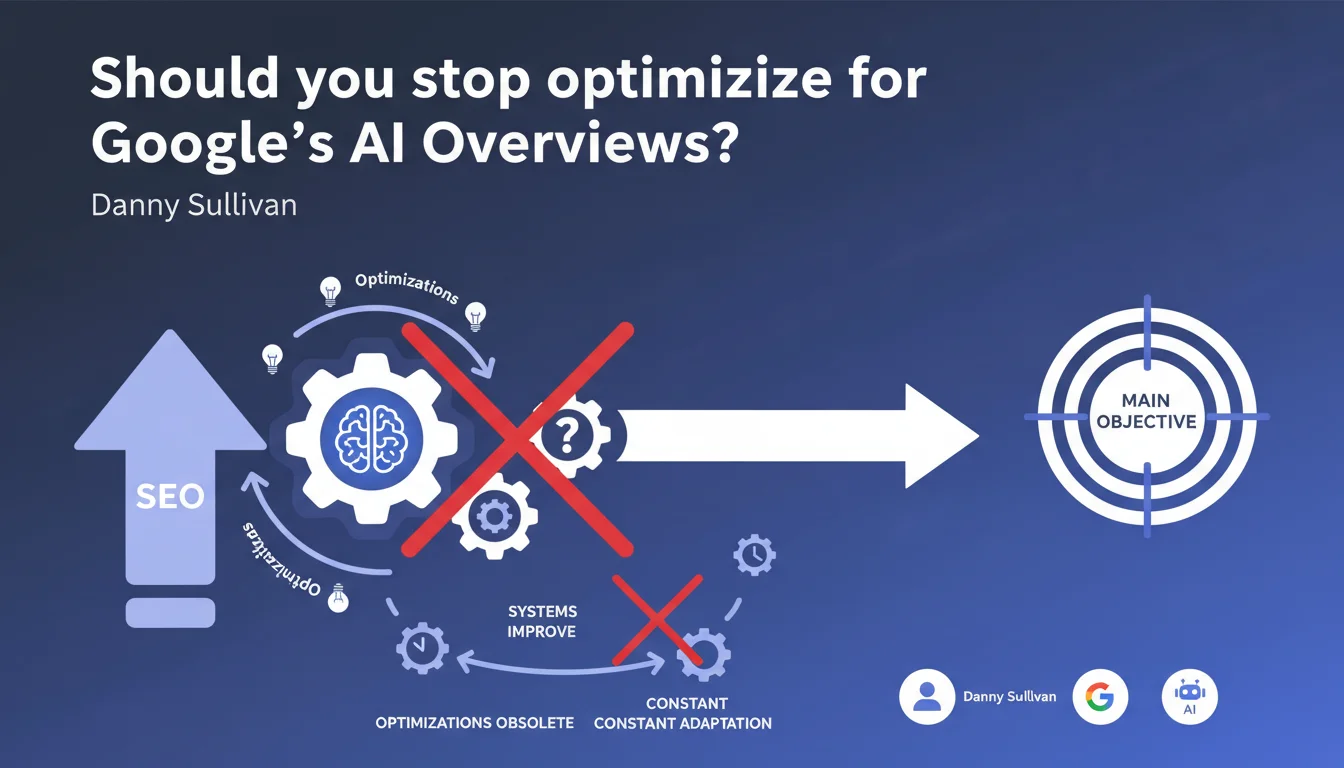
Google advises against specifically optimizing for AI Overviews or any other isolated system. Why? Because these optimizations quickly become outdated as algorithms evolve, forcing you into perpetual adaptation work. It's better to focus on timeless fundamentals.
What you need to understand
What does this warning really mean?
Danny Sullivan recalls a principle Google has been hammering for years: optimizing for a specific system rather than for the end user is a strategic dead end. With the arrival of AI Overviews, some SEO professionals naturally tried to decipher their mechanics to take advantage of them.
The problem? These systems constantly evolve. What works today can become counterproductive tomorrow, forcing you to revise your strategies continuously. Google prefers you to aim for intrinsic quality rather than temporary algorithm exploits.
Why is Google pushing this point now?
The emergence of AI Overviews has created a new wave of tactical optimizations. Some analyze response patterns, the structure of cited sources, preferred formats. Google wants to nip this approach in the bud before it becomes mainstream.
The argument being made? The continuous improvements to AI systems make these optimizations obsolete quickly. What worked in January could be useless by March. And if you've restructured all your content to fit a temporary pattern, you're stuck.
Is this position compatible with the reality of SEO work?
Here's where it gets sticky. SEO has always been about understanding systems to position yourself better within them. Saying "don't optimize for our systems" amounts to denying the very nature of the profession. Let's be honest: nobody does SEO for the love of art — we optimize for a specific engine.
Google seems to be asking SEOs to make "good content" without worrying about algorithmic mechanics. Except in reality, technical understanding remains essential to perform. This statement sounds more like a philosophical guardrail than operational advice.
- Optimizing for an isolated system (AI Overviews only) creates fragile dependency
- Frequent algorithmic evolutions make specific optimizations quickly obsolete
- Google recommends aiming for overall quality rather than exploiting temporary patterns
- This position creates tension with actual SEO practice, which requires technical understanding of systems
SEO Expert opinion
Is this statement consistent with Google's historical discourse?
Yes and no. Google has always preached "quality content for users," but at the same time, it has multiplied specific technical guidelines: Core Web Vitals, structured data, mobile optimization, etc. Hard not to see the contradiction.
Search Quality Rater Guidelines, for example, precisely describe what Google values. SEOs who study them and adapt their content accordingly — aren't they doing exactly what Sullivan advises against? Optimizing "for the" Google system?
In reality, this statement probably targets tactical over-optimizations: keyword stuffing, schema manipulation, exploit of loopholes. Not legitimate understanding of quality criteria. But the boundary remains fuzzy.
What risks are there in completely ignoring AI Overviews?
This is where Google's discourse becomes problematic. If AI Overviews capture a growing share of traffic by answering queries directly, not appearing in them means losing visibility. Saying "don't worry about it" amounts to accepting this loss.
Some sectors are already seeing their CTR collapse on informational queries because of rich snippets and featured snippets. AI Overviews amplify this phenomenon. Ignoring their mechanics on philosophical principle can cost real traffic.
The real advice should be: understand the mechanics, but don't sacrifice overall content coherence for marginal temporary advantage. A nuance that Sullivan's statement doesn't provide.
In what cases does this rule not really apply?
Take structured data. Google explicitly recommends implementing them to help its systems understand content. That's definitely optimizing "for a specific system" — and yet, it's encouraged.
Same with mobile optimization, HTTPS, Core Web Vitals. These are technical optimizations directly targeting Google's ranking criteria. If you follow Sullivan's logic to the letter, you'd have to ignore them. Absurd.
The rule therefore applies mainly to attempts to exploit fragile algorithmic patterns — not to documented best practices. But Google doesn't always make this distinction clear in its communication.
Practical impact and recommendations
What should you concretely do with this statement?
First thing: don't upend everything because Sullivan posted a tweet. If your content strategy is solid and user-centered, keep going. This statement doesn't invalidate fundamentals.
On the other hand, if you were planning to massively restructure your site only to "crack the code" of AI Overviews — ask yourself about ROI. These systems will evolve. Your redesign risks being obsolete before it pays off.
Concretely? Maintain surveillance on AI Overviews, understand their logic, but never sacrifice editorial coherence for an algorithmic pattern. If a specific optimization aligns with your user goals, OK. Otherwise, move on.
What mistakes should you absolutely avoid?
Mistake number one: believing that "making good content" is enough without understanding how Google works. That's naive. SEO remains a technical profession that requires deciphering algorithmic signals.
Mistake number two: over-interpreting every Google statement as absolute truth. Sullivan speaks from a communicator's position, not a technician's. His discourse aims as much at managing public perception as at giving operational advice.
Mistake number three: completely ignoring AI Overviews under the pretense that Google says not to optimize for them. If they impact your traffic, you must understand how they work — while maintaining a balanced strategy.
How do you verify your strategy remains relevant?
Ask yourself this question: if Google radically changed AI Overviews tomorrow, would your content remain relevant and performant? If the answer is yes, you're in a healthy approach.
Monitor your engagement metrics (time spent, bounce rate, conversions) rather than just rankings. Content that actually performs with real users generally ends up being rewarded by Google — even when systems change.
Finally, diversify your traffic sources. Don't bet everything on a single Google mechanism. Social networks, email, partnerships reduce your dependence on algorithmic whims.
- Continue to understand the mechanics of Google systems, without becoming dependent on them
- Prioritize optimizations that serve the user first, even if they also please the algorithm
- Don't massively restructure your site for a temporary AI Overviews pattern
- Monitor the real impact of AI Overviews on your traffic — don't ignore them on principle
- Maintain a coherent and sustainable editorial strategy, not a succession of short-term tactics
- Diversify your acquisition channels to reduce dependence on a single system
🎥 From the same video 12
Other SEO insights extracted from this same Google Search Central video · published on 17/12/2025
🎥 Watch the full video on YouTube →
💬 Comments (0)
Be the first to comment.