
Official statement
Other statements from this video 12 ▾
- □ Should you abandon AEO and GEO acronyms in favor of the classic SEO approach?
- □ Should you really ignore AI Overviews in your SEO strategy?
- □ Is the 'content for humans' mantra still worth believing in 2025?
- □ Should you stop optimizing for Google's AI Overviews?
- □ Has technical SEO really become automatic thanks to modern CMS platforms?
- □ Is original and authentic content really your best weapon against AI?
- □ Is basic factual content becoming useless for SEO?
- □ Will first-hand experience content really become Google's dominant ranking factor?
- □ Is multimodal content really the key to multiplying your visibility in Google?
- □ Does Google really say structured data isn't mandatory for AI rankings?
- □ Is your site missing from AI Overview even though it ranks well in traditional search results?
- □ Should you really optimize your content differently for each AI and search system?
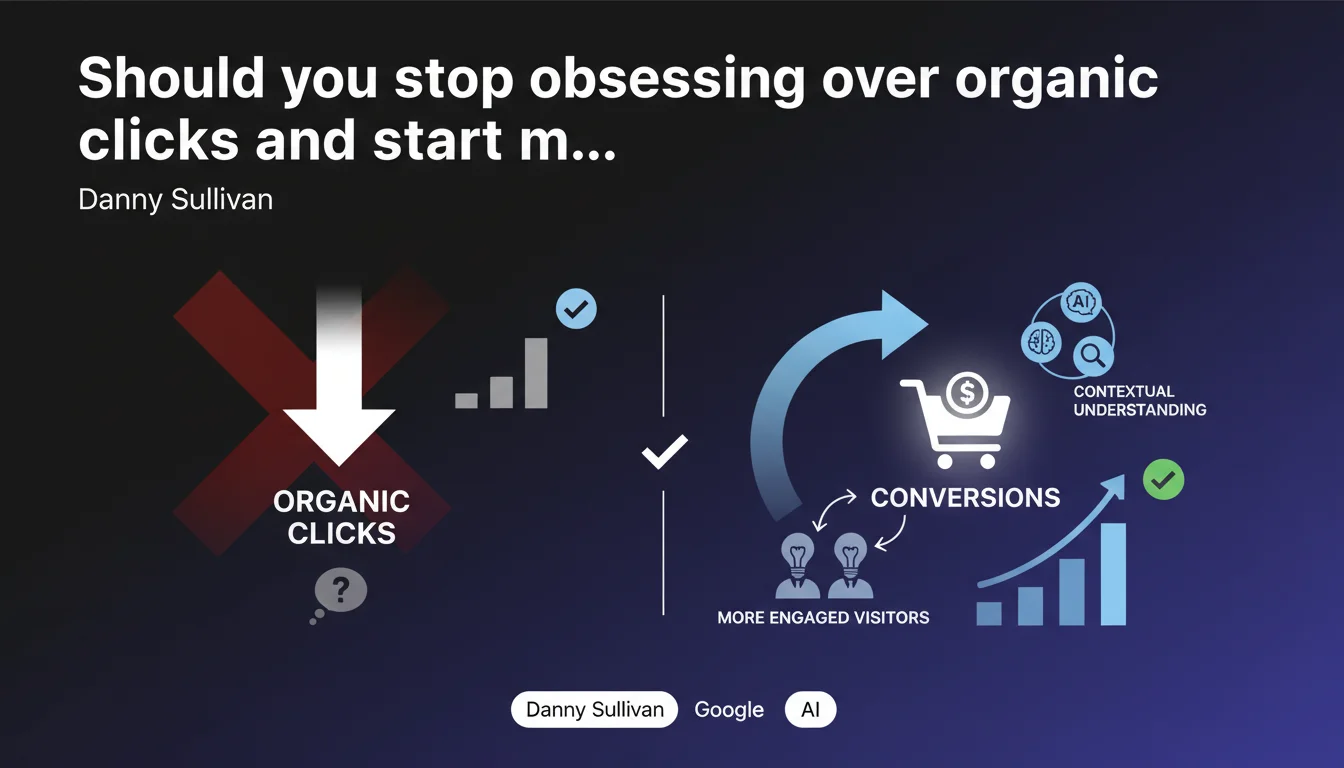
Google is pushing SEOs to move beyond the click metric and measure the real value generated by traffic. According to Danny Sullivan, visitors from AI formats (SGE, AI Overviews) arrive better qualified and convert at higher rates thanks to their contextual understanding. The implicit message: prepare to justify your ROI differently.
What you need to understand
Is Google really challenging the relevance of traditional traffic metrics?
This statement comes in a context where Google is massively rolling out AI formats (SGE, AI Overviews) that capture a growing share of SERP attention. These formats deliver direct answers and mechanically reduce the number of traditional organic clicks.
Sullivan is therefore shifting the debate: rather than lamenting declining CTR, you need to measure actual engagement and conversion. The argument? A visitor arriving after consuming AI-enriched content understands their need better — they click less often, but more effectively.
What does this "contextual understanding" actually mean in practice?
A user exposed to an AI Overview has already received information pre-qualification. They've read a synthesis, compared multiple sources, and refined their mental query. When they click, it's no longer from vague exploration but from precise intent.
For an e-commerce site, this translates to fewer bounces on mismatched product pages. For a B2B site, it means better-informed leads who arrive already with more advanced purchase maturity.
Which metrics become priorities in this new paradigm?
Goodbye simple organic session counting. Hello traffic quality indicators: real engagement time, navigation depth, assisted conversion rate, average transaction value from search.
- Macro and micro conversions: purchase, qualified lead, download, newsletter signup
- Behavioral engagement: scroll depth, interactions with key elements, active time on page
- Multi-touch attribution: understand search's role in a journey no longer limited to last-click
- Lifetime value: measure long-term profitability of visitors acquired via AI vs traditional search
SEO Expert opinion
Is this statement actually new or a defensive repositioning?
Let's be honest — Google has always preached conversion over vanity traffic. But this emphasis arrives at the exact moment when AI formats are cannibalizing organic clicks. Coincidence? Definitely not.
The underlying message: "Don't blame us for your traffic drop, look at the quality instead." It's a narrative repositioning to anticipate complaints from publishers watching their CTR curves plummet. Sullivan is setting the stage for a world where Google generates fewer outbound clicks but claims to create more value.
Do on-the-ground data actually confirm this better conversion?
Here's where it gets sticky. Google makes this argument but public data remains scarce. A few partial studies do suggest better engagement for certain segments — notably complex informational queries that lead to B2B conversions.
But for transactional sites or publishers living off display advertising, the logic reverses: fewer clicks means less revenue, period. "Better qualification" doesn't always compensate for raw volume loss, especially when AI formats answer directly without redirecting.
Should we expect complete decoupling between SERP visibility and actual traffic?
Probably. We're heading toward an ecosystem where being visible in an AI Overview no longer guarantees clicks but still influences purchase decisions or user choices — what I call "phantom influence".
SEO will therefore need to measure indirect metrics: brand awareness assisted by search, correlation between AI visibility and direct traffic, impact on branded queries. A fundamental mental model shift that many clients will struggle to digest.
Practical impact and recommendations
How do you adapt your KPIs to measure this qualitative value?
First step: segment organic traffic by source (classic SERP vs AI formats, if detectable via user-agent or behavior). Compare conversion rates, average cart value, and visit depth between these segments.
Next, implement granular event tracking: CTA interactions, key page visits, engagement with high-value content. GA4 becomes essential here for building custom audiences and conversions.
What mistakes should you avoid during this measurement transition?
Don't throw your traffic metrics away — they remain an SEO health indicator. The mistake would be justifying a 40% traffic drop by saying "yes but quality". Ideally, both should improve.
Another trap: overestimating your analytics tool maturity. Many sites haven't even properly configured assisted conversion tracking or micro-conversions. Before talking quality, make sure you're actually measuring it.
What should you implement concretely right now?
- Audit your GA4 setup: custom events, secondary conversions, data-driven attribution enabled
- Create custom segments to compare behavior and conversion by traffic source
- Implement micro-conversion tracking aligned with your funnel: add to cart, form start, strategic page visits
- Set up an executive dashboard blending volume metrics (traffic, impressions) and value metrics (conversion, revenue, engagement)
- Test CRM-Analytics integration to track complete customer value from organic search
- Document metric changes to justify the gradual shift to qualitative KPIs with clients/leadership
- Train marketing and sales teams on these new metrics to align expectations
🎥 From the same video 12
Other SEO insights extracted from this same Google Search Central video · published on 17/12/2025
🎥 Watch the full video on YouTube →
💬 Comments (0)
Be the first to comment.