
Official statement
Other statements from this video 12 ▾
- □ Faut-il abandonner les acronymes AEO et GEO au profit du bon vieux SEO ?
- □ Faut-il vraiment ignorer l'AI Overview dans sa stratégie SEO ?
- □ Faut-il vraiment encore croire au mantra « contenu pour les humains » en 2025 ?
- □ Faut-il arrêter d'optimiser pour les AI Overviews de Google ?
- □ Le SEO technique est-il vraiment devenu automatique grâce aux CMS modernes ?
- □ Le contenu original et authentique est-il vraiment votre meilleure arme face à l'IA ?
- □ Le contenu factuel basique est-il devenu inutile pour le SEO ?
- □ Le contenu de première main va-t-il vraiment devenir un critère de classement dominant ?
- □ Le contenu multimodal est-il vraiment la clé pour multiplier votre visibilité dans Google ?
- □ Les données structurées sont-elles vraiment inutiles pour l'IA de Google ?
- □ Faut-il arrêter de mesurer les clics organiques pour se concentrer sur les conversions qualitatives ?
- □ Faut-il optimiser son contenu différemment pour chaque IA et système de recherche ?
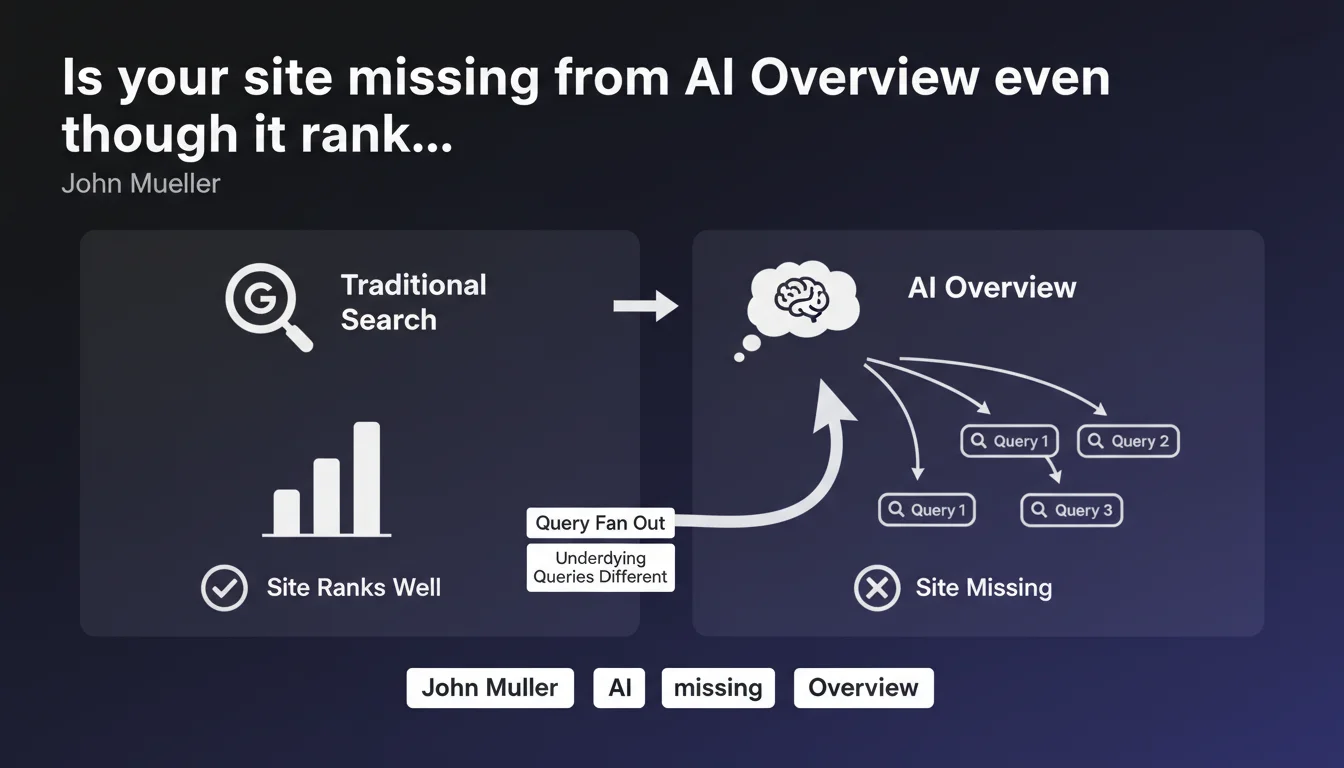
Google's AI Overview doesn't simply scan the results of a single search query. It automatically deploys multiple incremental searches in the background (query fan out) to assemble its answer. As a result, a site that ranks well for the initial query can completely disappear from the AI Overview because the underlying queries it triggers don't rank it highly enough.
What you need to understand
What exactly is "query fan out"?
The query fan out is a mechanism by which Google breaks down a user query into multiple automatic sub-queries. Instead of processing only "best CRM for small businesses," the AI Overview can simultaneously launch "what is a CRM," "CRM selection criteria," "CRM suited for small structures," and so on.
These incremental searches allow the AI to aggregate complementary information to produce a coherent synthesis. It's a radically different approach from the linear display of the classic 10 blue links.
Why does this mechanism change the game for SEO?
Because ranking on the main query is no longer enough. If your site doesn't rank for the sub-queries triggered behind the scenes, it has no chance of appearing in the AI Overview — even if it sits in position 1 for the initial search.
Google doesn't tell you which sub-queries are executed. You might be visible for "best CRM" but invisible for "CRM selection criteria," and find yourself excluded from the AI summary without understanding why.
What are the concrete implications for visibility?
Traditional organic traffic and visibility in AI Overview become two distinct channels, with different ranking logic. A site can perform well on one and fail on the other.
- AI Overview prioritizes broad thematic coverage over hyper-optimization on a single keyword
- Sites that answer peripheral questions have a better chance of being cited in AI summaries
- Freshness and content depth likely play an increased role in source selection
- Pages too specialized on a narrow query risk missing the AI Overview entirely
SEO Expert opinion
Is this statement consistent with what we observe in practice?
Yes — and it explains quite a few frustrations. We regularly see sites that dominate a commercial query get pushed out of AI Overview in favor of more generalist or educational content. Query fan out mechanically favors sites that cover a broader semantic spectrum.
Ultra-niche pure players, optimized tightly for a few high-ROI queries, end up penalized. The AI prefers to aggregate sources that answer connected sub-questions — often media outlets, sector wikis, or players that publish lots of contextual content.
What nuances should we add to this logic?
Query fan out is probably not activated uniformly across all queries. Complex informational searches ("how to choose X") likely trigger more sub-queries than simple transactional queries ("buy X cheap").
Another point: Google doesn't say how many sub-queries are launched or by what criteria they're selected. We're flying blind. It's impossible to know whether the AI executes 3, 10, or 50 incremental searches in the background.
In what cases does this mechanism work against you?
If your site is structured in ultra-isolated silos, with highly specialized pages but little cross-thematic content, you're missing out. The AI will pick from competitors who cover adjacent topics.
E-commerce sites with rich product sheets but zero peripheral editorial content are particularly exposed. Same goes for B2B services with a minimal corporate website: not enough material to feed informational sub-queries.
Practical impact and recommendations
What should you concretely do to improve your visibility in AI Overview?
Expand your semantic coverage. If you're targeting "accounting software," also publish on "how to choose accounting software," "difference between cloud vs on-premise," "essential features," etc. These peripheral contents feed the sub-queries of query fan out.
Adopt a topic cluster approach: one generalist pillar page plus detailed satellite content on sub-topics. The AI needs material to build its syntheses — give it something to draw from.
Work on depth rather than keyword density. Complete answers, well-structured, with varied angles, have a better chance of matching multiple simultaneous sub-queries.
What mistakes should you absolutely avoid?
Don't bet everything on a few hyper-optimized pages. This strategy still works for traditional SEO, but it makes you invisible to query fan out. The AI won't seek out your content if you only cover an ultra-narrow angle.
Also avoid duplicating the same content under different angles without adding distinct value. Google detects repetition — and the AI has no interest in citing the same source multiple times if it says the same thing.
How can you verify that your strategy is aligned with this logic?
- Audit your thematic coverage: do you identify and address peripheral questions related to your main queries?
- Analyze competitor AI Overviews on your target queries: which sites are cited? What types of content?
- Verify that your pillar pages have sufficiently developed and interlinked satellite content
- Test adjacent queries in your subject area: do you appear in the traditional results for these sub-queries?
- Examine your zero-click traffic: if you're losing impressions without clicks, it might be AI Overview cannibalizing your traffic
🎥 From the same video 12
Other SEO insights extracted from this same Google Search Central video · published on 17/12/2025
🎥 Watch the full video on YouTube →
💬 Comments (0)
Be the first to comment.