
Official statement
Other statements from this video 12 ▾
- □ Faut-il abandonner les acronymes AEO et GEO au profit du bon vieux SEO ?
- □ Faut-il vraiment ignorer l'AI Overview dans sa stratégie SEO ?
- □ Faut-il vraiment encore croire au mantra « contenu pour les humains » en 2025 ?
- □ Faut-il arrêter d'optimiser pour les AI Overviews de Google ?
- □ Le SEO technique est-il vraiment devenu automatique grâce aux CMS modernes ?
- □ Le contenu original et authentique est-il vraiment votre meilleure arme face à l'IA ?
- □ Le contenu de première main va-t-il vraiment devenir un critère de classement dominant ?
- □ Le contenu multimodal est-il vraiment la clé pour multiplier votre visibilité dans Google ?
- □ Les données structurées sont-elles vraiment inutiles pour l'IA de Google ?
- □ Faut-il arrêter de mesurer les clics organiques pour se concentrer sur les conversions qualitatives ?
- □ Pourquoi votre site n'apparaît-il pas dans l'AI Overview alors qu'il est bien positionné dans les résultats classiques ?
- □ Faut-il optimiser son contenu différemment pour chaque IA et système de recherche ?
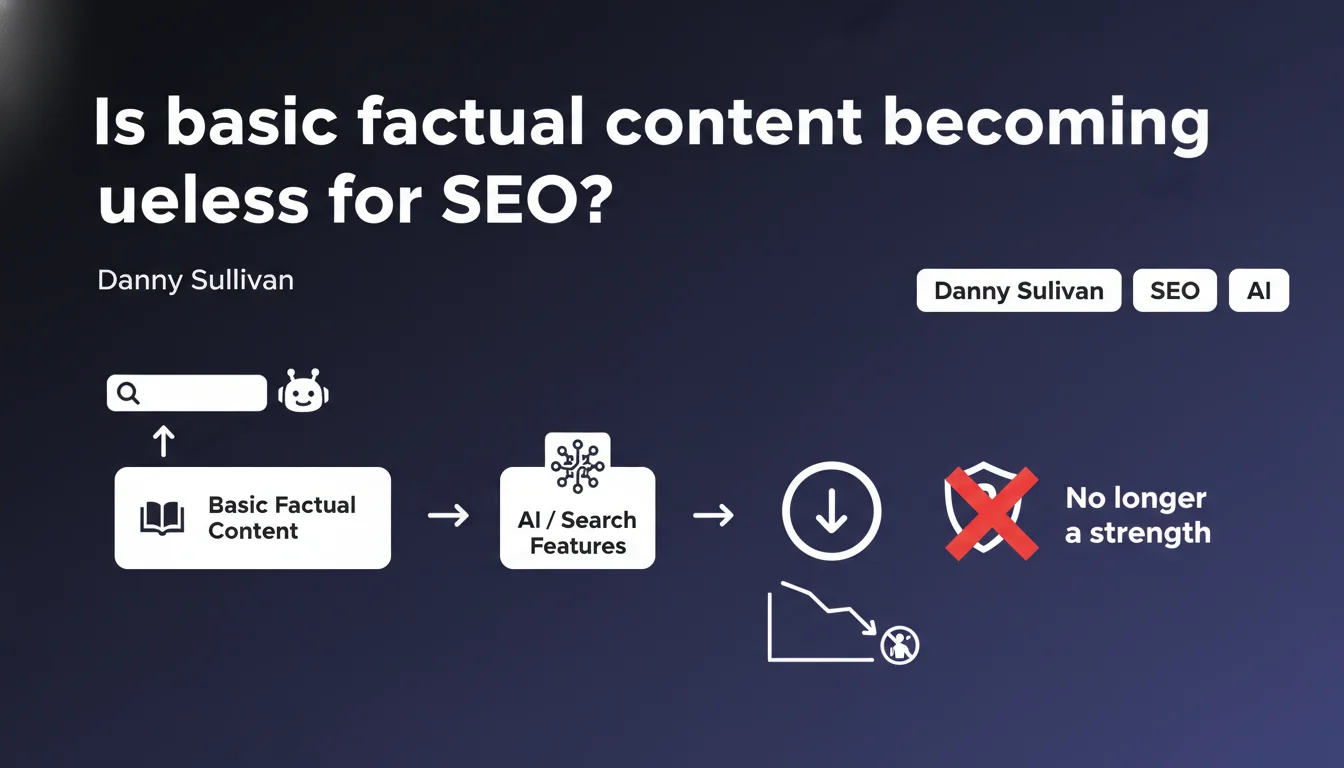
Google states that purely factual and basic content is now being handled directly by AI and integrated search features. This type of 'commodity' content no longer allows you to differentiate yourself or attract organic traffic meaningfully. Sites still relying on this type of content risk losing their visibility.
What you need to understand
What does Google mean by 'basic factual content'?
We're talking about simple, accessible and repetitive factual information: opening hours, standard definitions, unit conversions, historical dates, addresses, phone numbers. Everything that falls under the 'quick answer' category.
These types of content have long been the daily bread of many sites — often low-quality ones — that attracted traffic on simple informational queries. Google now says these pieces of information are handled directly by its systems: knowledge panels, featured snippets, AI Overviews, instant answers.
Why doesn't this content differentiate a site anymore?
Because the user no longer needs to click to get the answer. They see it directly in the SERP, without leaving Google.
Sites that only offer this type of content mechanically lose their reason for being in the search engine's eyes. They become redundant — Google can provide the same information without intermediation, faster, in a more readable format.
What signal is being sent to content creators?
The message is clear: add value or disappear. If your content is limited to rephrasing facts accessible elsewhere, you're not bringing anything that Google's AI cannot do itself.
It's not a direct threat, it's a logical evolution. Google is investing heavily in its ability to understand and deliver information without intermediaries. Sites that want to survive must offer analysis, context, expertise — not dressed-up copy-pasting.
- Basic factual content is handled natively by Google through AI and enriched features
- This type of content no longer drives qualified traffic because the user gets their answer without clicking
- Sites must absolutely increase their added value: expertise, analysis, unique perspective
- This evolution is not temporary — it's part of a logic of progressive disintermediation
SEO Expert opinion
Is this statement consistent with what we observe in the field?
Completely. For years, we've been seeing featured snippets, knowledge panels and AI Overviews cannibalize traffic from factual content sites. Directories, generic definition sites, basic information aggregators — all have seen their traffic collapse.
What's changed is that Google is saying it openly. Before, we talked about 'position zero', 'zero-click searches' — now Google owns it: we handle this content ourselves. And it makes sense — why send the user elsewhere when the answer fits in three lines?
What nuances should we add to this statement?
First nuance: not all factual content is equal. A dictionary definition, yes, that's pure commodity. But a detailed technical guide on a niche topic, even if factual, retains value — especially if expertise is visible and the format is well-crafted.
Second nuance — and this one is important: Google says 'increasingly non-differentiating', not 'useless'. This content can still serve as a foundation provided it's enriched with analysis, context, concrete examples. The problem is when it stands alone.
In what cases does this type of content remain relevant?
When it serves as a foundation for a larger demonstration. For example: defining a technical concept before explaining how to apply it, how it evolved, where it's commonly misunderstood. Factual content becomes a building block, not an end goal.
Another case: ultra-specialized sectors where Google doesn't (yet) have enough reliable data to generate automated answers. But that's just a reprieve — as soon as Google has crawled enough trusted sources, it will take over.
Practical impact and recommendations
What should you concretely do with your existing content?
Audit ruthlessly. Identify all content that merely answers a simple factual question, without unique value. If your 'What is SEO?' article just defines the term, it's dead.
Then, two options: either you enrich massively (add expertise, case studies, concrete examples, argued perspectives), or you merge or delete. Keeping zombie pages that no longer rank serves no purpose — it even dilutes crawl budget and thematic consistency.
How do you create content that resists this logic?
By consistently starting with the question: 'What can't Google's AI do as well as I can?'. If you don't have a clear answer, your content is fragile.
Concretely: bring real-world experience, proprietary data, comparative analyses, argued opinions. Move away from encyclopedic format. Human expertise is what Google cannot (yet) reliably reproduce.
- Conduct a complete audit of current basic factual content (definitions, generic FAQs, superficial guides)
- Identify pages that no longer generate traffic despite good historical rankings — a sign that Google displays the answer in SERP
- Enrich strategic content with real expertise: examples, case studies, comparatives, argued perspectives
- Merge or remove redundant content or content without clear added value
- Orient editorial strategy toward high added-value formats: in-depth analyses, methodological guides, experience reports
- Measure organic traffic evolution on factual pages to anticipate upcoming losses
- Invest in formats that cannot be summarized in one sentence: long tutorials, complex explainers, interactive content
🎥 From the same video 12
Other SEO insights extracted from this same Google Search Central video · published on 17/12/2025
🎥 Watch the full video on YouTube →
💬 Comments (0)
Be the first to comment.