
Official statement
Other statements from this video 12 ▾
- □ Should you really ignore AI Overviews in your SEO strategy?
- □ Is the 'content for humans' mantra still worth believing in 2025?
- □ Should you stop optimizing for Google's AI Overviews?
- □ Has technical SEO really become automatic thanks to modern CMS platforms?
- □ Is original and authentic content really your best weapon against AI?
- □ Is basic factual content becoming useless for SEO?
- □ Will first-hand experience content really become Google's dominant ranking factor?
- □ Is multimodal content really the key to multiplying your visibility in Google?
- □ Does Google really say structured data isn't mandatory for AI rankings?
- □ Should you stop obsessing over organic clicks and start measuring what actually converts?
- □ Is your site missing from AI Overview even though it ranks well in traditional search results?
- □ Should you really optimize your content differently for each AI and search system?
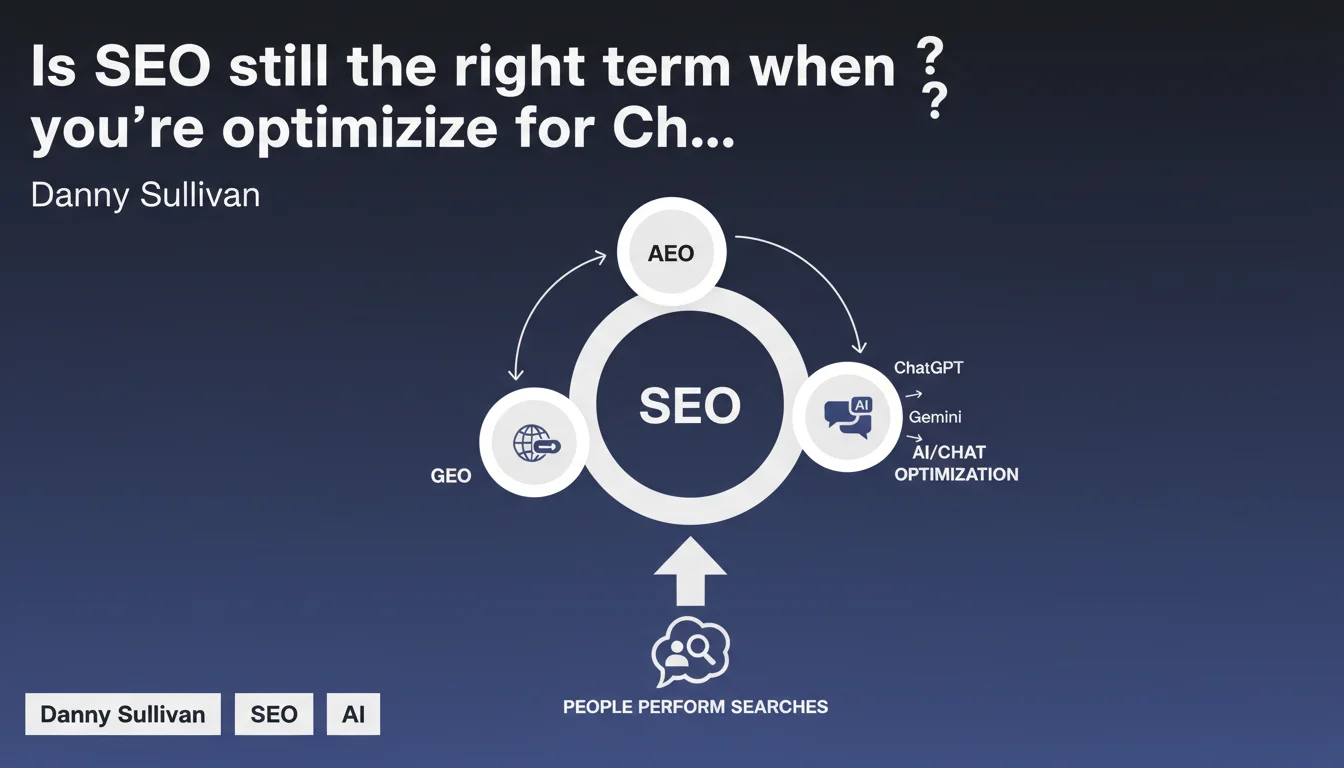
Google maintains that SEO remains the universal term encompassing all optimization practices, including for generative AI. Acronyms like AEO, GEO, or others are merely marketing sub-categories, not separate disciplines. Translation: no need to overhaul your pricing structure.
What you need to understand
Why is Google insisting on this clarification now?
The emergence of AI Overviews and generative search experiences has triggered an explosion of acronyms in the industry. AEO (Answer Engine Optimization), GEO (Generative Engine Optimization), LEO (LLM Engine Optimization)… each attempting to position itself as an entirely new discipline.
Google cuts the debate short: SEO remains the primary conceptual framework. This position is not insignificant—it aims to prevent fragmentation of the discourse and remind us that fundamentals remain the same regardless of how results are presented.
What does "sub-category" concretely mean in this context?
Danny Sullivan is not saying that optimization for generative answers is identical to optimization for traditional blue links. He's saying that both fall under the same logic: making your content accessible, understandable, and relevant to the search engine.
Techniques evolve, formats change, but the objective remains unchanged: maximize visibility in Google's ecosystem, regardless of how results are displayed.
Does this statement challenge the technical specifics of each format?
No. Optimizing for Featured Snippets requires different adjustments than those needed for AI Overviews. But these adjustments remain within the scope of classic SEO: semantic structuring, schema.org markup, thematic authority.
Google simply reminds us not to reinvent the wheel with each new interface. A good SEO professional's skills are sufficient—you just need to adapt them to the context.
- SEO remains the generic term for all optimization aimed at search engines, across all formats
- AEO, GEO, and other acronyms are tactical variations, not autonomous disciplines
- SEO fundamentals (relevance, authority, accessibility) still apply, even in AI experiences
- No need to artificially segment your skills or offerings—the foundation remains identical
SEO Expert opinion
Is this statement consistent with what we observe in practice?
Yes and no. In principle, Google is right: a site optimized according to classic SEO standards has a better chance of appearing in AI Overviews than a neglected site. Relevance and authority signals remain central.
But—and this is where it gets tricky—some generative formats favor specific content types. AI Overviews massively cite forums, conversational content, direct answers… not necessarily the type of content you would prioritize for ranking in position 1 classically. So there is indeed a necessary tactical adaptation.
Saying that everything stays under the "SEO" umbrella is conceptually true, but downplays the concrete strategic adjustments these new formats impose.
Why this Google insistence on continuity rather than disruption?
Because acknowledging a disruption would mean admitting that Google is fundamentally changing how it distributes visibility—and therefore traffic. This would concern publishers and advertisers.
By maintaining the discourse "it's still SEO," Google limits debates about organic traffic cannibalization by generative answers. Politically, it's clever. Technically, it's debatable.
Should you ignore acronyms like AEO or GEO nonetheless?
No. These terms have pedagogical and commercial value: they help segment practices and identify specific required skills. A client better understands "we optimize for AI Overviews" than "we're doing SEO with enhanced semantic layering."
The mistake would be presenting them as revolutions when they're really evolutions. Use these acronyms as descriptive shortcuts, not as separate disciplines with their own magical rules.
Practical impact and recommendations
What should you concretely adjust in your current SEO strategy?
Keep applying SEO fundamentals: clean architecture, expert content, E-E-A-T signals, coherent internal linking. These pillars remain valid for all search formats, including generative ones.
Next, integrate tactical adjustments to maximize chances of appearing in AI Overviews: prioritize direct, structured answers, use schema.org markup aggressively, multiply formats (FAQ, how-to, comparisons).
And most importantly, monitor the SERP features specific to your sector. Generative formats don't activate uniformly—some sectors see lots of AI Overviews, others almost none.
What mistakes should you avoid given this statement?
Don't fall into immobility by telling yourself "everything stays the same." Interfaces change, user behavior changes too. SEO remains the framework, but tactical priorities evolve.
Another trap: multiplying acronyms internally without clarifying what they actually cover. If you use AEO or GEO, precisely define the concrete actions associated—otherwise it's empty branding.
How to verify your strategy remains aligned with this Google vision?
Audit your content to identify pieces that directly answer frequently asked questions. These are your best candidates for generative formats.
Test your main queries in Search Console and directly in Google to see what types of results appear—AI Overviews, Featured Snippets, PAA, classic results. Adapt your production accordingly.
- Maintain SEO fundamentals (technical, content, authority) as an essential foundation
- Strengthen semantic structuring of content with schema.org and clean HTML5 markup
- Prioritize question-answer formats and conversational content when relevant
- Monitor the evolution of SERP features in your sector—not all are impacted equally
- Don't artificially segment your teams or budgets between "classic SEO" and "AEO"—it's a continuum
- Use AEO/GEO acronyms only as descriptive shortcuts, not as justification for budget overhaul
🎥 From the same video 12
Other SEO insights extracted from this same Google Search Central video · published on 17/12/2025
🎥 Watch the full video on YouTube →
💬 Comments (0)
Be the first to comment.