
Official statement
Other statements from this video 12 ▾
- □ Faut-il abandonner les acronymes AEO et GEO au profit du bon vieux SEO ?
- □ Faut-il vraiment encore croire au mantra « contenu pour les humains » en 2025 ?
- □ Faut-il arrêter d'optimiser pour les AI Overviews de Google ?
- □ Le SEO technique est-il vraiment devenu automatique grâce aux CMS modernes ?
- □ Le contenu original et authentique est-il vraiment votre meilleure arme face à l'IA ?
- □ Le contenu factuel basique est-il devenu inutile pour le SEO ?
- □ Le contenu de première main va-t-il vraiment devenir un critère de classement dominant ?
- □ Le contenu multimodal est-il vraiment la clé pour multiplier votre visibilité dans Google ?
- □ Les données structurées sont-elles vraiment inutiles pour l'IA de Google ?
- □ Faut-il arrêter de mesurer les clics organiques pour se concentrer sur les conversions qualitatives ?
- □ Pourquoi votre site n'apparaît-il pas dans l'AI Overview alors qu'il est bien positionné dans les résultats classiques ?
- □ Faut-il optimiser son contenu différemment pour chaque IA et système de recherche ?
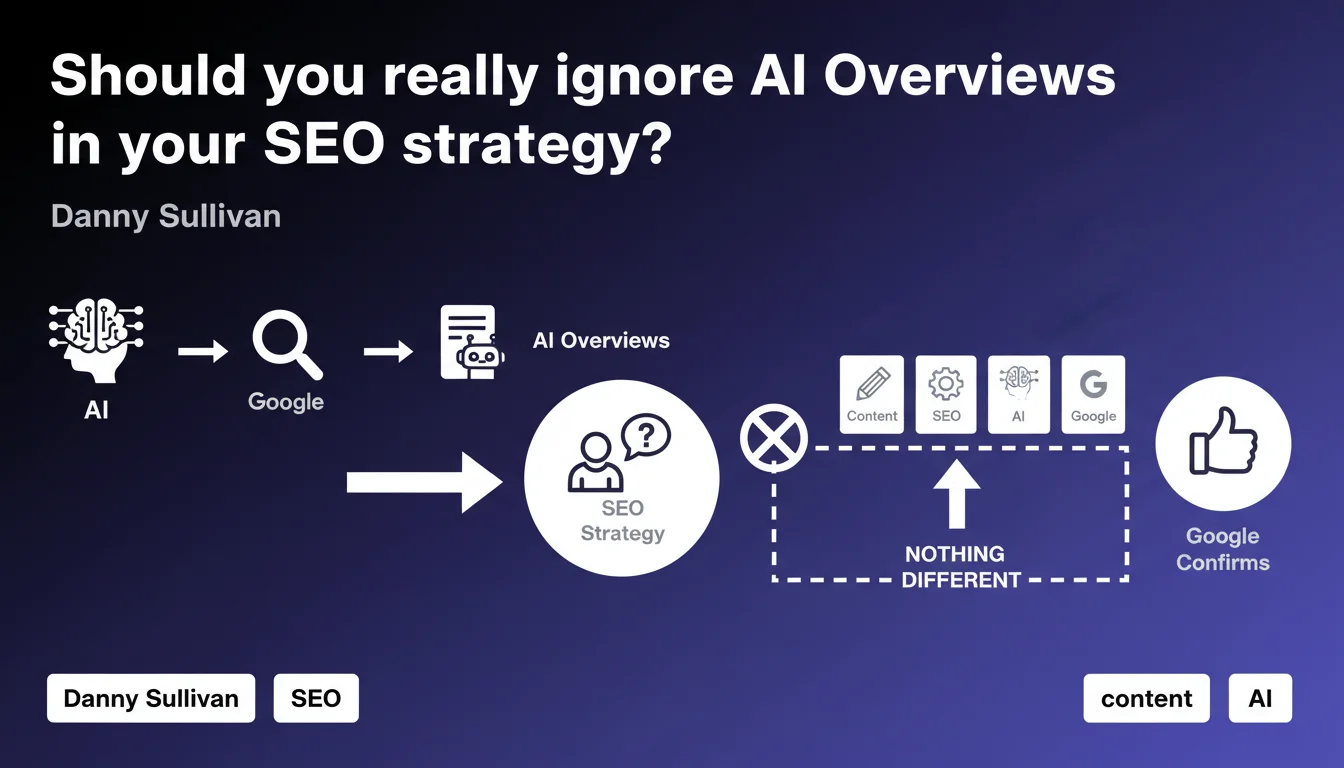
Google claims that no specific optimization is necessary for AI Overviews and generative formats. Traditional SEO principles remain valid — there's no new magic recipe to invent. But this statement raises more questions than it provides practical answers.
What you need to understand
What exactly does Google say in this statement?
Danny Sullivan, Google's public liaison, puts forward a simple principle: content creators don't need to adapt their SEO strategy specifically for AI Overviews or other generative formats from the search engine. In other words, the fundamentals remain identical.
This official position aligns with Google's usual line — the one that says quality content is enough, regardless of the display format. No technical revolution expected, no new protocol to implement.
Why is Google communicating about this now?
The arrival of generative results in SERPs has created uncertainty among publishers. Some fear cannibalization of organic traffic, others wonder if there are specific signals for being cited in AI Overviews.
Google is trying to calm things down by asserting there's no new variable in the equation. The message is clear: keep doing what you're doing, we'll handle the innovation on our end.
What are the direct implications for an SEO practitioner?
If you take this statement at face value, it means that the criteria for relevance and authority that allow you to rank in classic results are the same ones used to feed AI Overviews.
In practice, this would mean that pages well-positioned on informational queries already have a high probability of being cited by generative formats. Nothing new under the sun, then.
- No specific technical optimization is required to appear in AI Overviews
- Traditional SEO fundamentals (E-E-A-T, structure, semantics) remain the priority levers
- Google does not acknowledge the existence of signals dedicated to generative formats
- Content strategy remains centered on quality and relevance, not on adaptation to a display format
SEO Expert opinion
Is this statement consistent with what we're seeing on the ground?
Let's be honest: reality is more nuanced. Early field reports show that certain types of content are overrepresented in AI Overviews — notably those that adopt a clear question-answer structure, with concise definitions at the beginning of the page.
Pages that perform best often have reinforced semantic markup, short paragraphs, and very readable information architecture. It's no accident. Google's AI extracts and reformulates content — it mechanically favors what's easy to parse and restitute.
What nuances should be added to this official discourse?
Google is right on one point: there's no magic tag to add, no new file to submit. But that doesn't mean there's no editorial adjustment to consider.
Generative formats favor content dense in factual information, structured logically. If your content is scattered, unnecessarily long, or wrapped in marketing fluff, it has less chance of being extracted — even if it ranks well in classic organic results.
In which cases is this guidance insufficient?
If you operate in a YMYL sector (health, finance, legal), source authority weighs even more heavily in AI Overviews. Google cites established sources first — which can disadvantage you even if your content is technically good.
Furthermore, for transactional or commercial queries, AI Overviews are still experimental and inconsistent. Relying solely on classic principles in these contexts means ignoring that the rules are still being written.
Practical impact and recommendations
What should you concretely do with this information?
First thing: don't panic. If your site already performs well on informational queries, you have a good foundation. No need to overhaul everything overnight.
That said, use this period to strengthen editorial structure fundamentals: open paragraphs, clear answers in the first 100 words, logical heading hierarchy. These adjustments serve user experience anyway — and they happen to facilitate AI extraction.
What mistakes should you avoid when facing this statement?
Don't fall into the trap of complete inaction. Saying "nothing to do" can translate to "I'll keep going as before without questioning anything." Yet, generative formats change the visibility game — even if the underlying criteria haven't changed.
Another classic mistake: over-optimizing for AI at the expense of human readability. Google reads with human eyes (well, crawler eyes trained on human behavior). If your content becomes robotic just to please AI Overviews, you lose on both fronts.
How do you verify that your content is well-positioned for the future?
Start by auditing your most strategic pages. Ask yourself: if an AI had to summarize this page in 3 sentences, what would it say? If the answer is unclear or requires a full re-read, you have a clarity problem.
Also monitor Featured Snippets and People Also Ask. These formats are often precursors to what ends up in AI Overviews. If you don't appear anywhere in these zones, it's a weak but useful signal.
- Verify that your informational pages clearly answer a question within the first 100 words
- Audit heading structure: every title should be a question or clear statement
- Strengthen E-E-A-T: author signatures, cited sources, visible credibility
- Test readability: short sentences, open paragraphs, no unnecessary jargon
- Monitor your performance in Featured Snippets and People Also Ask
- Never sacrifice user experience for technical over-optimization
🎥 From the same video 12
Other SEO insights extracted from this same Google Search Central video · published on 17/12/2025
🎥 Watch the full video on YouTube →
💬 Comments (0)
Be the first to comment.