
Official statement
Other statements from this video 12 ▾
- □ Faut-il abandonner les acronymes AEO et GEO au profit du bon vieux SEO ?
- □ Faut-il vraiment ignorer l'AI Overview dans sa stratégie SEO ?
- □ Faut-il vraiment encore croire au mantra « contenu pour les humains » en 2025 ?
- □ Faut-il arrêter d'optimiser pour les AI Overviews de Google ?
- □ Le SEO technique est-il vraiment devenu automatique grâce aux CMS modernes ?
- □ Le contenu original et authentique est-il vraiment votre meilleure arme face à l'IA ?
- □ Le contenu factuel basique est-il devenu inutile pour le SEO ?
- □ Le contenu multimodal est-il vraiment la clé pour multiplier votre visibilité dans Google ?
- □ Les données structurées sont-elles vraiment inutiles pour l'IA de Google ?
- □ Faut-il arrêter de mesurer les clics organiques pour se concentrer sur les conversions qualitatives ?
- □ Pourquoi votre site n'apparaît-il pas dans l'AI Overview alors qu'il est bien positionné dans les résultats classiques ?
- □ Faut-il optimiser son contenu différemment pour chaque IA et système de recherche ?
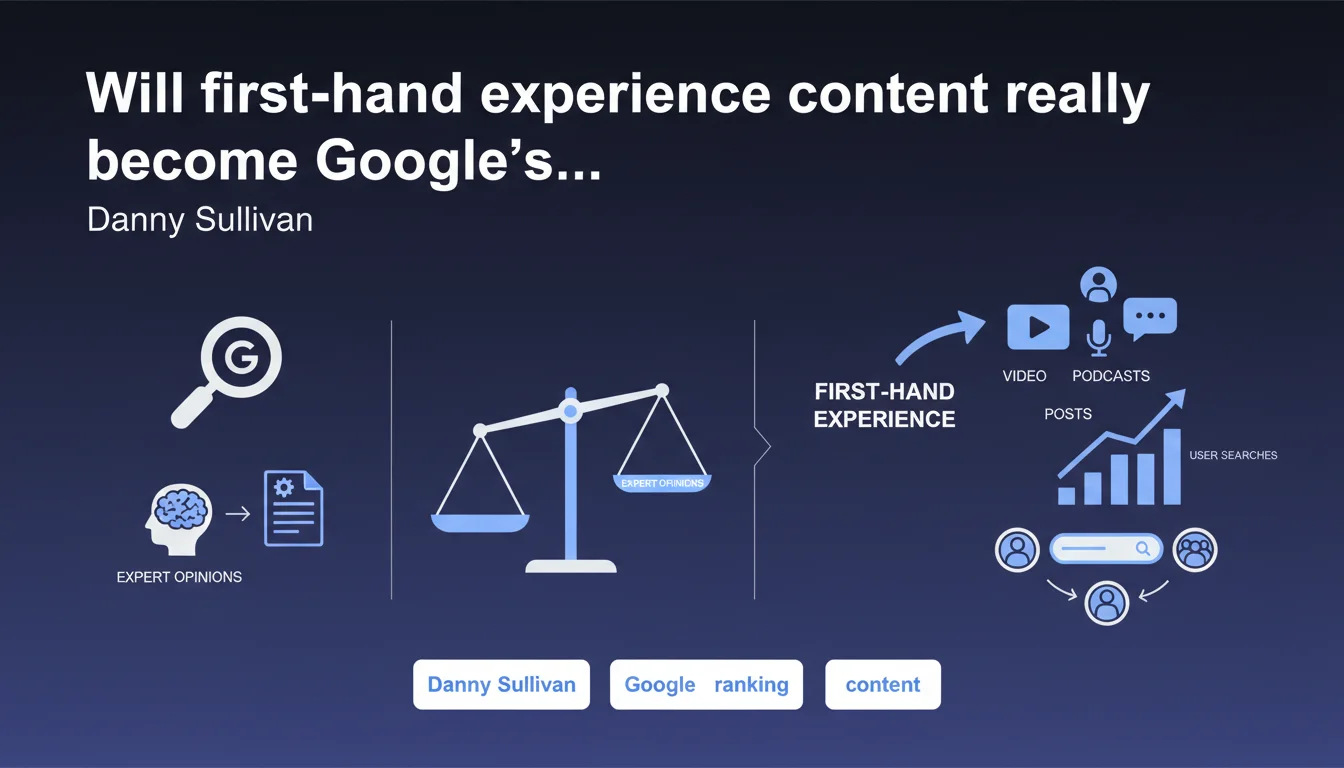
Google claims to increasingly value content based on authentic personal experiences — videos, podcasts, testimonials. The goal: complement theoretical expertise with lived perspectives. For SEOs, this means integrating formats and voices that demonstrate direct experience, not just a compilation of secondary sources.
What you need to understand
What does Google really mean by "first-hand content"?
Google is contrasting lived experience with theoretical expertise here. An expert opinion may be technically flawless, but if no one has actually tested the product, tried the recipe or visited the location, the content remains abstract.
The search engine now values authentic formats: unboxing videos, interview podcasts, blog posts with personal photos, detailed experience reports. No Hollywood-style staging — authenticity wins.
Why this shift now?
Users want human perspectives, not copy-pasted product sheets. Queries like "is X worth it" or "my experience with Y" are exploding.
Google is following this demand by adjusting its algorithms to distinguish between someone who has actually used the product and someone who just paraphrased the Amazon description.
How does this differ from traditional E-E-A-T criteria?
The first "E" in E-E-A-T is precisely Experience. But until now, its application remained vague.
With this statement, Google clarifies: personal experience becomes a distinct signal, not just a cosmetic bonus. If two pieces of content have the same level of expertise, the one with first-hand experience gets the edge.
- First-hand content doesn't replace expertise, it complements it
- Rich formats (video, audio) make it easier to prove direct experience
- Google is looking for authenticity markers: original photos, specific details, lived anecdotes
- This trend responds to an evolution in search behavior, not algorithmic whim
SEO Expert opinion
Does this statement really reflect what we're seeing in the SERPs?
Yes and no. On commercial or practical advice queries, we're definitely seeing "authentic" content gaining ground — particularly on YouTube and in featured snippets.
But let's be honest: on pure transactional queries, big affiliate sites with zero real experience still hold their ground. Google's theory and SERP reality aren't always aligned.
What risks if we take this directive literally?
Some publishers will fall into the fake authenticity trap: buying reviews, forcing employees to make calibrated videos, inventing experiences. Google knows this, and its Quality Rater teams are trained to spot these manipulations.
The other pitfall is believing that a simple photo or video is enough. It's not. What matters is the depth of the testimony — specific details, usage context, nuances, acknowledged limitations.
In which sectors does this rule not really apply?
On strict YMYL topics (health, finance, law), certified expertise remains paramount. Personal testimony will never replace the opinion of a qualified doctor or lawyer.
Similarly, on highly technical informational queries — like "how does a compiler work" — first-hand experience matters less than scientific rigor.
Practical impact and recommendations
What concrete changes should you make to your content strategy?
Start by auditing your existing content: which pieces are based on real experience, which are compiled from third-party sources? Prioritize updating the latter.
Integrate internal contributors who have direct experience: product testers, actual users, field teams. Their voice must come through — quote, photo, video.
On new pages, think rich formats from the design stage. A product review without an unboxing video is a handicap. A travel guide without personal photos sounds hollow.
Which mistakes should you absolutely avoid?
Don't fabricate fake testimonials. Users can smell the scam, and so can Quality Raters. If you haven't tested it, say so — or find someone who has.
Don't neglect proof metadata: photo dates, verified purchase mentions, links to real social profiles. These small signals reinforce credibility.
Also avoid the exclusively subjective content trap. Experience should complement expertise, not replace it. A personal opinion without technical context remains weak.
How can you verify your site meets these expectations?
Put yourself in a Quality Rater's shoes: does your content show tangible proof of direct experience? Original photos, non-generic detailed descriptions, specific anecdotes?
Compare with well-ranked competitors: do they have videos, podcasts, "tested by our team" sections? If so, that's a clear signal of what Google values on that query.
- Identify content without direct experience and enrich it with real testimonials
- Integrate videos or podcasts on strategic pages (reviews, guides, comparisons)
- Train internal teams to produce authentic content, not scripted material
- Add visual proof: original photos, screenshots, unboxing videos
- Avoid any fake testimonials or manipulation — credibility is lost faster than it's gained
- Monitor SERP evolution on your key queries to detect rising formats
- Work on consistency between displayed authenticity and actual site reality (about, team, process)
🎥 From the same video 12
Other SEO insights extracted from this same Google Search Central video · published on 17/12/2025
🎥 Watch the full video on YouTube →
💬 Comments (0)
Be the first to comment.