
Official statement
Other statements from this video 12 ▾
- □ Faut-il abandonner les acronymes AEO et GEO au profit du bon vieux SEO ?
- □ Faut-il vraiment ignorer l'AI Overview dans sa stratégie SEO ?
- □ Faut-il arrêter d'optimiser pour les AI Overviews de Google ?
- □ Le SEO technique est-il vraiment devenu automatique grâce aux CMS modernes ?
- □ Le contenu original et authentique est-il vraiment votre meilleure arme face à l'IA ?
- □ Le contenu factuel basique est-il devenu inutile pour le SEO ?
- □ Le contenu de première main va-t-il vraiment devenir un critère de classement dominant ?
- □ Le contenu multimodal est-il vraiment la clé pour multiplier votre visibilité dans Google ?
- □ Les données structurées sont-elles vraiment inutiles pour l'IA de Google ?
- □ Faut-il arrêter de mesurer les clics organiques pour se concentrer sur les conversions qualitatives ?
- □ Pourquoi votre site n'apparaît-il pas dans l'AI Overview alors qu'il est bien positionné dans les résultats classiques ?
- □ Faut-il optimiser son contenu différemment pour chaque IA et système de recherche ?
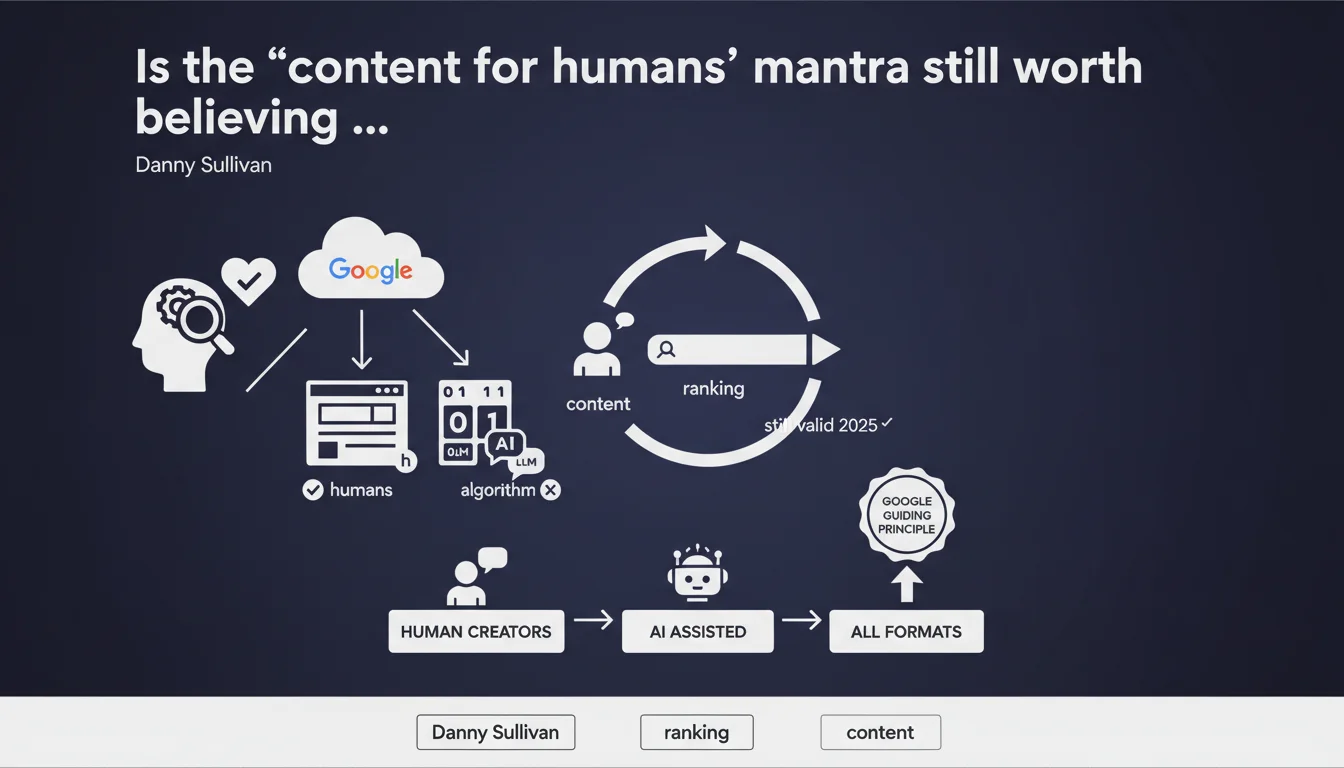
Google reaffirms that all its ranking systems aim to reward content created for humans, not for algorithms or LLMs. This principle now applies to all formats, including those generated by AI. In other words: the intent remains to evaluate the value perceived by the end user, regardless of the mode of production.
What you need to understand
Why is Google still insisting on this principle in 2025?
Because the massive arrival of AI-generated content has muddied the waters. Millions of pages are now produced by LLMs, and Google wants to clarify its position: it's not the production method that matters, but the quality perceived by the end user.
This statement comes at a time when the distinction between "human content" and "automated content" is becoming blurred. Google wants to prevent SEO professionals from falling into the trap of over-optimizing for its systems — or worse, for other LLMs — at the expense of actual user experience.
What does this actually change for ranking?
In theory, nothing. In practice, it repositions the needle. Google asserts that its ranking algorithms evaluate relevance, usefulness, reliability — criteria centered on humans. It doesn't matter whether the text is written by hand or generated by GPT-4.
The underlying message: if you create content solely to boost volume, check SEO technical boxes, or feed your own AI models, you're taking a risk. The algorithm looks for signals of engagement, satisfaction, added value — not keyword density.
How to interpret "created for humans, not for LLMs"?
This nuance is new. Google knows that some publishers produce content specifically formatted to be well understood and reused by other AIs — what's sometimes called "LLM-ready content." Ultra-normalized structures, implicit XML formatting, concept repetitions… all of this can appeal to a language model without providing anything to a reader.
Google says: that's not our target. The north star remains the end user, not an algorithmic intermediary, even if it's supposed to serve that user. It's a position of principle, not necessarily verifiable in fact — but it sets a framework.
- The mode of production (human, AI, hybrid) is not a ranking criterion in itself.
- Google evaluates the value perceived by the end user, not compliance with a technical checklist.
- Creating content to please other LLMs or maximize automatic indexing is not aligned with this logic.
- The principle applies to all formats: text, video, audio, interactive.
SEO Expert opinion
Does this statement hold up under real-world observation?
Partially. On paper, yes: Google rewards well-documented, structured, useful content. But in reality, we still observe technical signals that strongly influence ranking — semantic density, internal linking, loading speed, structured data.
Let's be honest: content that's "amazing for humans" but poorly optimized technically loses to mediocre content that's well-structured. Google's discourse remains a guiding ideal, not an exhaustive description of how rankings actually work.
What nuances should we add to this principle?
First nuance: the notion of "content for humans" is fuzzy. An article packed with technical jargon can be excellent for an engineer and unreadable for a beginner. Google doesn't define which human serves as the reference — it's up to you to know your audience.
Second nuance: generative AI often produces perfectly readable, informative, structured content… that is completely generic. This type of content may technically answer the query, but lacks differentiation, angle, real added value. Google says it's aiming for "perceived quality," but its systems still struggle to detect what is truly distinctive.
In what cases does this rule not really apply?
On simple transactional queries or local searches, user experience trumps content itself. An e-commerce site with basic product sheets but a fluid purchasing journey can outrank a competitor with elaborate storytelling.
Another case: data aggregators. Google indexes and ranks well pages that compile information (hours, prices, technical specs) without any "content for humans" in the editorial sense. Because the utility lies in the structure, not in narration.
Practical impact and recommendations
What should you actually do to align your strategy with this principle?
First action: audit your existing content to identify pages produced solely to rank, without real user value. If a page answers no clear intent, solves no problem, it's a candidate for redesign or removal.
Next, review your production processes. If you're using generative AI — which is perfectly legitimate — add a layer of human editing that brings an angle, concrete examples, domain expertise. Raw LLM text is rarely sufficient.
Finally, test user satisfaction directly: surveys, heatmaps, journey analysis. Google says it's targeting "humans," so measure what your actual humans think and do on your pages.
What mistakes should you absolutely avoid?
Mistake #1: believing that "content for humans" means ignoring technical SEO. Wrong. Great content that's invisible remains useless. Technical optimization is the vehicle, not the enemy of user experience.
Mistake #2: producing at scale without differentiation. If your strategy rests on 500 AI-generated pages with minimal variations, you're exactly what Google is targeting. Volume doesn't compensate for lack of added value.
Mistake #3: assuming Google automatically detects AI. It's not a penalty criterion in itself. But if your content looks like filler, whether human or automated, it risks being downranked for other reasons (low engagement, semantic duplication, lack of trust signals).
How to verify that your site respects this logic?
Ask yourself a simple question for each page: "If Google didn't exist, would I publish this content?" If the answer is no, that's a warning sign.
Also check engagement metrics in Google Analytics or Search Console: time spent, pages per session, adjusted bounce rate. If users quickly leave your page after a search, Google sees it — and it weighs.
- Audit pages without clear user intent or real added value
- Add a layer of human editing to all AI-generated content
- Measure user satisfaction with qualitative tools (heatmaps, surveys)
- Never sacrifice technical optimization in the name of "human content"
- Avoid mass production without differentiation or editorial angle
- Analyze engagement signals (time spent, bounce, pages/session)
- Apply the test: "Would I publish this content if Google didn't exist?"
🎥 From the same video 12
Other SEO insights extracted from this same Google Search Central video · published on 17/12/2025
🎥 Watch the full video on YouTube →
💬 Comments (0)
Be the first to comment.