
Official statement
Other statements from this video 12 ▾
- □ Should you abandon AEO and GEO acronyms in favor of the classic SEO approach?
- □ Should you really ignore AI Overviews in your SEO strategy?
- □ Is the 'content for humans' mantra still worth believing in 2025?
- □ Should you stop optimizing for Google's AI Overviews?
- □ Has technical SEO really become automatic thanks to modern CMS platforms?
- □ Is original and authentic content really your best weapon against AI?
- □ Is basic factual content becoming useless for SEO?
- □ Will first-hand experience content really become Google's dominant ranking factor?
- □ Is multimodal content really the key to multiplying your visibility in Google?
- □ Should you stop obsessing over organic clicks and start measuring what actually converts?
- □ Is your site missing from AI Overview even though it ranks well in traditional search results?
- □ Should you really optimize your content differently for each AI and search system?
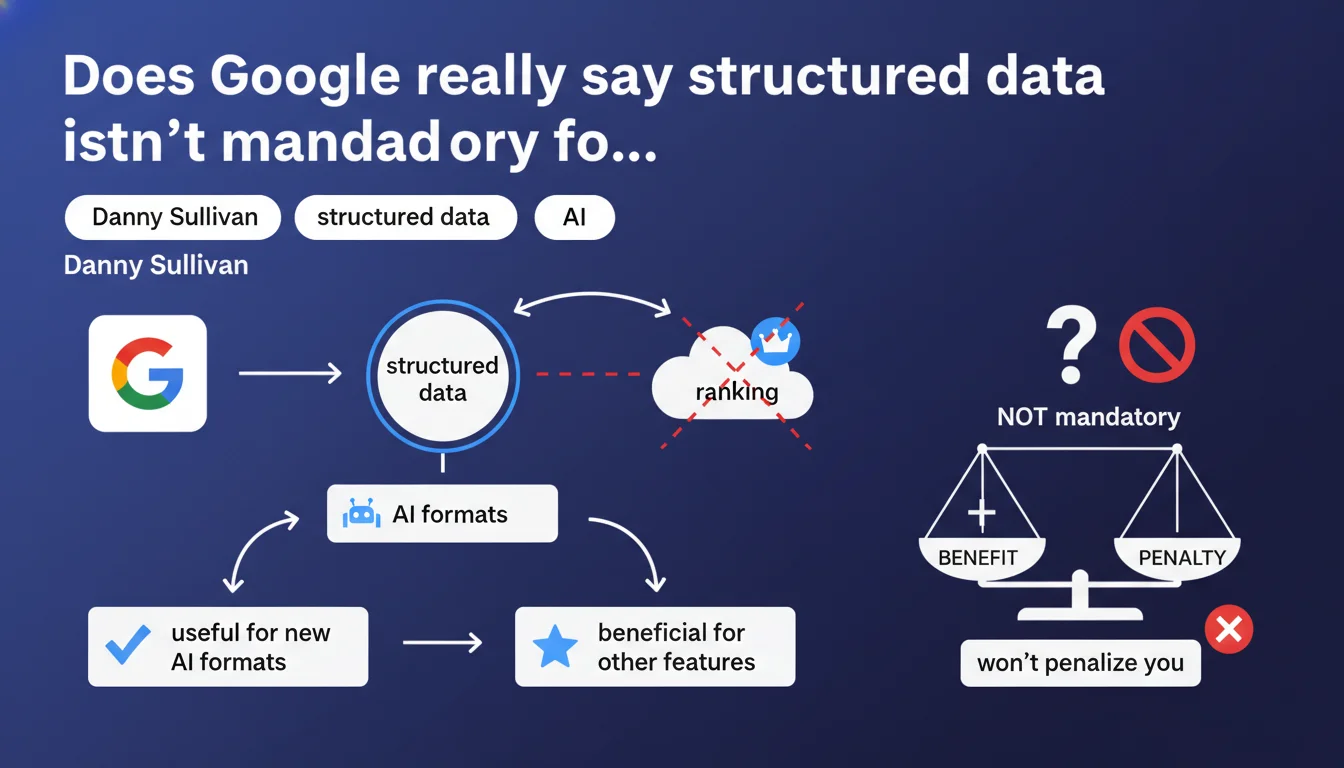
Google confirms that structured data remains relevant for AI and rich features, but doesn't require it. Its absence triggers no penalty — which doesn't mean it's worthless. In short, useful but not compulsory.
What you need to understand
Why does Google emphasize that structured data isn't essential?
This statement aims to defuse the anxiety of those who fear being excluded from AI results due to imperfectly implemented schema.org. Google reaffirms that its engine can extract information without explicit markup — thanks to natural language processing and contextual analysis of content.
In other words: if you don't have the resources to mark everything up, you won't be blacklisted. But don't confuse "not essential" with "useless".
Which formats and features benefit from structured data?
Rich snippets, recipe carousels, enriched product cards, FAQs, events, reviews — all rely on schema.org. For AI Overviews and generative answers, Google can leverage these tags to contextualize faster and display structured sources.
In short: structured data facilitates extraction and formatting. It doesn't create content, but it speeds up machine understanding.
What does "not having it won't penalize you" really mean?
This is typical Google phrasing: absence of a penalty doesn't mean absence of a benefit. If your competitor gains a rich snippet through proper markup and you don't, you lose visibility — without being "penalized" in algorithmic terms.
Google plays with words. You don't lose rankings through punishment, but you lose clicks through missed opportunity.
- Structured data facilitates display in rich formats and generative AI
- Its absence triggers no direct algorithmic penalty
- But it can reduce visibility in rich results and AI summaries
- Google can understand without markup, but with markup, it's faster and more reliable
SEO Expert opinion
Is this statement consistent with what we observe in the field?
Yes and no. On informal queries, Google can indeed extract meaning without schema.org. However, on e-commerce, events, or local verticals, the absence of markup drastically reduces chances of appearing in rich modules.
We've also found that some sites without markup can appear in AI Overviews — but they show up as raw citations without structured presentation. A competitor with markup will often get more explicit display (price, reviews, availability).
In which cases does structured data become truly critical?
On three verticals in particular: e-commerce (Product, Offer, Review), events (Event), and local (LocalBusiness). On these segments, lack of markup equals invisibility in carousels, Knowledge Panels, or Google Shopping.
For everything else — blog articles, editorial content — the gain is real but less decisive. Unless you're targeting FAQ snippets or HowTo features, where markup often makes the difference.
Should you keep investing in structured markup?
Let's be honest: if you're in a competitive market, not doing it amounts to leaving room for competitors. Google doesn't make it mandatory, but it rewards those who make its job easier.
Implementation cost is moderate, visibility gain can be substantial. Unless you're in an ultra-niche where nobody benefits from rich snippets, the trade-off clearly favors markup.
Practical impact and recommendations
What should you do concretely on your site?
Start by auditing what exists. Use Google Search Console (Improvements > Structured Data section) and Rich Results Test to identify errors and missed opportunities.
Prioritize schemas with direct CTR impact: Product, Review, FAQ, Breadcrumb, Article. Don't waste time on exotic markup — focus on what generates visible enriched displays.
What mistakes should you avoid during implementation?
Avoid misleading markup (fake reviews, inaccurate prices). Google can remove you from rich results — and there, you'll actually be penalized, contrary to what Sullivan says.
Don't overload markup either: one schema per main element, not ten nested schemas for show. Google values clarity, not complexity.
How do you ensure markup stays current and relevant?
Set up regular monitoring: schema types evolve, Google removes some, prioritizes others. What worked two years ago may be obsolete today.
Also test AI compatibility: verify if your marked-up content appears correctly in generative summaries. It's still empirical, but it gives clues about what Google prioritizes.
- Audit existing structured data via Search Console
- Implement as priority Product, Review, FAQ, Article, Breadcrumb
- Validate with Rich Results Test before production launch
- Avoid misleading markup — Google can penalize
- Monitor schema evolution and adjust regularly
- Test display in rich results and generative AI
🎥 From the same video 12
Other SEO insights extracted from this same Google Search Central video · published on 17/12/2025
🎥 Watch the full video on YouTube →
💬 Comments (0)
Be the first to comment.