
Official statement
Other statements from this video 16 ▾
- □ Le SEO Starter Guide de Google est-il vraiment le meilleur point de départ pour apprendre le référencement ?
- □ Faut-il vraiment définir objectifs et conversions avant d'optimiser son SEO ?
- □ Faut-il vraiment adapter sa stratégie SEO à l'audience avant d'optimiser techniquement ?
- □ Les CMS courants comme WordPress suffisent-ils vraiment pour le SEO technique ?
- □ Faut-il vraiment tester l'indexation d'un site en cherchant son nom de domaine sur Google ?
- □ Faut-il vraiment interroger vos clients pour bâtir votre stratégie SEO ?
- □ Les petits sites peuvent-ils vraiment tester librement sans risque SEO ?
- □ Pourquoi Martin Splitt insiste-t-il autant sur l'installation de Search Console et d'outils de mesure ?
- □ Combien de temps faut-il vraiment pour qu'une modification de contenu soit visible dans Google ?
- □ Peut-on vraiment rechercher son propre site sur Google sans risque ?
- □ Pourquoi les environnements de staging sont-ils inefficaces pour tester vos optimisations SEO ?
- □ Faut-il embaucher un expert SEO uniquement quand on peut mesurer son ROI ?
- □ Les promesses de classement #1 sont-elles toutes des arnaques SEO ?
- □ Les Search Essentials de Google sont-elles vraiment le mode d'emploi du SEO ?
- □ Pourquoi certaines optimisations SEO prennent-elles des mois à produire des résultats ?
- □ Votre site web est-il toujours indispensable à l'ère de l'IA générative ?
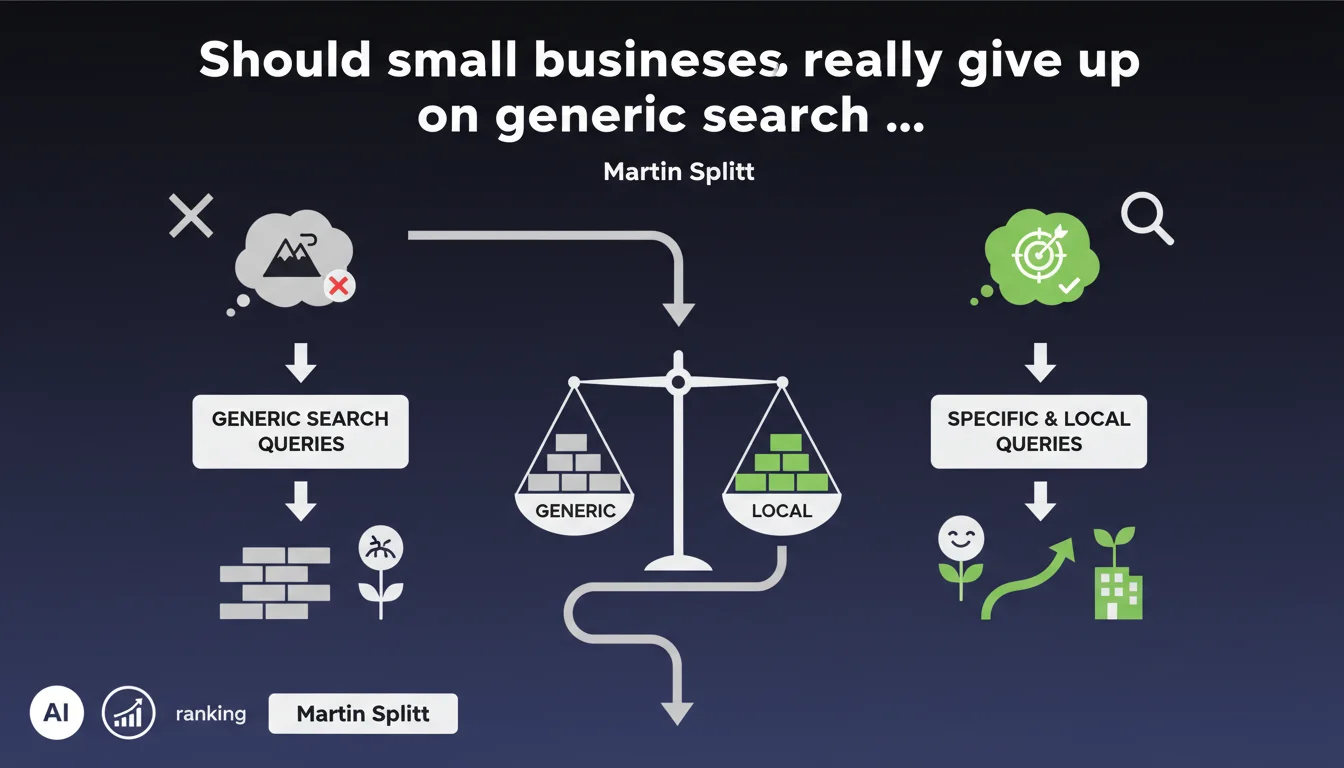
Martin Splitt reminds small businesses of a hard truth: ranking for ultra-competitive generic terms is unrealistic. It's better to target specific and local queries where competition is less fierce and conversion probability is higher.
What you need to understand
Martin Splitt's statement reflects SEO pragmatism. It reminds companies of modest size that there is a hierarchy of difficulty when it comes to keyword targeting. Generic terms with high search volume attract players with colossal budgets, making competition unbalanced.
Google's message here is straightforward: choose your battles. Rather than wasting resources and time on unattainable goals, focus on niches where your expertise and geographic proximity become decisive advantages.
Why does Google emphasize this distinction so much?
Because too many businesses waste months optimizing for queries where they have virtually no real chance of breaking through. Google likely observes massive wastage of poorly directed SEO efforts, which harms user experience (low-relevance sites trying to force their presence) and search result quality.
By directing small structures toward more specific queries, Google encourages an ecosystem where each player finds their place. Long-tail and local queries often convert better, benefiting both users and businesses.
What criteria define an "unrealistic" query for a small business?
Several signals indicate a term is out of reach: very high search volume, SERPs dominated by national or international brands, astronomical advertising budgets on Google Ads for that term, and overwhelming domain authority among competitors in position.
If your DA caps at 20 and the top three results all have DA above 70, that's a clear signal. Similarly, if ranked sites have hundreds of thousands of backlinks while you have a few hundred, the battle is lost before it starts.
What exactly do we mean by "specific and local queries"?
Specific queries incorporate niche modifiers: product features, precise use cases, detailed customer problems. Instead of "running shoes," target "women's trail running shoes for overpronation." Competition collapses and intent sharpens.
Local queries add a geographic dimension: "plumber Paris 15th," "vegetarian restaurant Lyon Part-Dieu." Google naturally favors local players for these terms, especially via Google Business Profile and maps. Your proximity becomes a natural filter that eliminates big national players.
- Accept the limits of your competitive situation rather than exhausting yourself on unrealistic goals
- Prioritize long-tail queries that combine modest volume with high conversion rates
- Leverage local anchoring as a competitive advantage against national giants
- Measure keyword feasibility before investing time and money
- Align SEO objectives with available resources to maximize ROI
SEO Expert opinion
Is this vision consistent with real-world observations?
Absolutely. Any experienced practitioner has seen clients insist on "car insurance" or "attorney" when they lack backlinks, budget, or content structure to compete. These sites languish on pages 5-6, invisible, while their local competitors crush it on "young driver car insurance Toulouse" with three times less effort.
What Splitt doesn't say explicitly—but data confirms—is that Google actively favors geographic and sectoral diversity in its results. A small local business well-optimized can beat a national giant on a geolocalized query, even with lower DA. It's an underexploited lever.
What nuances should we add to this recommendation?
First nuance: "unrealistic" doesn't mean "impossible forever." A progressive strategy can start on long-tail to accumulate authority and backlinks, then gradually move up toward more generic terms. But that takes years, not months.
Second nuance: some sectors have less competitive generic queries than you'd think. An apparently broad term can be dominated by mediocre players if the industry is poorly digitalized. [To verify] before giving up: really analyze the SERP, don't assume.
Third nuance: semantic variations of a generic term can be accessible. "Running shoes" is unattackable, but "best running shoes for marathons" or "how to choose running shoes for beginners" open doors. Google no longer thinks in isolated keywords but in thematic clusters.
In what cases can this rule be circumvented?
If you have significant marketing budget and a dedicated team, you can attempt a hybrid SEO/SEM strategy to grab positions on generics, accepting negative short-term ROI. Some do this for branding reasons, not immediate profit.
Another exception: emerging niches where generic terms haven't yet been locked down by leaders. If you're a pioneer in a nascent market, go after generics before competition arrives. But these windows close quickly.
Practical impact and recommendations
What concrete steps should you take to identify the right keywords?
Start with a feasibility audit: list your target keywords, analyze the top 10 results for each (DA, backlinks, content freshness, site structure). If the gap is abysmal, immediately pivot to long-tail variations.
Use Google Search Console to identify queries where you're already ranking 11-30. These are your quick wins: you have a foundation, just optimize it. Concentrate there rather than starting from scratch on an impossible term.
For local, ensure your Google Business Profile is flawless: updated hours, regular photos, precise categories, review responses. Combine it with localized pages on your site ("Our services in [city]") and consistent citations in local directories.
What mistakes should you avoid when targeting keywords?
Classic mistake: relying solely on search volume. A term with 50,000 monthly searches but inaccessible gets you zero visitors. A term with 200 searches where you rank first brings in 80 qualified visitors. Do the math.
Another trap: neglecting search intent. A keyword may seem perfect in volume and feasibility, but if intent is informational while you're selling a service, conversion rate will be catastrophic. Analyze SERPs to understand what Google considers the expected answer.
Finally, don't scatter your efforts. It's better to dominate 10 specific queries than be invisible on 50 generics. Concentrated effort pays more in SEO than a scattered strategy.
How do you measure if your keyword targeting strategy works?
Track your positions on chosen queries, but especially measure qualified organic traffic and conversion rate. If positions improve but traffic stagnates, search volume was overestimated or intent doesn't match.
Monitor organic CTR in Search Console too. Good targeting generates high CTR because your title/meta exactly matches what the searcher wants. Low CTR despite good positions signals misalignment between your content and the query.
- Analyze full SERP (DA, backlinks, freshness) before targeting a keyword
- Prioritize queries where you're already ranking 11-30 for quick wins
- Create dedicated pages by city or service area for local
- Optimize Google Business Profile with photos, hours, precise categories
- Build semantic clusters around each theme rather than isolated keywords
- Measure qualified traffic and conversions, not just positions
- Accept abandoning generic terms if competitive gap is too large
The strategy Google recommends rests on a simple principle: concentrate your efforts where you have a real chance to win. For most small businesses, this means abandoning generic queries in favor of specific niches and local anchoring.
This approach requires fine-grained competitive analysis, precise understanding of search intent, and the ability to identify long-tail opportunities. It also demands resisting the temptation of high volume in favor of relevance and feasibility.
For many businesses, this strategic shift represents a complete turnaround in their SEO approach. Identifying the right keywords, structuring coherent semantic architecture, and finely optimizing for local require pointed expertise and regular monitoring. In this context, engaging a specialized SEO agency can be crucial to avoid costly mistakes and accelerate results without wasting resources on inaccessible objectives.
❓ Frequently Asked Questions
Comment savoir si un mot-clé est trop compétitif pour mon site ?
Les requêtes locales fonctionnent-elles vraiment mieux pour les petites entreprises ?
Peut-on remonter vers des requêtes génériques après avoir démarré sur la longue traîne ?
Les outils SEO sont-ils fiables pour évaluer la faisabilité d'un mot-clé ?
Combien de requêtes spécifiques faut-il cibler pour compenser l'absence de trafic sur les génériques ?
🎥 From the same video 16
Other SEO insights extracted from this same Google Search Central video · published on 10/07/2025
🎥 Watch the full video on YouTube →
💬 Comments (0)
Be the first to comment.