
Official statement
Other statements from this video 16 ▾
- □ Le SEO Starter Guide de Google est-il vraiment le meilleur point de départ pour apprendre le référencement ?
- □ Faut-il vraiment définir objectifs et conversions avant d'optimiser son SEO ?
- □ Faut-il vraiment adapter sa stratégie SEO à l'audience avant d'optimiser techniquement ?
- □ Les CMS courants comme WordPress suffisent-ils vraiment pour le SEO technique ?
- □ Faut-il vraiment tester l'indexation d'un site en cherchant son nom de domaine sur Google ?
- □ Faut-il vraiment renoncer aux requêtes génériques quand on est une petite entreprise ?
- □ Les petits sites peuvent-ils vraiment tester librement sans risque SEO ?
- □ Pourquoi Martin Splitt insiste-t-il autant sur l'installation de Search Console et d'outils de mesure ?
- □ Combien de temps faut-il vraiment pour qu'une modification de contenu soit visible dans Google ?
- □ Peut-on vraiment rechercher son propre site sur Google sans risque ?
- □ Pourquoi les environnements de staging sont-ils inefficaces pour tester vos optimisations SEO ?
- □ Faut-il embaucher un expert SEO uniquement quand on peut mesurer son ROI ?
- □ Les promesses de classement #1 sont-elles toutes des arnaques SEO ?
- □ Les Search Essentials de Google sont-elles vraiment le mode d'emploi du SEO ?
- □ Pourquoi certaines optimisations SEO prennent-elles des mois à produire des résultats ?
- □ Votre site web est-il toujours indispensable à l'ère de l'IA générative ?
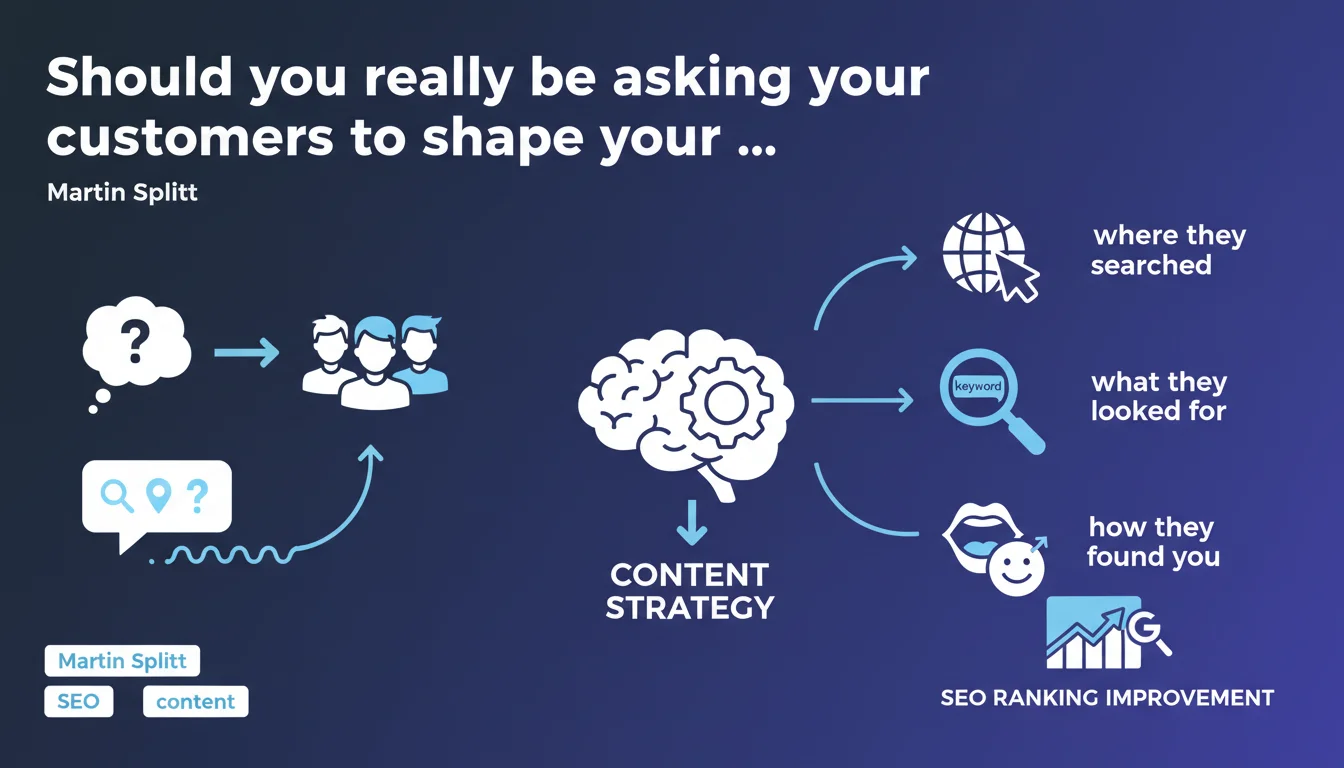
Martin Splitt recommends asking customers directly how they found your business to build a relevant content strategy. This approach places real behavioral data at the heart of optimization, rather than relying solely on traditional SEO tools. In practice, Google suggests leveraging user verbatims to identify actual search queries and real friction points.
What you need to understand
Why does Google insist on direct customer feedback?
Splitt's statement aligns with the user-centric logic that Google has been emphasizing for years. Algorithms aim to satisfy real search intent, not the intent imagined by SEOs. Questioning customers directly reveals the natural vocabulary they use, the questions they ask before converting, and unexpected customer journeys.
This approach bypasses the bias of keyword suggestion tools that often only reflect estimated search volumes without emotional or intentional context. A customer who says "I was looking for a solution to reduce my energy bills" provides more intelligence than a keyword planner showing "reduce electricity bill" at 800 searches per month.
What specific information should you collect from customers?
Splitt mentions three axes: how they found you (acquisition channel), what they were looking for (intent and exact wording), and where they searched (platforms, including outside Google). This triangulation often reveals surprises—Reddit forums, Facebook groups, or niche blogs that drive qualified traffic but don't appear in any backlink checker.
The goal is to detect gaps between your SEO assumptions and ground reality. If 40% of your customers say they searched on YouTube before finding you, your video strategy becomes a priority, even if your GA4 dashboard doesn't signal it clearly.
How does this method differ from traditional analytics?
Google Analytics or Search Console tell you which queries worked, but rarely why they worked or what the user really hoped to find. A customer who converts after "plumber Paris 15" might have actually been looking for "someone who answers on weekends"—a nuance invisible in metrics.
Post-purchase surveys or qualitative interviews reveal micro-decision moments: the reassuring word on a product page, the customer review that tipped the scales, the FAQ that resolved a doubt. These insights allow you to optimize not just for ranking, but for conversion and retention.
- Real user vocabulary vs. third-party tool estimates
- Identification of overlooked channels (forums, social networks, digital word-of-mouth)
- Detection of friction points in the search journey
- Understanding of contextual intent behind queries
- Content prioritization based on expressed needs, not estimated volumes
SEO Expert opinion
Is this recommendation actually being applied by professional SEOs?
Let's be honest: very few agencies or SEO consultants systematically integrate qualitative customer interviews into their process. Most rely on Search Console data, position tracking tools, and competitive analysis. Yet the rare ones who do report major discoveries—unexploited semantic niches, recurring customer objections that no page addresses.
The problem? This approach requires time, cross-team coordination (sales, support, marketing) and a qualitative data culture that many organizations lack. Google knows this well. Recommending this approach is consistent with their "user-first" vision, but it's also an indirect way of reminding pure-play SEOs that ignoring ground-level feedback misses the essentials.
What limitations does this approach present in practice?
Direct customer feedback suffers from several biases. First, the memory bias—people forget or rationalize their search journey. Someone might say "I found your site on Google" when they first clicked a Facebook ad, then searched your brand name. Cross-referenced analytics remain essential.
Then there's survivorship bias: you interview those who converted, not those who bounced after 5 seconds. Lost customers would have equally valuable insights into what doesn't work—poorly worded pages, off-topic content, deceptive title promises.
In which contexts does this tactic deliver the most value?
This approach shines particularly in complex B2B, where sales cycles are long and decision-makers consult 10-15 sources before contacting a supplier. Identifying third-party content (comparison sites, professional forums, LinkedIn groups) that influences decisions allows you to target strategic backlinks or partnerships.
In niche e-commerce, asking customers about the "problem" queries they searched before finding your solution often reveals content opportunities—guides, comparisons—that generate qualified traffic upstream of the funnel. [To verify]: the real impact on rankings is rarely measurable in isolation, but the combined effect on conversion rate and repeat purchase is often significant.
Practical impact and recommendations
How do you practically structure this customer feedback collection?
Integrate a simple post-purchase survey into your confirmation journey. Three questions suffice: "How did you discover our business?", "What exact search did you do before finding us?", "Did you consult other sites or resources?". Provide open-ended fields, not checkboxes—you want raw verbatim.
For high-value customers, schedule short interviews (10-15 minutes) with your sales or support team. Ask them to note exact wording used, hesitations expressed, content consulted. Centralize this data in a shared tool—Notion, Airtable—accessible to the SEO team.
What mistakes should you avoid when leveraging this data?
Don't turn every verbatim into a dedicated page without checking search volume and ranking feasibility. A single customer who typed an ultra-specific query doesn't necessarily justify editorial investment. Look for recurring patterns—if 20% of your customers mention the same objection or friction point, you've found a goldmine.
Also avoid over-optimizing for your current audience at the expense of acquisition. Existing customers often found your brand through roundabout paths (word-of-mouth, referral, brand search). To scale, you must also target generic and informational queries that reach cold prospects.
How do you integrate these insights into your editorial roadmap and technical strategy?
Create a prioritization matrix crossing mention frequency, estimated search volume, and SEO difficulty. Quick wins—recurring verbatims + low competition—move to priority 1. High-volume but saturated topics need a differentiation approach (unique angle, original format, strengthened authority).
On the technical side, if your customers mention difficulty finding certain information (price, availability, specific FAQs), that's a signal your architecture or semantic markup needs work. Audit structured data, internal linking, and visibility of key content.
- Install a post-purchase survey with open-ended fields (no closed multiple choice)
- Train sales and support teams to note customer verbatims during conversations
- Centralize feedback in a collaborative tool accessible to the SEO team
- Cross-reference verbatims with Search Console and Analytics to detect gaps
- Identify third-party channels mentioned (forums, networks, blogs) for backlink opportunities
- Prioritize content by mention frequency + search volume + difficulty
- Audit site architecture if customers report navigation difficulties
- Test content formats aligned with expressed preferences (video, comparisons, detailed FAQs)
❓ Frequently Asked Questions
Faut-il interroger tous les clients ou un échantillon suffit-il ?
Comment exploiter les verbatims clients sans cannibaliser le SEO existant ?
Les clients mentionnent souvent des canaux hors-Google (YouTube, forums). Comment les intégrer à la stratégie SEO ?
Quelle fréquence adopter pour cette collecte de feedback ?
Comment convaincre la direction d'investir du temps dans cette approche qualitative ?
🎥 From the same video 16
Other SEO insights extracted from this same Google Search Central video · published on 10/07/2025
🎥 Watch the full video on YouTube →
💬 Comments (0)
Be the first to comment.