
Official statement
Other statements from this video 16 ▾
- □ Is Google's SEO Starter Guide really the best foundation to learn search engine optimization from scratch?
- □ Should you really define goals and conversions before optimizing your SEO?
- □ Should you really tailor your SEO strategy to your audience before optimizing technically?
- □ Are popular CMS platforms like WordPress really enough for serious technical SEO?
- □ Is searching your domain name on Google really enough to verify your site's technical health?
- □ Should you really be asking your customers to shape your SEO strategy?
- □ Should small businesses really give up on generic search queries?
- □ Can small websites really test freely without major SEO risks?
- □ How long does it really take for a content change to show up in Google search results?
- □ Is it really safe to search for your own website on Google without getting penalized?
- □ Why can't you rely on staging environments to validate your SEO improvements?
- □ Should you only hire an SEO expert once you can actually measure the ROI?
- □ Are all #1 ranking guarantees really SEO scams?
- □ Are Google's Search Essentials really the ultimate SEO rulebook you need to follow?
- □ Why do some SEO optimizations take months to deliver results?
- □ Is your website still essential in the age of generative AI?
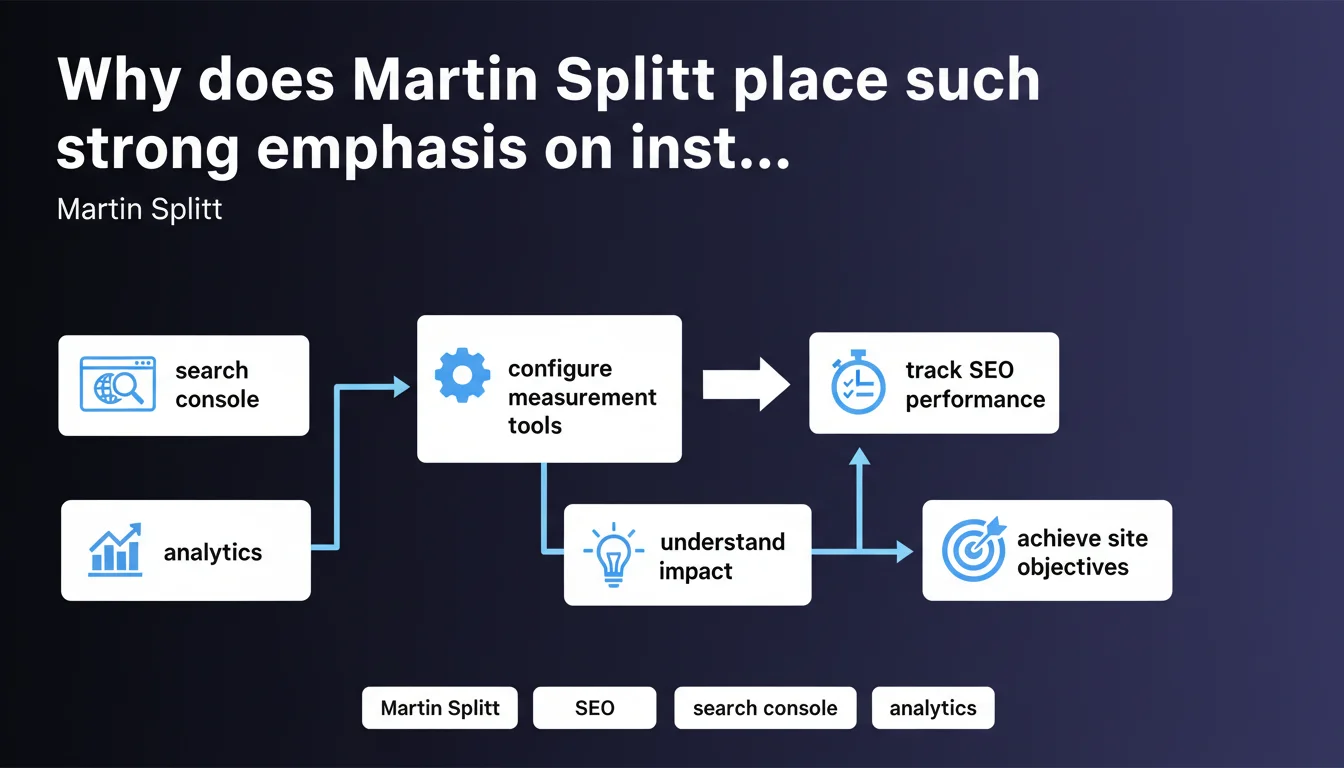
Google emphasizes that Search Console and an analytics system are essential for measuring the real impact of your SEO actions. Without these tools, there's no way to know whether your optimizations are delivering concrete results or missing the mark entirely.
What you need to understand
Why does Google insist on what seems like an obvious point?
Because Martin Splitt regularly observes that websites — even professional ones — neglect or misconfigure their measurement tools. The result: SEO decisions made blind, without reliable data to validate assumptions.
Search Console isn't just a passive reporting tool. It's the official channel through which Google signals indexing issues, technical errors, manual penalties and anomalies detected by algorithms.
What does "a measurement system" concretely mean?
Google is talking about analytics — Google Analytics, of course, but also any other tool capable of correlating organic traffic with business objectives. The idea is to link SEO KPIs (impressions, clicks, rankings) to conversions, revenue, and actual bounce rates.
Without this layer, you're optimizing in a vacuum. You might gain traffic on keywords that don't convert, or lose rankings on queries that were never valuable to you anyway.
What pitfalls should you avoid when setting this up?
The most common: installing tools without configuring them properly. A misplaced tag, overly aggressive analytics filters, a Search Console property not verified across all domain variants — and you end up with partial or biased data.
Another classic mistake: looking only at impressions and clicks without cross-referencing user behavior post-click. If your traffic skyrockets but conversion rates plummet, it's a sign you're attracting the wrong audience.
- Search Console : essential for diagnosing technical problems (404 errors, coverage, Core Web Vitals, sitemaps)
- Analytics : necessary to measure the real business impact of SEO optimizations
- Correlation between the two : the only way to validate that organic traffic gains translate into conversions
- Rigorous configuration : domains, subdomains, HTTPS/HTTP, trailing slashes — every variant must be tracked correctly
SEO Expert opinion
Is this recommendation still consistent with observed practices?
Yes, but it also reveals a gap in Google's communication. If Splitt brings up this basic point, it's because many sites still neglect these fundamentals — and that's a structural problem in the industry.
We regularly see e-commerce sites that invested tens of thousands of euros in technical redesigns, but never verified whether their analytics tags were working. Result: impossible to measure the ROI of optimizations.
What nuances should you add to this statement?
Search Console is non-negotiable — that's beyond debate. But the choice of analytics tool deserves careful thought. Google Analytics 4 is free and powerful, but it has limitations — notably data sampling for large sites and the progressive loss of long-session data.
Some professionals prefer Matomo, Adobe Analytics or custom stacks. The key is having a tool that allows you to segment organic traffic by search intent, track assisted conversions, and identify zombie pages that drain crawl budget without adding value.
In what cases might this rule not apply strictly?
Let's be honest: for a 10-page brochure site with no conversion goals, installing a complete analytics stack is overkill. But as soon as there's a business intent behind organic traffic, this rule becomes non-negotiable.
Some sites in launch phase prefer to wait before installing Search Console to avoid polluting historical data with pre-production errors. It's a defensible strategy, but it should remain temporary — beyond a few weeks, you're losing critical signals.
Practical impact and recommendations
What concrete steps should you take to follow this recommendation?
First step : Verify that Search Console is properly installed across all domain variants (www, non-www, HTTPS, HTTP if applicable). Add all relevant administrators and developers as users — a single account is a loss-of-access risk.
Second step : Install and configure an analytics tool capable of tracking business objectives. If you use GA4, define clear conversion events (purchases, leads, downloads, qualified session duration). Segment your organic traffic by page type and search intent.
Third step : Regularly cross-reference Search Console and analytics data to identify inconsistencies. If Search Console shows 10k clicks on a landing page but analytics only sees 7k, you have a tracking problem.
What mistakes should you avoid during setup?
Don't fail to validate all domain properties in Search Console. Google treats example.com and www.example.com as two distinct entities — if you only validate one, you lose half your data.
Forgetting to configure exclusions in analytics: internal traffic, bots, spam referrers. Without these filters, your data is polluted and decisions based on it are flawed.
Never checking the reports. Installing tools is fine — but if nobody reviews Search Console alerts or analyzes analytics trends, you might as well not bother.
- Validate all domain variants (www, non-www, HTTPS) in Search Console
- Add multiple administrators to prevent access loss if someone leaves
- Install an analytics tool (GA4, Matomo, Adobe) with conversion tracking
- Configure conversion events aligned with actual business objectives
- Exclude internal traffic, bots, and spam referrers in analytics filters
- Regularly cross-reference Search Console and analytics data to catch inconsistencies
- Automate alerts for sudden traffic drops or critical indexing errors
❓ Frequently Asked Questions
Search Console est-il obligatoire pour être indexé par Google ?
Peut-on utiliser un autre outil analytics que Google Analytics ?
Faut-il vraiment croiser Search Console et analytics, ou l'un des deux suffit ?
Combien de temps faut-il pour voir des données fiables après installation ?
Que faire si Search Console et analytics donnent des chiffres différents ?
🎥 From the same video 16
Other SEO insights extracted from this same Google Search Central video · published on 10/07/2025
🎥 Watch the full video on YouTube →
💬 Comments (0)
Be the first to comment.