
Official statement
Other statements from this video 16 ▾
- □ Is Google's SEO Starter Guide really the best foundation to learn search engine optimization from scratch?
- □ Should you really define goals and conversions before optimizing your SEO?
- □ Should you really tailor your SEO strategy to your audience before optimizing technically?
- □ Are popular CMS platforms like WordPress really enough for serious technical SEO?
- □ Is searching your domain name on Google really enough to verify your site's technical health?
- □ Should you really be asking your customers to shape your SEO strategy?
- □ Should small businesses really give up on generic search queries?
- □ Can small websites really test freely without major SEO risks?
- □ Why does Martin Splitt place such strong emphasis on installing Search Console and measurement tools?
- □ How long does it really take for a content change to show up in Google search results?
- □ Why can't you rely on staging environments to validate your SEO improvements?
- □ Should you only hire an SEO expert once you can actually measure the ROI?
- □ Are all #1 ranking guarantees really SEO scams?
- □ Are Google's Search Essentials really the ultimate SEO rulebook you need to follow?
- □ Why do some SEO optimizations take months to deliver results?
- □ Is your website still essential in the age of generative AI?
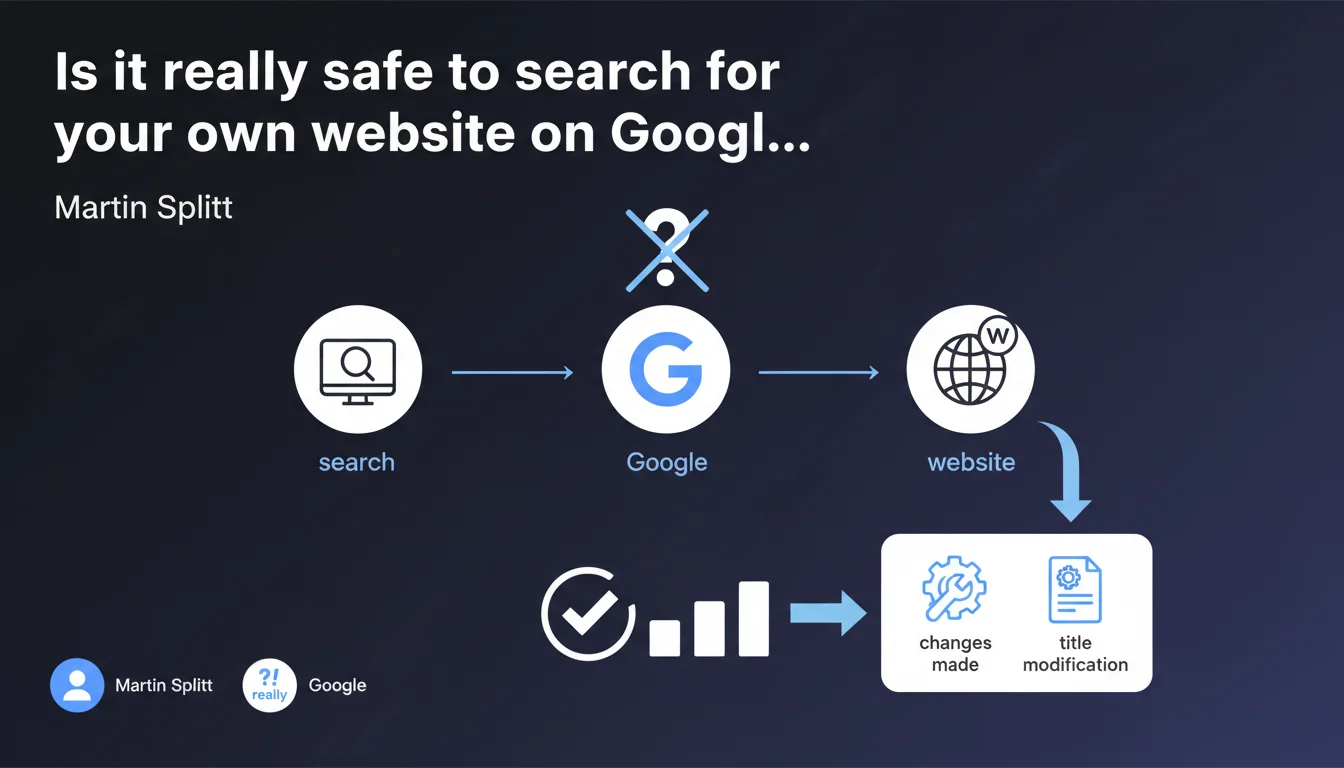
Google confirms there is no risk in searching your own site to verify changes (titles, meta descriptions, content). This common SEO practice triggers no penalties and raises no algorithmic red flags. End of urban myth.
What you need to understand
Where does this fear of searching your own site come from?
Many SEO practitioners have long avoided searching their own site for fear of sending contradictory signals to Google. The reasoning: if I click on my result but bounce back quickly (because I'm just checking a title), does Google interpret that as a bad user signal?
This concern rests on the idea that Google uses behavioral data (CTR, time spent, bounce rate) as direct ranking factors. Spoiler: it's more nuanced than that.
What exactly does Martin Splitt say?
The statement is crystal clear: searching your site is not prohibited. You can verify whether a title modification has been indexed, whether a new page appears, whether a rich snippet displays correctly. Google will not penalize you for doing this.
He doesn't explicitly clarify whether repeated clicks on your own result influence anything, but the underlying message is clear: this common practice is not an algorithmic problem.
What are the legitimate use cases?
- Verify the indexation of new content or a modified page
- Check the display of titles and meta descriptions after optimization
- Validate the appearance of rich snippets, FAQs, or other SERP features
- Monitor the presence of sitelinks, knowledge panel or other brand elements
- Compare mobile vs desktop positioning in real conditions
SEO Expert opinion
Is this reassurance consistent with field observations?
Yes. No one has ever documented a penalty related to searching your own site. The ranking variations observed after manual checks are either coincidental or due to other factors (competition, freshness, algorithmic fluctuations).
What's missing from this statement: Google doesn't say whether behavioral data from these searches (your CTR, your time on page, your browsing path) are filtered or weighted differently. We assume they are — via Google Account connection, repetitive patterns, etc. — but there's no official confirmation. [To verify]
In what cases can this practice skew your analysis?
Regularly searching your site on the same queries creates a personalization bias. Google adjusts results based on your browsing history, especially if you're logged into your account.
Result: you see your site artificially climb on certain queries, when an average user wouldn't see it at that position. This is why it's important to check rankings via third-party non-personalized tools or in private browsing + VPN.
Should you continue using Search Console rather than searching manually?
Search Console remains the source of truth for knowing your real performance (impressions, clicks, average position). It aggregates unbiased data across thousands of queries.
Searching manually is useful for spot visual checks: verifying that a snippet displays correctly, spotting a competitor climbing, testing a new SERP feature. But it's never a reliable method for measuring positions or trends.
Practical impact and recommendations
How do you check your site without skewing results?
If you absolutely must search your site manually, do it in private browsing (Incognito/Private). This avoids personalization linked to your search history and Google account.
Better yet: use a VPN with geolocation to simulate searches from different locations. Useful if you target multiple geographic areas or want to check local results without pollution from your usual IP.
- Use Search Console for objective performance data
- Check manually in private browsing to monitor visual display
- Use rank tracking tools to follow positions across hundreds of queries without bias
- Test on multiple devices and browsers (mobile, desktop, Chrome, Safari) to spot inconsistencies
- Never repeatedly click your own result from the same IP/account
What mistakes should you avoid during these checks?
Don't confuse manually observed position with real average position. Your result might appear at #3 in a single search, while the average position in Search Console is #8 on that query.
Avoid searching the same queries in a loop, logged into your Google account, from the same device. You'll end up seeing ultra-personalized results that don't reflect the experience of a neutral user.
Should you automate these checks?
Yes, but with caution. SERP scraping scripts can automate monitoring of your snippets, but Google detects and blocks automated queries via CAPTCHAs or IP bans.
Prioritize official APIs (Search Console API, professional rank tracker APIs) or solutions that rotate IPs and space out requests. Manual verification remains viable for spot checks after a major deployment.
❓ Frequently Asked Questions
Est-ce que Google peut détecter que je cherche mon propre site ?
Mes recherches manuelles peuvent-elles fausser mes statistiques dans la Search Console ?
Dois-je me déconnecter de mon compte Google avant de chercher mon site ?
Pourquoi mon site apparaît-il mieux positionné quand je le cherche moi-même ?
Les outils de rank tracking sont-ils plus fiables que les recherches manuelles ?
🎥 From the same video 16
Other SEO insights extracted from this same Google Search Central video · published on 10/07/2025
🎥 Watch the full video on YouTube →
💬 Comments (0)
Be the first to comment.