
Official statement
Other statements from this video 16 ▾
- □ Is Google's SEO Starter Guide really the best foundation to learn search engine optimization from scratch?
- □ Should you really define goals and conversions before optimizing your SEO?
- □ Should you really tailor your SEO strategy to your audience before optimizing technically?
- □ Are popular CMS platforms like WordPress really enough for serious technical SEO?
- □ Is searching your domain name on Google really enough to verify your site's technical health?
- □ Should you really be asking your customers to shape your SEO strategy?
- □ Should small businesses really give up on generic search queries?
- □ Can small websites really test freely without major SEO risks?
- □ Why does Martin Splitt place such strong emphasis on installing Search Console and measurement tools?
- □ Is it really safe to search for your own website on Google without getting penalized?
- □ Why can't you rely on staging environments to validate your SEO improvements?
- □ Should you only hire an SEO expert once you can actually measure the ROI?
- □ Are all #1 ranking guarantees really SEO scams?
- □ Are Google's Search Essentials really the ultimate SEO rulebook you need to follow?
- □ Why do some SEO optimizations take months to deliver results?
- □ Is your website still essential in the age of generative AI?
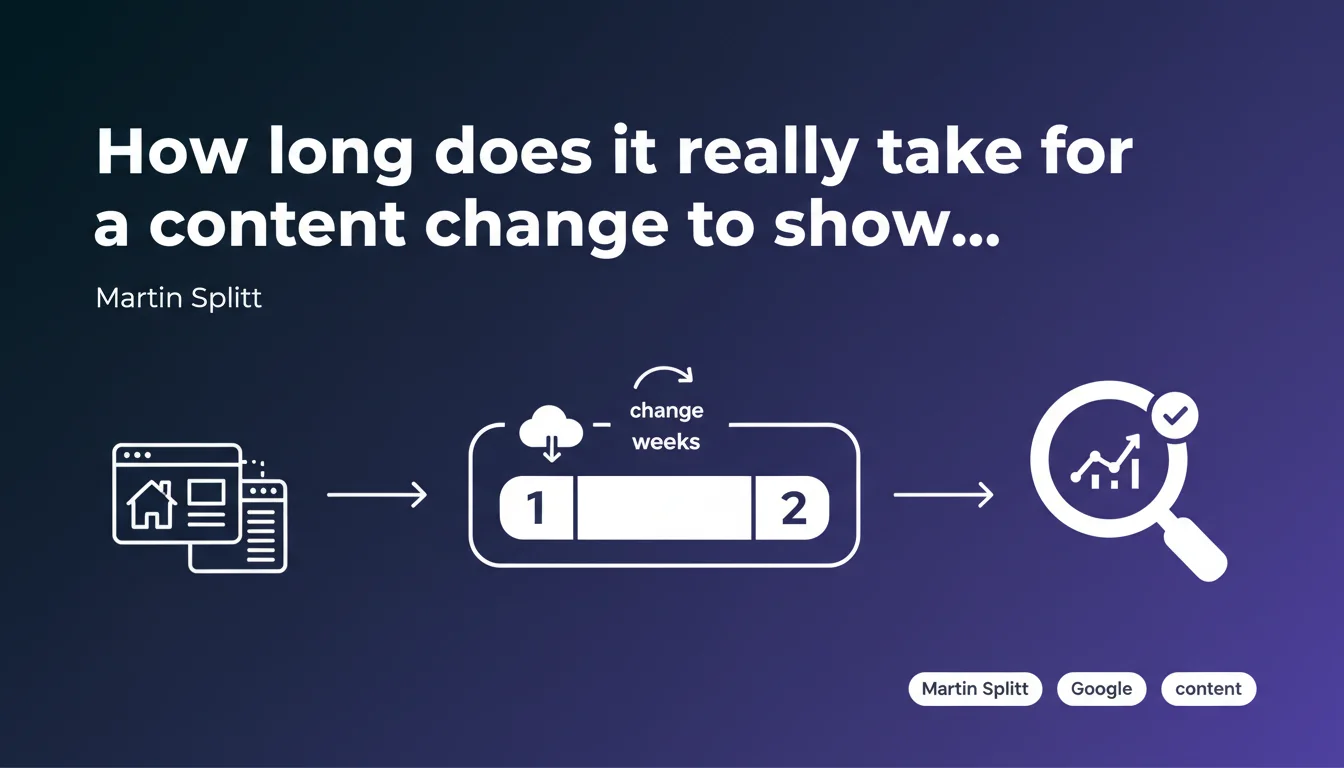
Martin Splitt claims that on a small website, content changes should appear in search results within 1 to 2 weeks. This timeframe only applies to minimal sites (homepage plus a few pages) and remains vague about what happens beyond that. In reality, it depends on multiple factors that Google doesn't detail here.
What you need to understand
What does Google actually mean by a "small site"?
Google is referring to a website composed of a homepage and a few pages. We're talking about a basic brochure website, probably fewer than 10 pages total. Once you go beyond that threshold — a blog, even a modest e-commerce site, a corporate website with dozens of pages — this estimate becomes obsolete.
The statement doesn't specify the exact page volume, the necessary crawl frequency, or the quality of internal linking. It's intentionally vague, which limits its usefulness for the vast majority of professional websites.
Why 1 to 2 weeks instead of immediately?
Because Google doesn't crawl in real time. Even on a small site, Googlebot needs to return, index the new content, and then the algorithm needs to re-evaluate rankings. This chain takes time, even if the site is technically flawless.
The speed also depends on the site's usual crawl frequency, its authority, and the expected freshness of the content. A rarely updated site will be crawled less often than an active blog. Google says nothing about any of this here.
What about more complex websites?
Radio silence. The statement stops abruptly after "small site." For a website with 100, 1,000, or 10,000 pages, there's no indication of timeframe. We can assume it takes several weeks or even months, depending on crawl budget, the depth of modified pages, and publication velocity.
- The statement only applies to very small websites (homepage plus a few pages)
- The 1 to 2 week timeframe assumes regular crawling and smooth indexation
- No guarantee of timeframe for sites beyond this minimal threshold
- No mention of levers to accelerate the process (sitemaps, Search Console, internal linking)
SEO Expert opinion
Does this 1 to 2 week estimate hold up in practice?
Yes, on micro-sites with generous crawl budget and decent authority. I've seen 5-page brochure websites reflect changes within 3-4 days via Search Console. But as soon as you step outside this ultra-limited framework, timeframes explode.
The problem: this statement says nothing about non-nominal cases. A penalized site? An orphaned site with no backlinks? A site with misconfigured sitemaps? No nuance whatsoever. It's a theoretical answer that sidesteps real-world complexity. [Verify] in real conditions, site by site.
What can drastically lengthen this timeframe?
Everything Google doesn't mention: an insufficient crawl budget, pages buried 4-5 clicks deep from the homepage, a site with no external authority, modifications on URLs not listed in the sitemap, duplicate content creating cannibalization.
I've seen content modifications on 50-page sites take 6 to 8 weeks to be fully reflected in search results, simply because crawling was sporadic. Splitt's statement doesn't factor in any of these constraints.
Do you need to force indexing via Search Console to meet this timeframe?
Google doesn't say, but empirically: yes, submitting the modified URL via the inspection tool almost always speeds up indexing. Without it, you're dependent on Googlebot's natural crawl cycle, which can be slow even on a small, inactive site.
Let's be honest: this statement assumes ideal Google behavior, friction-free. In the real world, forcing the issue via GSC is often necessary to hit the 1-2 week window mentioned here.
Practical impact and recommendations
How can you maximize the chances that modifications are visible quickly?
Submit the URL via Google Search Console right after publishing. Don't wait for Googlebot to pass naturally. Verify that the page is properly included in your XML sitemap and that it's up to date.
Make sure the modified page is accessible within 1-2 clicks from the homepage. The deeper it is in your site structure, the less frequently it gets crawled. Strengthen internal linking to signal the page's importance.
What mistakes should you avoid that extend the timeframe?
Don't block crawling of the page via robots.txt or meta robots tags. Check that no 301/302 redirects point to another URL, which dilutes the update signal. Avoid modifying many pages simultaneously without a clear structure — Google may crawl erratically as a result.
Don't rely on this estimate if your site exceeds ten pages. Beyond that threshold, timeframes are structurally longer, regardless of technical quality.
How do you verify that the modification has been properly picked up?
Use the URL inspection tool in Search Console to check the last crawl date and cached version. Compare the HTML rendering with the live version. Monitor impressions and clicks on your target query in the Performance report.
- Submit the modified URL via Google Search Console's URL inspection tool
- Verify that your XML sitemap is up to date and accessible
- Strengthen internal linking to modified pages
- Check for crawl blocks (robots.txt, meta robots tags, incorrect canonicals)
- Monitor last crawl date in GSC to confirm indexing
- Don't expect 1-2 weeks on a site with more than 10 pages — adjust your expectations
❓ Frequently Asked Questions
Cette estimation de 1-2 semaines s'applique-t-elle à tous les types de modifications de contenu ?
Mon site a 50 pages, combien de temps faut-il attendre ?
Faut-il soumettre l'URL via Search Console ou attendre le crawl naturel ?
Pourquoi mes modifications ne sont-elles toujours pas visibles après 2 semaines ?
Cette règle s'applique-t-elle aussi aux suppressions de contenu ?
🎥 From the same video 16
Other SEO insights extracted from this same Google Search Central video · published on 10/07/2025
🎥 Watch the full video on YouTube →
💬 Comments (0)
Be the first to comment.