
Official statement
Other statements from this video 16 ▾
- □ Is Google's SEO Starter Guide really the best foundation to learn search engine optimization from scratch?
- □ Should you really tailor your SEO strategy to your audience before optimizing technically?
- □ Are popular CMS platforms like WordPress really enough for serious technical SEO?
- □ Is searching your domain name on Google really enough to verify your site's technical health?
- □ Should you really be asking your customers to shape your SEO strategy?
- □ Should small businesses really give up on generic search queries?
- □ Can small websites really test freely without major SEO risks?
- □ Why does Martin Splitt place such strong emphasis on installing Search Console and measurement tools?
- □ How long does it really take for a content change to show up in Google search results?
- □ Is it really safe to search for your own website on Google without getting penalized?
- □ Why can't you rely on staging environments to validate your SEO improvements?
- □ Should you only hire an SEO expert once you can actually measure the ROI?
- □ Are all #1 ranking guarantees really SEO scams?
- □ Are Google's Search Essentials really the ultimate SEO rulebook you need to follow?
- □ Why do some SEO optimizations take months to deliver results?
- □ Is your website still essential in the age of generative AI?
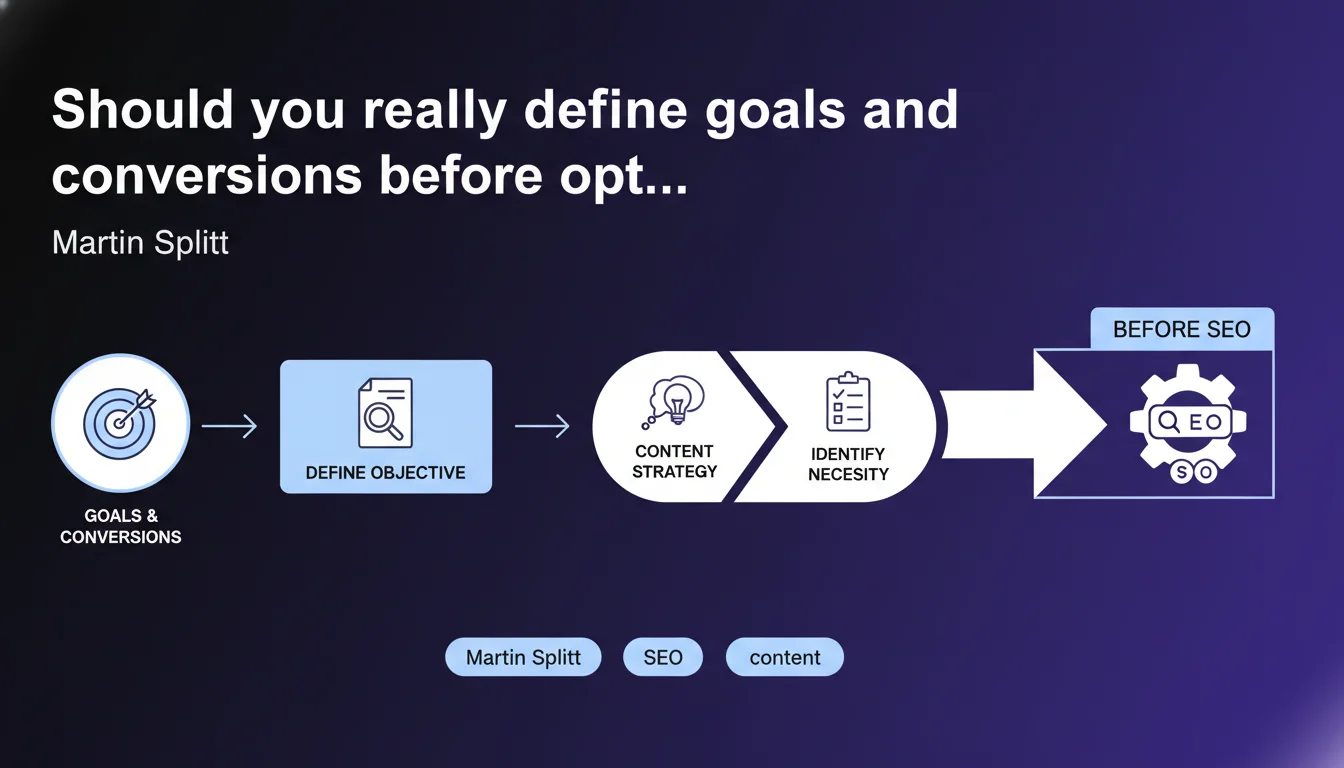
Martin Splitt emphasizes: before diving into SEO, clearly define your website's objective and target conversion. This is meant to guide your content strategy and avoid wasting time on non-essential elements. The question remains whether this obvious principle really needs reminding to professionals.
What you need to understand
Why does Google insist on this strategic obvious truth?
Splitt reframes here a basic principle that many practitioners neglect under operational pressure. Defining objective and conversion before diving into technical optimizations prevents SEO from becoming a blind race for traffic.
The underlying message: Google wants sites to serve their users, not accumulate visitors without clear intent. A site whose objective remains fuzzy typically produces generic content — exactly what the algorithms try to demote.
What counts as a "conversion" in this logic?
Splitt deliberately keeps it broad. A conversion can be a sale, a completed form, a download, significant time spent on editorial content. The key: identify a measurable signal that reflects your site's success.
Without this compass, it's hard to prioritize SEO projects. Should you focus on long-tail informational content or transactional pages? The answer entirely depends on your target conversion.
How does this guide your content strategy?
A clear objective filters content ideas. If your target conversion is B2B lead generation, producing broad audience listicles dilutes your effort. If it's time spent on in-depth analysis, betting solely on bare landing pages misses the mark.
This approach aligns with Google's repeated recommendations on search intent alignment with content objective. Content that serves neither the user nor your site's objective ends up as dead weight in your information architecture.
- Objective and conversion must be defined before any technical or editorial optimization
- This clarity prevents dispersing effort on content that doesn't convert
- Google values sites whose structure and content serve an identifiable user purpose
- Without a clear objective, it's impossible to measure the real ROI of your SEO actions
SEO Expert opinion
Does this statement really bring anything new to SEO practitioners?
Let's be honest: reminding people they need to define their objectives before acting is basic marketing common sense. Any serious consultant starts with a strategic audit phase that includes these questions. That Splitt repeats it mainly signals that too many sites still launch into SEO without this foundation.
What's missing here is operational nuance. Some sites evolve: a media outlet might want to test multiple models (subscription, advertising, affiliate) before stabilizing its strategy. Locking in objectives too early can also limit necessary pivots.
Does Google actually distinguish sites by the clarity of their objectives?
Hard to say. Google doesn't have a "strategic objective score" in its algorithms. What systems detect is overall site coherence: logical information architecture, relevant internal linking, content aligned with targeted queries.
A site with a fuzzy objective will likely produce inconsistent signals — erratic bounce rates, chaotic user journeys, backlinks disconnected from the topic. But that's an indirect effect, not a direct penalty for lacking a business roadmap. [To verify]: Google has never documented how it evaluates a domain's "strategic clarity."
When can this rule become counterproductive?
In certain exploratory contexts — launching new segments, testing emerging markets — overly rigidifying objectives upfront limits agility. An iterative approach (publish, measure, adjust) can prove more relevant than locking everything down before having field data.
Similarly, on complex editorial sites with multiple editorial lines, imposing a single objective risks artificially homogenizing content. Better then to segment objectives by section or page type.
Practical impact and recommendations
What should you concretely do before launching an SEO initiative?
Start by mapping ideal user journeys and identifying key conversion points. For an e-commerce site: add to cart, order confirmation. For a service site: contact form, appointment booking. For a media outlet: newsletter signup, reading time.
Next, audit what exists to identify content already feeding these conversions and content generating traffic with no business impact. This distinction guides your optimization priorities: strengthen what converts, refocus or remove what dilutes.
How do you align your content strategy with these objectives?
Each new piece of content must answer: what search intent does it capture, and how does this intent fit into your conversion funnel? A top-of-funnel informational article should naturally lead to more transactional content through internal linking.
Conversely, if you find content driving traffic but never converting, you have two options: either optimize it to better push toward conversion, or archive it if maintaining it costs more than it delivers. Objective clarity enables these tradeoffs.
What mistakes should you avoid in this framing phase?
Confusing traffic with performance. Many sites celebrate traffic increases without measuring real conversion impact. If traffic climbs but business objectives stagnate, SEO missed its target.
Another trap: multiplying contradictory objectives. A site can't simultaneously maximize time on site (media objective) and accelerate purchase (e-commerce objective) without creating UX friction. Prioritize one main objective per page type.
- Identify your site's main business objective (sales, leads, engagement, brand awareness)
- Define 1 to 3 measurable conversions that translate this objective
- Map typical user journeys leading to these conversions
- Audit existing content to distinguish what converts from what dilutes
- Prioritize SEO projects based on their potential impact on target conversions
- Implement precise Analytics tracking to measure each funnel step
- Regularly review these objectives as your site and market evolve
❓ Frequently Asked Questions
Google pénalise-t-il les sites sans objectif de conversion clair ?
Faut-il un seul objectif de conversion pour tout le site ?
Comment mesurer si mon contenu SEO sert réellement mes objectifs ?
Peut-on ajuster les objectifs en cours de route sans compromettre le SEO ?
Cette recommandation vaut-elle aussi pour les sites purement informatifs sans conversion monétaire ?
🎥 From the same video 16
Other SEO insights extracted from this same Google Search Central video · published on 10/07/2025
🎥 Watch the full video on YouTube →
💬 Comments (0)
Be the first to comment.