
Official statement
Other statements from this video 6 ▾
- □ Are social media platforms becoming real SEO competitors for your website?
- □ Are social media profiles really websites from an SEO perspective?
- □ Is a website really still the number one tool for maximizing your online visibility in 2024?
- □ Why does owning a website give you far more control over monetization than relying on social media platforms?
- □ Does a clean website really boost your credibility in Google's eyes?
- □ Why does Google still prioritize the open web over native mobile apps?
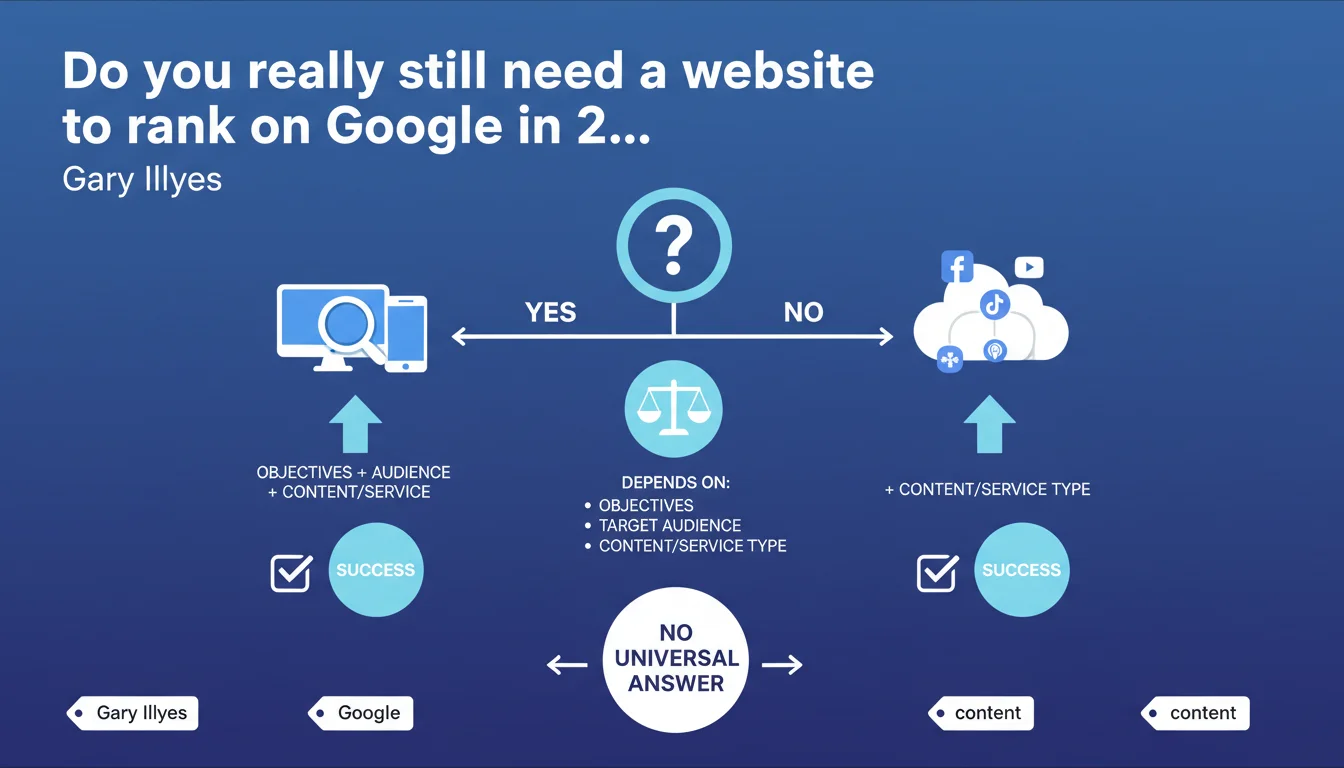
Google states that having a website is no longer a universal requirement. The relevance of a website depends on your business objectives, target audience, and the type of service you offer. Some businesses can thrive solely through Google Business profiles, third-party platforms, or mobile applications.
What you need to understand
Why is Google questioning the necessity of a website?
This statement reflects a context where Google is diversifying its search surfaces. Between Google Business Profile, Google Shopping, rich results, and app integrations, the search engine now offers legitimate alternatives to traditional web presence.
For certain businesses—local restaurants, skilled trades, proximity services—an optimized Google Business profile generates more conversions than a poorly designed brochure website. Gary Illyes acknowledges this ground reality rather than maintaining the dogma that everyone needs a website.
What types of businesses can skip having a website?
Ultra-local retailers with neighborhood clientele are the primary candidates. A plumber serving a 20km radius doesn't necessarily need a website if their Google Business profile is complete and generates direct calls.
Single-platform content creators also fit this category: a YouTuber can build their entire presence on YouTube without an external website. The same applies to certain Instagram influencers or TikTok creators whose audience never leaves the native platform.
Is Google trying to reduce dependence on websites?
This is the unsettling question. Google has a financial incentive to keep users within its ecosystem: more time spent on its surfaces equals more advertising revenue. This statement can be read as strategic validation of a less open web.
But let's be honest: for 95% of businesses with growth ambitions, this logic doesn't hold up. The moment you want to control your brand, your conversion funnel, or your topical SEO rankings, a website remains central.
- A website is no longer automatically necessary according to Google
- Viable alternatives exist for certain ultra-local or single-platform businesses
- The decision depends on growth objectives and the need for control over your digital presence
- Google implicitly validates its closed ecosystem as an alternative to the open web
SEO Expert opinion
Does this statement really reflect what works in practice?
Yes and no. In the field, we do observe micro-local businesses performing well without websites. A restaurant with 400 Google reviews and quality photos converts better than a low-end Wix site rarely updated.
But this reality applies only to a very narrow segment. The moment a business wants to capture informational search traffic, rank on competitive keywords, or sell online, the absence of a website becomes a major strategic handicap.
What are the unstated limitations of this approach?
Gary Illyes doesn't mention complete dependence on Google's rules. A Business profile can be suspended without notice, moderation rules change, and local algorithms fluctuate. Without a backup website, you have no safety net.
Another missing point: building thematic authority. How do you become a recognized expert on a topic without deep content? A Google profile can't replace 50 optimized articles that answer your audience's questions and generate qualified long-term organic traffic.
When does this logic become dangerous?
For any business with a content strategy, it's a mistake. Modern SEO relies on demonstrating expertise through structured content—impossible without a website. Google can claim a site isn't necessary, but its algorithm massively rewards those with well-built ones.
[Needs verification]: Google provides no data comparing conversion rates between website versus profile alone. This absence of metrics makes the claim difficult to evaluate objectively for sectors beyond ultra-local services.
Practical impact and recommendations
How do you evaluate whether your business can skip a website?
Start by analyzing your current conversion funnel. If 80%+ of your customers find you via Google Maps and convert through direct calls, a website might not be immediately priority. But remember—"not priority" doesn't mean "useless long-term".
Next, examine your industry. B2B services, e-commerce, and complex offerings always require reassurance and detailed information. A Google profile alone never suffices in these cases.
What risks should you consider before abandoning a website?
First risk: volatility of third-party platforms. Local algorithms change, Google Business rules evolve without notice. A website remains an asset you control 100%.
Second risk: growth ceiling. Without a website, you can't build an email list, run sophisticated retargeting campaigns, or capture traffic on informational queries that feed your funnel.
What should you do concretely based on your situation?
- Audit your current traffic sources: what share comes from organic search versus Google Business versus social media
- Identify your 12-24 month objectives: limited local growth or geographic and thematic expansion
- Evaluate your Google dependence: do you have credible alternative acquisition channels
- Analyze your industry: do your direct competitors have websites ranking on strategic keywords
- Calculate the opportunity cost: how much qualified traffic are you missing by not ranking on informational keywords
- Test before deciding: launch a minimal website (10-15 optimized pages) and measure the impact over 6 months
❓ Frequently Asked Questions
Un profil Google Business peut-il vraiment remplacer un site web pour le SEO local ?
Quels sont les risques de ne pas avoir de site web en tant qu'entreprise ?
Google favorise-t-il ses propres surfaces au détriment des sites web indépendants ?
Dans quels secteurs un site web reste-t-il absolument nécessaire ?
Comment mesurer si mon business peut se passer d'un site web ?
🎥 From the same video 6
Other SEO insights extracted from this same Google Search Central video · published on 12/02/2026
🎥 Watch the full video on YouTube →
💬 Comments (0)
Be the first to comment.