
Official statement
Other statements from this video 6 ▾
- □ Are social media platforms becoming real SEO competitors for your website?
- □ Are social media profiles really websites from an SEO perspective?
- □ Why does owning a website give you far more control over monetization than relying on social media platforms?
- □ Does a clean website really boost your credibility in Google's eyes?
- □ Why does Google still prioritize the open web over native mobile apps?
- □ Do you really still need a website to rank on Google in 2024?
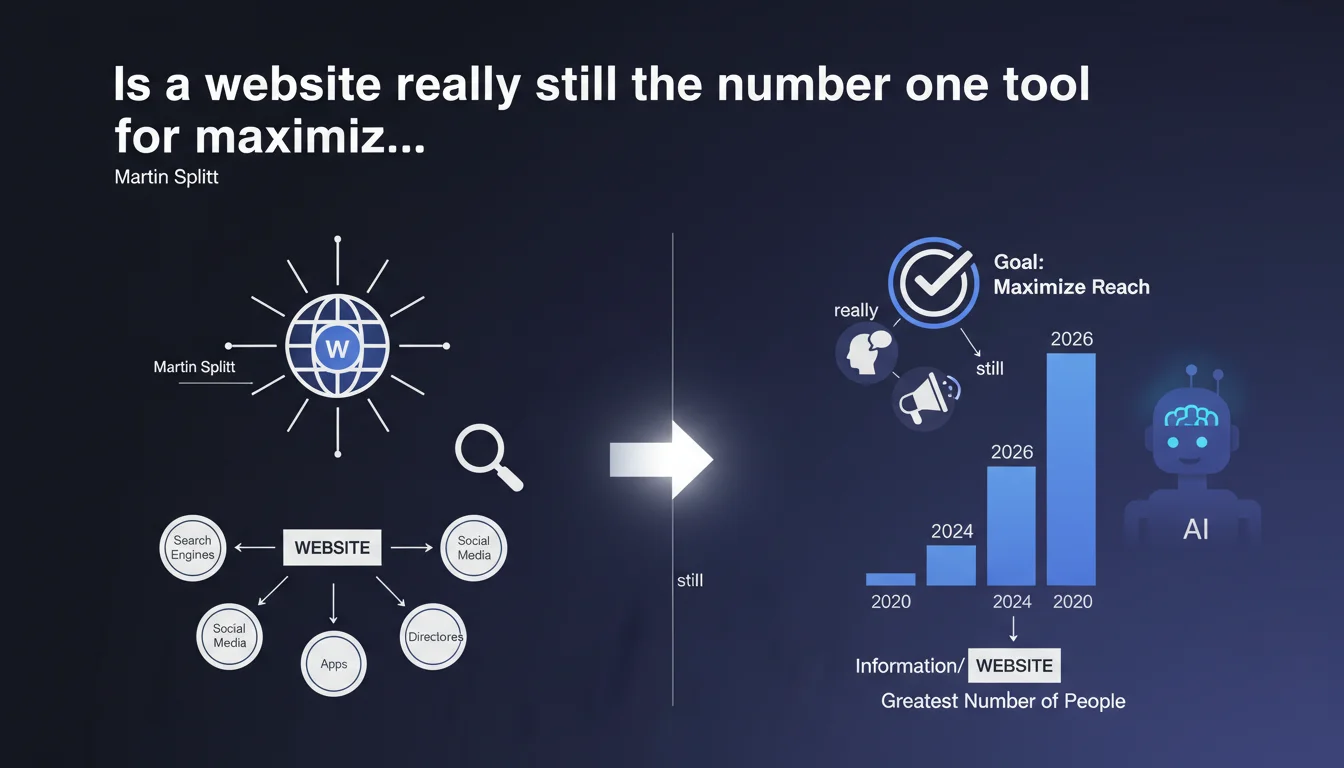
Martin Splitt asserts that a website remains the optimal solution for reaching the maximum number of users and making content accessible to the widest audience. This statement comes at a time when third-party platforms (social networks, marketplaces) are eating into visibility shares. Google is reaffirming here that owning a website remains strategically essential for controlling your digital presence.
What you need to understand
Why does Google insist on the primacy of websites as a visibility tool?
Google has every incentive to ensure that economic actors continue investing in their websites rather than migrating entirely to closed ecosystems it doesn't control. TikTok, Instagram, LinkedIn — all platforms that capture traffic without Google having access for indexing.
A website remains the only channel where you fully own your data, your audience, and your content strategy. Social media algorithms change overnight — your organic reach can collapse without warning. Your website, on the other hand, remains your digital property.
Is Google's position purely disinterested or strategic?
Let's be honest: Google is defending its business model. The more indexable websites exist, the more relevant its search engine remains and the more its AdSense/AdWords advertising revenue is maintained.
That said, its position isn't wrong either. A website offers flexibility, traceability, and technical control that no third-party platform guarantees long-term. The problem is that this statement comes at a time when many businesses are realizing their audience is elsewhere — on YouTube, on Amazon, on mobile apps.
What does this concretely mean for an SEO professional?
It means you need to continue prioritizing the website as your central visibility hub while intelligently interconnecting it with other channels. The website can no longer be an isolated silo: it must be the anchor point of an omnichannel strategy.
- The website remains the most controllable digital asset: you manage the infrastructure, content, and user data.
- Google structurally favors indexable websites: as long as Search remains dominant, ignoring your website amounts to ignoring a massive chunk of potential traffic.
- Third-party platforms are complementary levers, not substitutes: TikTok can generate awareness, but rarely converts as effectively as a controlled on-site journey.
- The statement is a strategic reminder: don't abandon your website in favor of social networks exclusively, especially if your business model relies on qualified conversions.
SEO Expert opinion
Is this statement consistent with practices observed in the field?
Yes and no. In certain sectors — mass-market B2C e-commerce, local services, SaaS — the website indeed remains the primary visibility lever. Traffic data shows that Google Search still generates the majority of qualified sessions for these verticals.
But in other niches — fashion, lifestyle, coaching, entertainment — brands that go all-in on Instagram, TikTok, or YouTube achieve more reach and engagement than with their websites. The website then becomes a transactional landing point, not the primary visibility engine. Martin Splitt speaks of "making available to the widest audience": does that still primarily go through Google Search? [To verify] depending on your target audience.
What nuances should be added to this claim?
Google is right in principle: owning your website means owning your digital infrastructure. But visibility ≠ ownership. You can have a technically perfectly optimized website and generate zero traffic if your audience is elsewhere.
The real nuance is that the website should be designed as the central node of an ecosystem, not as the sole channel. Modern SEO strategies incorporate link building through YouTube content, TikTok partnerships, backlinks from podcasts — all of this redirects to the website, but initial visibility happens elsewhere.
In which cases does this rule not fully apply?
If your model relies on short-term virality (memes, ephemeral content, micro-influencers), a website can be secondary. Some content creators generate six-figure revenues without a functional website — everything goes through Patreon, YouTube, Substack.
Similarly, for certain native mobile apps (fitness, games, dating), the website is often a marketing placeholder: the bulk of usage and conversion happens in-app. Google Search plays a marginal role compared to App Store Optimization (ASO) or paid social campaigns.
Practical impact and recommendations
What concretely should you do to maximize your website's visibility?
Start by auditing the technical health of your website: crawlability, indexability, loading speed, Core Web Vitals. If Google can't properly access your pages, no content strategy will compensate.
Next, ensure your information architecture is logical and user-oriented. A well-structured website facilitates crawling, improves internal linking, and boosts thematic relevance signals. Think semantic clusters, topic silos, clear breadcrumbs.
What errors should you avoid when managing your website as a visibility tool?
Don't fall into the trap of the "abandoned brochure website." A website with no fresh content, no regular updates, no editorial strategy quickly becomes invisible — Google favors active websites that demonstrate continuous expertise.
Also avoid massively duplicating content present on your social networks or marketplaces. Google hates duplication: if your Amazon product listing is identical to your website's, it's often Amazon that will rank, not you.
How do you verify that your website is truly optimized to maximize its visibility?
Use Google Search Console to monitor indexation rate, crawl errors, search performance. If your strategic pages aren't indexed or if your click-through rate (CTR) is anemic, dig deeper: failing meta tags? Superficial content? Keyword cannibalization?
Also analyze your Core Web Vitals via PageSpeed Insights and CrUX. Google has clearly signaled that user experience weighs on ranking — a slow or visually unstable website loses visibility, regardless of your other optimizations.
- Conduct a complete technical audit (crawl, indexation, speed, mobile-first)
- Structure the website into coherent thematic silos with solid internal linking
- Produce regular, unique content oriented toward user intent
- Optimize Core Web Vitals and mobile experience
- Monitor performance via Search Console and Analytics
- Avoid content duplication between website and third-party platforms
- Interconnect the website with other channels (social networks, YouTube, newsletters) to create a cohesive ecosystem
❓ Frequently Asked Questions
Un site web est-il encore nécessaire si mon entreprise est très présente sur les réseaux sociaux ?
Google favorise-t-il vraiment les sites web par rapport aux contenus hébergés sur des plateformes tierces ?
Faut-il dupliquer le contenu de mon site sur mes réseaux sociaux ou l'inverse ?
Mon site e-commerce est aussi présent sur Amazon et eBay. Lequel Google va-t-il favoriser ?
Cette déclaration signifie-t-elle que Google va pénaliser les marques qui n'ont pas de site web ?
🎥 From the same video 6
Other SEO insights extracted from this same Google Search Central video · published on 12/02/2026
🎥 Watch the full video on YouTube →
💬 Comments (0)
Be the first to comment.