
Official statement
Other statements from this video 6 ▾
- □ Les réseaux sociaux deviennent-ils de vrais concurrents SEO pour votre site ?
- □ Les profils de réseaux sociaux sont-ils vraiment des sites web au sens SEO ?
- □ Le site web reste-t-il vraiment l'outil numéro un pour maximiser sa visibilité en ligne ?
- □ Pourquoi un site web offre-t-il plus de contrôle sur la monétisation que les réseaux sociaux ?
- □ Un site web propre augmente-t-il vraiment votre crédibilité aux yeux de Google ?
- □ Faut-il encore un site web pour être visible sur Google ?
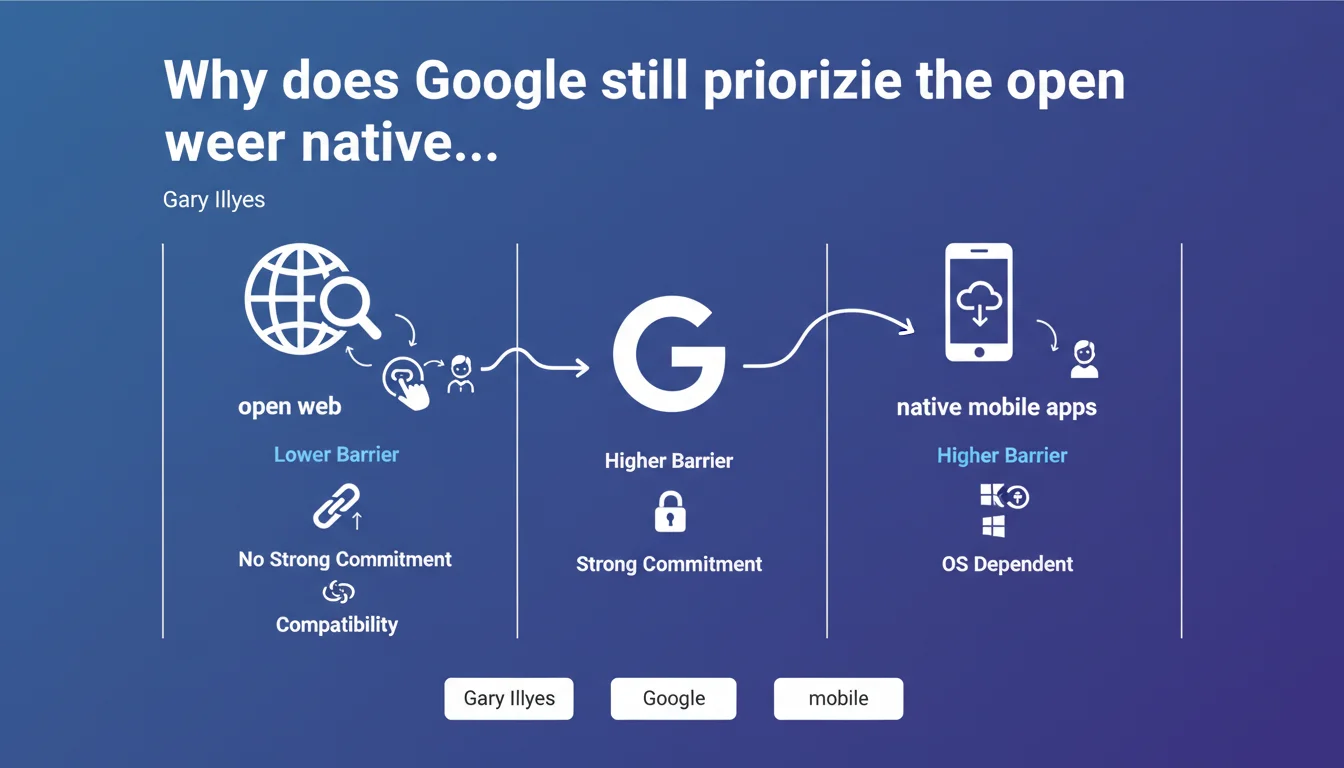
Gary Illyes reminds us that sharing a web link requires far less user engagement than downloading an app — no OS constraints, no installation process. This lower friction explains why Google continues to value the open web in the face of closed app ecosystems. For SEOs, the message is crystal clear: the web remains the primary playing field.
What you need to understand
What does "lower barrier to entry" actually mean in practice?
A web link is shared in one click, opens instantly in a browser. No download, no iOS or Android compatibility check, no storage space consumed. Users access content without any prior commitment decision.
A mobile app requires multiple steps: opening an app store, checking system compatibility, downloading which may fail on unstable connections, multiple permissions requests. Each step is an opportunity to drop off.
Why is Google emphasizing this point now?
Google is defending its web ecosystem against the growing dominance of native applications. Mobile giants (Apple, Meta) are pushing toward experiences locked within their apps, where Google controls neither indexing nor ad monetization.
This statement is far from neutral. It reminds publishers that betting solely on an app means abandoning the organic discoverability that only the indexable web can offer.
What's the direct implication for search optimization?
Content accessible via URL remains indexable, shareable, and measurable. Native app content largely escapes these mechanisms. If your digital strategy neglects the web in favor of a closed application, you're cutting off your organic acquisition channels.
Google cannot crawl what lives exclusively in an app — even with deep links, the experience remains fragmented and conditional on prior installation.
- Reduced friction: no installation = lower initial bounce rate
- Universal compatibility: a link works everywhere, an app depends on the OS
- Discoverability: only the web enables traditional organic search rankings
- Seamless sharing: copying and pasting a link vs forcing users to install an app to view content
SEO Expert opinion
Is this statement consistent with what we observe in the field?
Absolutely. We've been seeing for years that publishers who lock their content in apps experience Google visibility drops. Media outlets that attempted "mobile app only" strategies have all reversed course — organic traffic collapses without an indexable web presence.
Progressive Web Apps (PWAs) emerged precisely as a compromise: app-like experience without installation friction. Google actively promotes them because they preserve indexability while delivering advanced functionality.
What nuances should we add to this claim?
Gary Illyes is talking about "barrier to entry," not quality of the final experience. A well-designed native app can deliver performance, user experience, and features that mobile web still struggles to match. Push notifications, true offline access, system integration — advantages the web only partially compensates for.
The real debate isn't "web VS app" but "when to use each." For informational, editorial, discovery-oriented content — the web wins. For user retention, daily usage patterns, complex features — apps still have merit. [To verify]: Google provides no quantitative data on conversion gap between web links and app deep links, which limits the operational applicability of this statement.
In what cases does this rule not apply?
If your audience is already captive and installed (social networks, mobile games, banking services), installation friction is already absorbed. The app becomes the primary channel, and the web merely an acquisition showcase.
Brands with strong awareness (Nike, Spotify) can afford to heavily redirect traffic to their apps — their SEO relies on brand recognition itself, not organic discovery of long-tail content.
Practical impact and recommendations
What should you do concretely to capitalize on the web's advantages?
Ensure that every key feature of your service is accessible via an indexable URL. If you have an app, develop a complete web version in parallel, not just an app download landing page.
Invest in Progressive Web Apps if you want the app experience without the friction. They enable "light" installation while remaining crawlable and shareable via standard URLs.
What mistakes should you absolutely avoid?
Never automatically redirect mobile users to an app store. That's the best way to destroy your organic traffic. Google hates these forced redirects and may classify them as intrusive interstitials.
Avoid "app walls" — those popups that block content access until the app is installed. You lose both indexability and user experience. If you want to promote your app, use a subtle banner, not a content wall.
- Verify that all important pages are accessible via URL without requiring app installation
- Test sharing your links across different devices and operating systems — content must display without friction
- Audit your mobile redirects: no automatic redirects to app stores
- If you offer an app, implement smart deep links that fall back to the web if the app isn't installed
- Measure mobile user bounce rates: a spike may indicate access friction
- Consider a PWA to combine web advantages (indexability, shareability) with app benefits (performance, engagement)
❓ Frequently Asked Questions
Dois-je abandonner mon app mobile au profit d'un site web ?
Les Progressive Web Apps remplacent-elles vraiment les apps natives ?
Google pénalise-t-il les sites qui redirigent vers un app store ?
Comment mesurer si ma stratégie app nuit à mon SEO ?
Les deep links suffisent-ils à rendre une app indexable ?
🎥 From the same video 6
Other SEO insights extracted from this same Google Search Central video · published on 12/02/2026
🎥 Watch the full video on YouTube →
💬 Comments (0)
Be the first to comment.