
Official statement
Other statements from this video 6 ▾
- □ Les réseaux sociaux deviennent-ils de vrais concurrents SEO pour votre site ?
- □ Les profils de réseaux sociaux sont-ils vraiment des sites web au sens SEO ?
- □ Le site web reste-t-il vraiment l'outil numéro un pour maximiser sa visibilité en ligne ?
- □ Un site web propre augmente-t-il vraiment votre crédibilité aux yeux de Google ?
- □ Pourquoi Google privilégie-t-il les liens web plutôt que les applications mobiles ?
- □ Faut-il encore un site web pour être visible sur Google ?
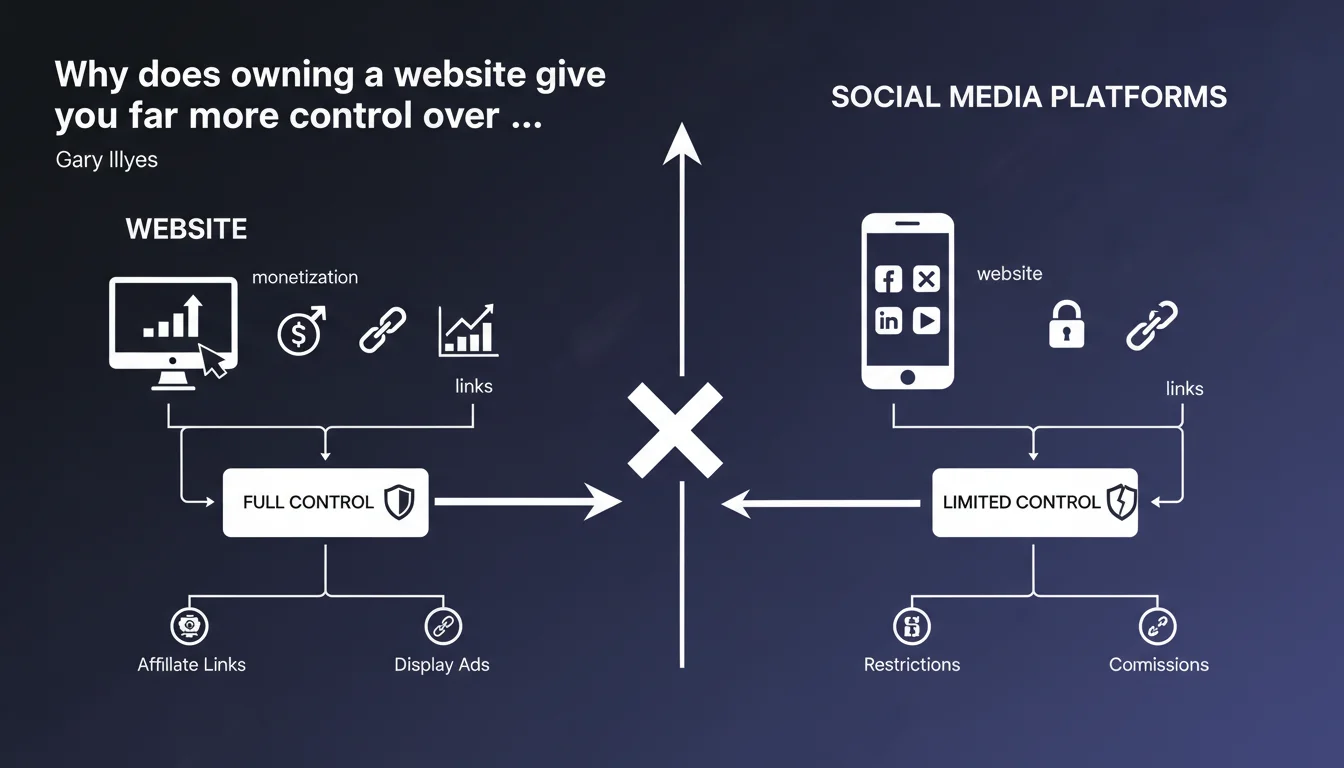
Google emphasizes that a self-owned website gives you complete control over monetization strategies — affiliate links, advertising, product sales — without any intermediary taking commissions. Social platforms impose strict rules, technical limitations, and capture a portion of your revenue. For sustainable business growth, owning your domain remains the foundation of financial independence.
What you need to understand
What does Google mean by "complete control" over monetization?
Gary Illyes points out a simple reality: a website under your own domain lets you choose how, when, and with whom you monetize your traffic. Affiliate links, display ads, subscriptions, direct sales — everything is possible without asking permission from a third-party platform.
On social networks, every revenue model is subject to imposed rules. Facebook restricts outbound links, Instagram limits calls-to-action, TikTok takes a cut from tips. A website, meanwhile, is neutral: you control the code, the trackers, the redirects.
Why this statement now?
Google benefits when content remains indexable and crawlable — meaning published on the open web, not locked inside closed applications. This stance encourages creators and publishers not to abandon their websites in favor of social platforms alone.
It's also a reminder that diversifying your channels protects you against algorithm changes or policy shifts from a single platform. An Instagram account can be deactivated overnight, but your domain stays under your control as long as you pay the registrar.
What forms of monetization are covered?
- Affiliate marketing: tracked links to third-party products, commissions in your pocket
- Display advertising: Google Ads, Mediavine, programmatic networks, direct advertiser negotiations
- Direct sales: physical products, courses, SaaS subscriptions
- Paid content: paywalls, premium membership, digital downloads
- Sponsored partnerships: dedicated articles or space without an intermediary taking a cut
SEO Expert opinion
Is this statement aligned with Google's strategy?
Absolutely. Google has every incentive to defend the open web against walled gardens like Meta, TikTok, or LinkedIn. If content migrates massively to proprietary platforms, the search engine loses its raw material — and its advertising model weakens.
But let's be honest: this position doesn't stop Google from building its own closed ecosystems (YouTube Premium, Google Shopping, Travel…). The nuance is that Google would rather index your site and sell you advertising than watch you move to Instagram with no crawlable links.
When is a website not the optimal solution?
If your audience lives exclusively on TikTok or Discord, investing in a website might be secondary in the short term. Some creators earn six figures without ever touching WordPress — everything flows through live streams, tips, and native app affiliations.
The problem is vulnerability. An algorithm shift, account suspension, or terms of service change — and revenue collapses. Your website remains the digital asset no one can take away from you, even if its immediate ROI takes longer to build.
What data is missing to go deeper?
[Needs verification] Google provides no comparative figures on conversion rates or average revenue generated by a website versus a social page. We know empirically that a well-optimized website outperforms in long-tail affiliate revenue, but aggregated data doesn't exist publicly.
Practical impact and recommendations
What concrete steps should you take to maximize this control?
Own your domain, host your content with a reliable provider, and structure your site to capture organic traffic through SEO. A well-ranked blog generates visitors without depending on an algorithmic feed.
Build multiple revenue streams: affiliate links through clean plugins, display ads with networks that respect your standards (header bidding, direct deals), direct sales via integrated WooCommerce or Shopify. The more you diversify, the less vulnerable you are to any single partner's policy change.
What mistakes should you avoid?
Don't turn your site into an aggressive affiliate catalog. Google penalizes thin content stuffed with Amazon links that add no value. Control doesn't mean anarchy — user experience is still scrutinized by algorithms.
Avoid relying 100% on a single ad network (like AdSense). If your account gets suspended, you lose everything overnight. Combine multiple partners: Ezoic, Mediavine, AdThrive, or direct deals with brands.
How do you verify your site is optimized for monetization?
- Check that your affiliate links use
rel="sponsored"ornofollowas appropriate - Measure click-through rates on your monetization CTAs with GA4 events
- Test different placements for ad blocks (A/B testing via Google Optimize or equivalent)
- Monitor Core Web Vitals: overly heavy ad scripts degrade rankings
- Ensure sponsored content is clearly labeled (transparency equals trust equals conversions)
- Diversify traffic sources: SEO, newsletters, push notifications — don't depend on one channel
❓ Frequently Asked Questions
Un site web peut-il vraiment générer plus de revenus qu'une page Instagram avec 100k abonnés ?
Quels CMS sont les plus adaptés pour gérer plusieurs sources de monétisation ?
Google pénalise-t-il les sites trop monétisés ?
Faut-il abandonner les réseaux sociaux au profit d'un site ?
Quels indicateurs suivre pour mesurer la performance monétisation d'un site ?
🎥 From the same video 6
Other SEO insights extracted from this same Google Search Central video · published on 12/02/2026
🎥 Watch the full video on YouTube →
💬 Comments (0)
Be the first to comment.