
Official statement
Other statements from this video 6 ▾
- □ Les réseaux sociaux deviennent-ils de vrais concurrents SEO pour votre site ?
- □ Les profils de réseaux sociaux sont-ils vraiment des sites web au sens SEO ?
- □ Le site web reste-t-il vraiment l'outil numéro un pour maximiser sa visibilité en ligne ?
- □ Pourquoi un site web offre-t-il plus de contrôle sur la monétisation que les réseaux sociaux ?
- □ Pourquoi Google privilégie-t-il les liens web plutôt que les applications mobiles ?
- □ Faut-il encore un site web pour être visible sur Google ?
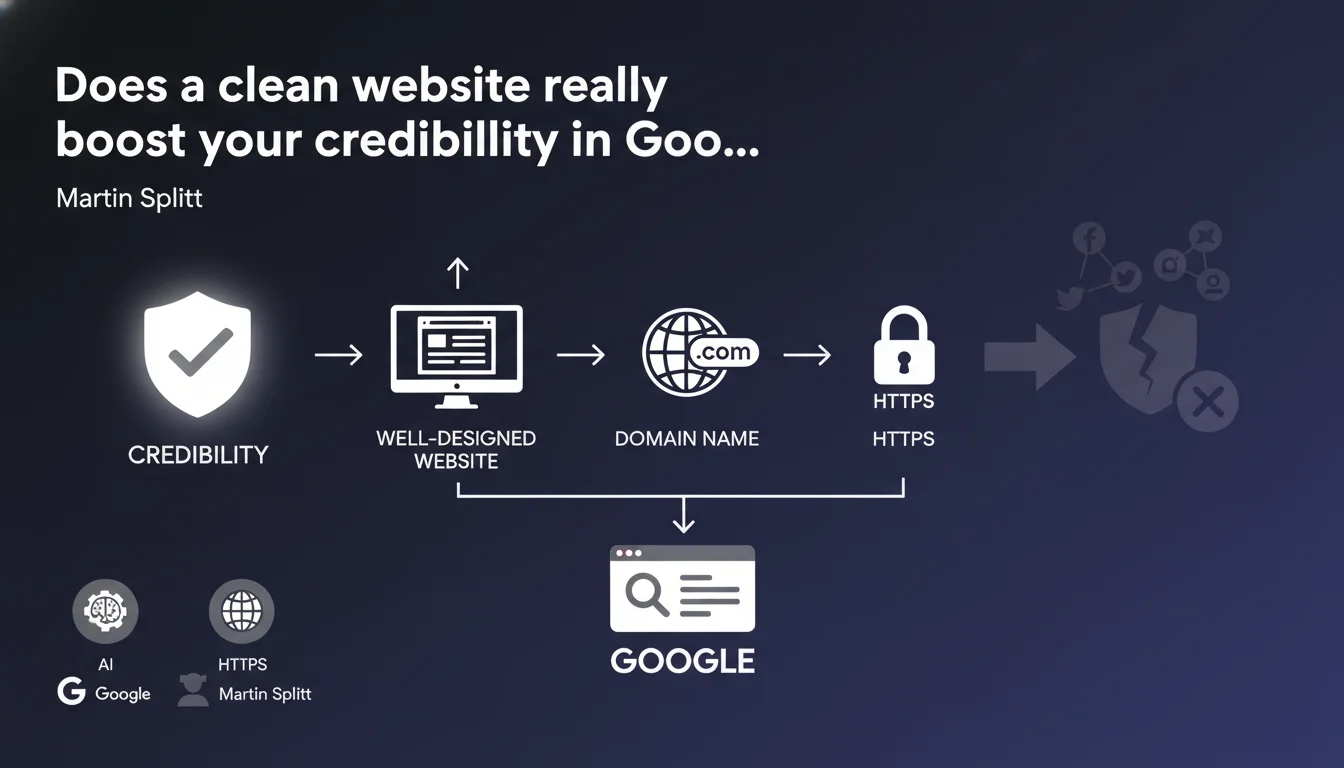
Martin Splitt claims that a website with a proper domain name and HTTPS reinforces perceived credibility compared to a presence solely on social media. This statement targets user trust, not directly ranking — but the distinction between human perception and algorithmic signals remains blurry.
What you need to understand
Is Google talking about ranking or user perception here?
Splitt emphasizes the perception of legitimacy: a clean website inspires more trust than an Instagram profile or Facebook page. Nothing revolutionary — it's plain marketing sense. But be careful: he's not saying this factor directly impacts organic ranking.
The phrasing remains deliberately vague. Does Google measure this "perceived credibility" through behavioral signals (bounce rate, time on site, SERP returns)? No confirmation. We're left in typical Google communication fog.
Why the emphasis on HTTPS and an appropriate domain name?
HTTPS is a confirmed ranking signal for years — subtle, but real. An "appropriate" domain name (meaning: not a free subdomain like example.wix.com) sends a signal of seriousness. Not necessarily to the algorithm, but to users who click — or don't — on your result.
The real stakes? Engagement metrics. If a user hesitates between your HTTPS site with a proper domain and a competitor on Medium, they'll likely choose yours. This choice affects CTR, pogosticking, dwell time — all signals Google observes, even if it refuses to admit their exact weight.
What is the actual scope of this statement?
This statement is clearly aimed at small businesses still wondering whether investing in a website is worth it versus social networks. For a seasoned SEO professional, this has been settled for years.
What's critically missing: quantified data. Google provides no study, no public A/B test showing the performance gap between a proper website and pure social media presence. You're asked to take their word for it.
- HTTPS = confirmed ranking signal (subtle)
- Proper domain name ≠ direct signal, but impacts user perception
- No quantified data provided by Google
- Statement oriented toward "best practices" more than technical revelation
SEO Expert opinion
Does this statement bring anything new to the table?
Let's be honest: no. Every SEO practitioner has known since 2014 that HTTPS is a ranking factor. As for a proper domain name, it's common business sense — you don't need Google to understand that.
What's irritating is the intentional blur between "user perception" and "algorithmic signal". Google freely mixes the two without ever clearly stating whether this "perceived legitimacy" translates into a ranking boost. Spoiler: probably yes, through indirect behavioral metrics — but Google will never admit it explicitly.
Do behavioral signals really play a role here?
Theoretically, Google denies that CTR or dwell time are direct ranking factors. [Needs verification] — because on the ground, the correlations are glaring. A website that inspires trust generates more clicks, fewer immediate SERP returns, more time spent.
Do these behaviors influence the algorithm? It's hard to believe Google completely ignores these signals. But until we get official confirmation with supporting data, we're left with interpretation. What is certain: HTTPS and a proper domain improve user experience, and that's measurable from the analytics side.
In what cases does this rule not apply?
Some niches thrive perfectly without a classic website. Content creators on YouTube or TikTok, sellers on marketplaces (Amazon, Etsy), freelancers in pure LinkedIn networks — all can prosper without a proper domain.
But for Google organic SEO, there's no choice: you need a crawlable website. Social networks don't replace a website for search visibility — their pages are poorly indexed, content belongs to the platform, technical control is zero.
Practical impact and recommendations
What concretely needs to be done to maximize this perceived legitimacy?
First reflex: migrate to HTTPS if you haven't already. In 2026, it's non-negotiable. An HTTP site displays a big "Not Secure" warning in Chrome — it's like posting a "No Entry" sign on your storefront.
Next, invest in a proper and memorable domain name. Avoid free subdomains (mysite.wordpress.com), exotic TLDs without reason (.xyz, .top), long-winded names. A .com or national TLD remains the safe bet.
Design-wise, a professional website with legal notices, privacy policy, visible contact information strengthens trust. Google doesn't say it outright, but a complete footer, verifiable coordinates, a visible SSL certificate — all of this plays on perception.
What errors should you avoid that sabotage this credibility?
Classic mistake: an HTTPS site but with mixed content (HTTP resources on an HTTPS page). Result: browser warning, immediate trust loss. Check your images, scripts, CSS — everything must be served over HTTPS.
Another trap: a proper domain but a cheap or broken design on mobile. Perceived legitimacy collapses if the site is unreadable on smartphone. Google prioritizes mobile-first indexing — a poorly designed mobile site is a double negative signal: UX and technical.
Also avoid intrusive pop-ups, invasive ads, sneaky redirects. Nothing transforms a visitor into an immediate SERP return faster. Google penalizes aggressive interstitials — and users hate them even more.
How can you verify your site sends the right legitimacy signals?
Audit your site with Chrome DevTools: Security tab to verify the SSL certificate, Console to track mixed content. Also test on PageSpeed Insights and Search Console to spot HTTPS or mobile issues.
On the user perception side, run a simple test: send your URL to someone outside your professional bubble. Their first impression in 5 seconds? If they hesitate, that's a bad sign. A legitimate site inspires trust instantly.
- Migrate to HTTPS with a valid SSL certificate
- Eliminate all mixed content (HTTP in HTTPS)
- Choose a proper and memorable domain name
- Display legal notices, contact info, privacy policy
- Optimize mobile design (mobile-first indexing)
- Remove intrusive pop-ups and aggressive ads
- Regularly test with Chrome DevTools and Search Console
❓ Frequently Asked Questions
HTTPS est-il vraiment un facteur de ranking ou juste une recommandation ?
Un site sur sous-domaine gratuit (Wix, WordPress.com) peut-il ranker correctement ?
Google mesure-t-il vraiment cette 'légitimité perçue' ou est-ce juste du marketing ?
Faut-il privilégier un TLD spécifique (.com, .fr, etc.) pour renforcer la crédibilité ?
Le mixed content (HTTP dans HTTPS) pénalise-t-il le ranking ou juste l'UX ?
🎥 From the same video 6
Other SEO insights extracted from this same Google Search Central video · published on 12/02/2026
🎥 Watch the full video on YouTube →
💬 Comments (0)
Be the first to comment.