
Official statement
Other statements from this video 6 ▾
- □ Les réseaux sociaux deviennent-ils de vrais concurrents SEO pour votre site ?
- □ Le site web reste-t-il vraiment l'outil numéro un pour maximiser sa visibilité en ligne ?
- □ Pourquoi un site web offre-t-il plus de contrôle sur la monétisation que les réseaux sociaux ?
- □ Un site web propre augmente-t-il vraiment votre crédibilité aux yeux de Google ?
- □ Pourquoi Google privilégie-t-il les liens web plutôt que les applications mobiles ?
- □ Faut-il encore un site web pour être visible sur Google ?
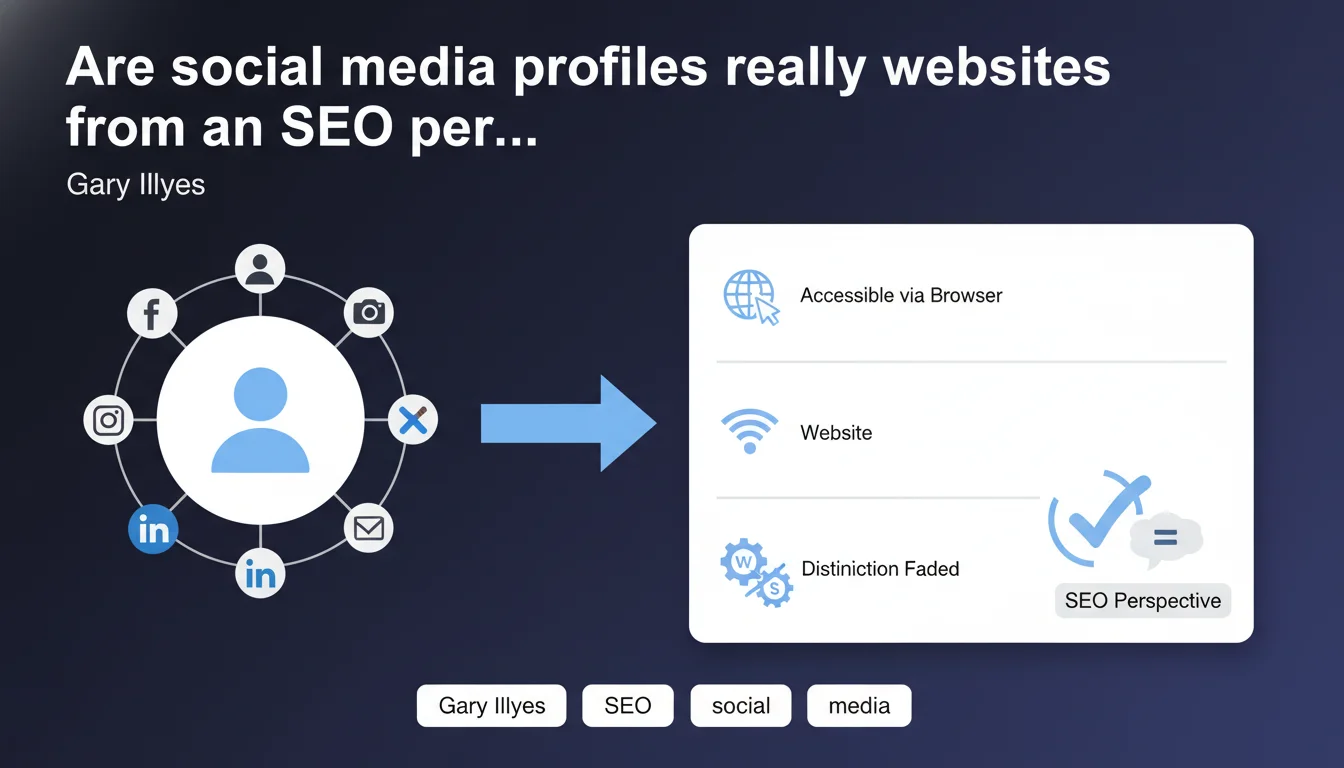
Google considers social media profiles as genuine websites from a technical standpoint. The traditional distinction between 'website' and 'social network' is blurring, which could have implications for how we think about optimizing social presence for search.
What you need to understand
What exactly does Google mean by 'website'?
Gary Illyes' statement is based on a simple technical definition: a website is any content accessible via a browser. An Instagram profile, a Facebook page, a TikTok shop — all of these are HTML pages served via HTTP/HTTPS, so technically they are websites.
This perspective isn't a philosophical revolution, it's a factual observation. Social networks aren't magical entities isolated from the web — they are the web. Their profiles have URLs, meta tags, indexable content (when they allow it).
Why is this distinction fading now?
Social platforms have evolved. Instagram Shopping, Facebook Marketplace, LinkedIn profiles optimized with structured content — the boundary between 'storefront' and 'social network' is becoming blurred.
From a user perspective, navigation increasingly happens via mobile browser rather than native app. From a search engine perspective, crawlers can access certain public profiles like any other site. The question is no longer 'site or social network?' but 'is this content crawlable and indexable?'
What are the practical implications for SEO?
- Public social profiles can appear in standard SERPs, not just through dedicated carousels.
- SEO optimization rules (title tags, descriptions, text content) potentially apply to these pages.
- Integrated shops (Instagram Shopping, etc.) are technically crawlable — though indexation often remains limited by the platforms themselves.
- The notion of 'website' becomes a spectrum: traditional e-commerce, social profile, marketplace, blog — all share common SEO mechanisms.
SEO Expert opinion
Is this statement consistent with what we observe in practice?
Yes and no. Technically, Gary Illyes is right: a Facebook profile is a web page. But from a practicing SEO perspective, reality is more nuanced.
Most social content remains blocked from indexation via robots.txt or requires authentication. Instagram, for example, makes many profiles publicly readable, but Google only indexes a fraction of posts. LinkedIn indexes certain profiles, Twitter/X has fluctuated between openness and closure depending on the period. The technical potential exists, but actual indexation depends on strategic choices by the platforms.
In which cases does this logic become actionable?
For public profiles with stable URLs and rich text content: LinkedIn notably. A well-optimized profile (clear title, description with keywords, regular posts) can rank for personal branding queries.
Integrated social shops are a borderline case. Technically websites, they often remain inaccessible to crawlers or redirect to the app. [To verify] — no clear public data on Google's indexation of Instagram Shopping product pages.
Should you treat social profiles as SEO pages to optimize?
Let's be honest: for 90% of businesses, social profiles will never be a significant organic SEO lever. They mainly play a role of brand signal and content distribution.
However, for experts, consultants, agencies — those betting on personal branding — optimizing LinkedIn with relevant semantic vocabulary, structuring published articles, refining descriptions... it can generate qualified traffic. But you need to stay realistic: we're talking about marginal gains compared to a well-built proprietary site.
Practical impact and recommendations
What should you concretely do with your social profiles?
Treat your public profiles (LinkedIn, possibly Twitter/X) as satellite pages of your digital ecosystem. Choose a clear profile name (first name + expertise), write a description with your industry keywords, publish indexable text content.
For social shops (Instagram Shopping, Facebook Marketplace), accept that they remain primarily conversion channels, not organic discovery channels. Optimization happens on the platform's internal algorithm (hashtags, engagement), not on the Google side.
What mistakes should you absolutely avoid?
Don't duplicate your website content on your social profiles word-for-word — you'd create cannibalization without benefit. Social platforms generally do not pass SEO juice (nofollow links), so a well-ranking profile won't directly boost your site.
Avoid leaving half-abandoned profiles ranking on your brand name with outdated content. If an old 2012 MySpace or Google+ account resurfaces in the SERPs, delete it or redirect it.
How do you verify what's indexed?
- Run a
site:linkedin.com/in/your-profilesearch to see what Google has crawled. - Check the Search Console to see if your social profile URLs generate impressions (rare, but possible).
- Use Screaming Frog in list mode to crawl your public profile URLs and spot meta tags, titles, canonicals.
- Monitor the SERP for your brand name: if a social profile ranks higher than your site, it's a warning signal about your on-site SEO.
Social profiles are technically websites, but their SEO potential remains limited and depends on platform choices. Optimize your public profiles as brand pages, but never rely on them as your main lever. Your proprietary site remains the absolute priority.
These cross-optimizations between social presence and organic search require an overview of your digital ecosystem. If you want to structure a coherent strategy without spreading yourself thin, guidance from a specialized SEO agency can help you prioritize the levers that truly matter for your business.
❓ Frequently Asked Questions
Google indexe-t-il automatiquement tous les profils de réseaux sociaux ?
Un profil LinkedIn bien optimisé peut-il ranker sur des mots-clés métier ?
Les liens depuis les profils sociaux transmettent-ils du jus SEO ?
Faut-il créer des profils sur toutes les plateformes pour couvrir plus d'URLs ?
Les boutiques Instagram Shopping sont-elles indexées par Google ?
🎥 From the same video 6
Other SEO insights extracted from this same Google Search Central video · published on 12/02/2026
🎥 Watch the full video on YouTube →
💬 Comments (0)
Be the first to comment.