
Official statement
Other statements from this video 16 ▾
- □ Is Google's SEO Starter Guide really the best foundation to learn search engine optimization from scratch?
- □ Should you really define goals and conversions before optimizing your SEO?
- □ Should you really tailor your SEO strategy to your audience before optimizing technically?
- □ Are popular CMS platforms like WordPress really enough for serious technical SEO?
- □ Is searching your domain name on Google really enough to verify your site's technical health?
- □ Should you really be asking your customers to shape your SEO strategy?
- □ Should small businesses really give up on generic search queries?
- □ Can small websites really test freely without major SEO risks?
- □ Why does Martin Splitt place such strong emphasis on installing Search Console and measurement tools?
- □ How long does it really take for a content change to show up in Google search results?
- □ Is it really safe to search for your own website on Google without getting penalized?
- □ Why can't you rely on staging environments to validate your SEO improvements?
- □ Are all #1 ranking guarantees really SEO scams?
- □ Are Google's Search Essentials really the ultimate SEO rulebook you need to follow?
- □ Why do some SEO optimizations take months to deliver results?
- □ Is your website still essential in the age of generative AI?
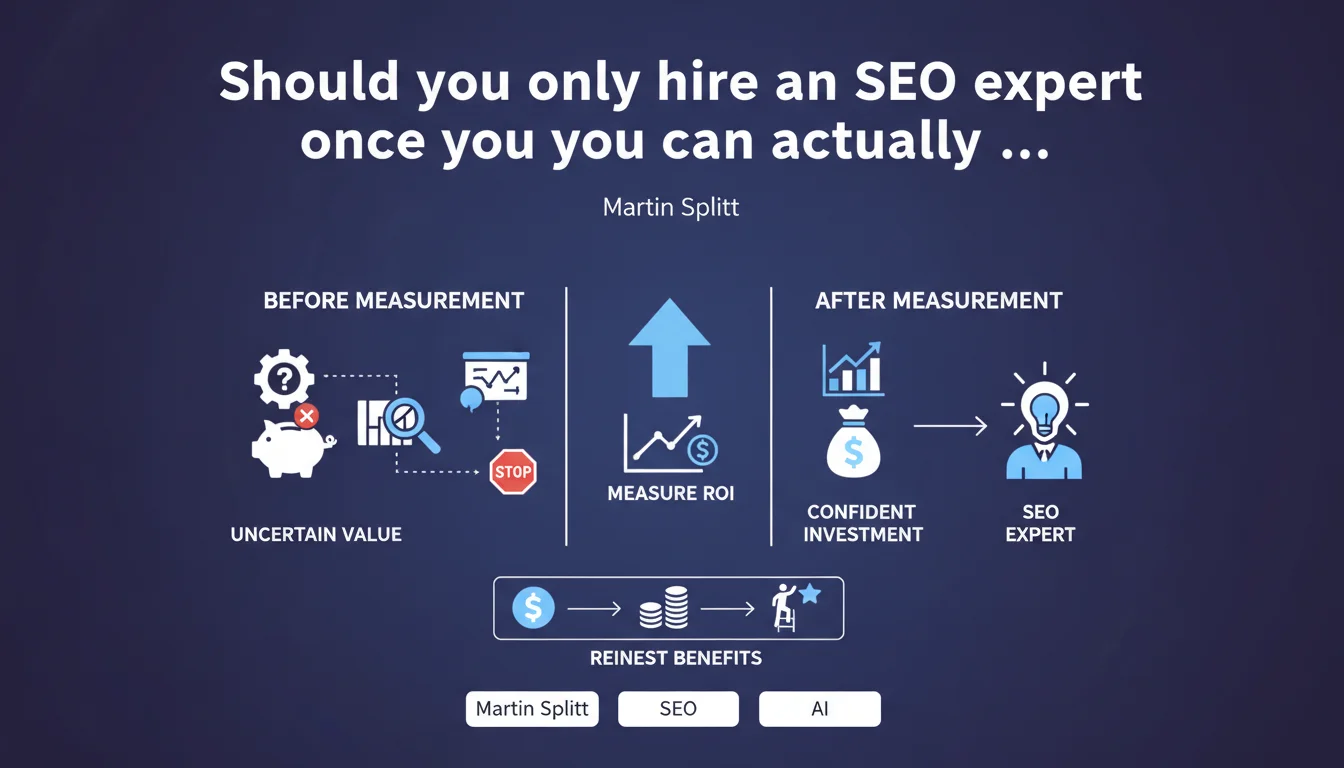
Google recommends hiring an SEO expert only when you can concretely measure the value of SEO for your business. The idea: reinvest a portion of the profits generated by SEO into this expertise. A position that assumes you already have results before hiring.
What you need to understand
What does Google mean by "measuring the value" of SEO?
Martin Splitt isn't talking about vanity metrics here — meaning: tracking rankings or organic traffic for the sake of it. He's talking about measurable revenue, conversions, turnover attributable to SEO.
The underlying idea: if you don't know how much SEO brings to your company, hiring an expert would be like betting blind. Google suggests waiting until you have a documented return on investment before injecting additional human or financial resources.
Why is Google pushing this approach over any other?
Two likely reasons. First, to prevent companies without SEO maturity from being scammed by unscrupulous service providers who promise the moon without results. Second, to encourage a culture of data-driven decision making — an obsession deeply rooted at Google.
The implicit message: don't rush headlong into an expensive hire if you have no performance baseline. Prove first that the organic channel works, even modestly.
Does this recommendation apply to all businesses?
No. And that's where it gets tricky.
Google is speaking from the position of a large organization with well-defined KPIs and properly configured analytics tools. But for a startup launching a product, an e-commerce site starting from scratch, or an SMB with no organic visibility, waiting to have measurable results before hiring is putting the cart before the horse.
- Mature businesses with existing organic traffic: yes, measure value before investing more.
- Projects in launch phase: no, you'll need an SEO strategy from site design onward.
- Ultra-competitive sectors: waiting to have results without an expert could mean waiting indefinitely.
- Penalized sites or those losing visibility: urgency doesn't allow for waiting for an academic ROI measurement.
SEO Expert opinion
Is this statement consistent with practices observed in the field?
Partially. In an ideal world, yes: you should be able to trace every euro invested in SEO back to a measurable return. But in practice, SEO rarely works like an on/off lever you activate after already harvesting fruit.
In the real world, companies that perform well in organic search are those who invested early — often before having tangible proof of ROI. Splitt's argument works for organizations that already have a traffic base, but completely ignores nascent projects or redesigns where SEO expertise needs to intervene upstream.
What nuances should be added to this Google advice?
First, measuring the value of SEO isn't always straightforward. Multi-touch attribution, fragmented user journeys, indirect impact on brand awareness — all of this complicates pure and simple ROI measurement. If you wait for perfect measurement, you'll never hire.
Second, Google's advice assumes you can generate SEO results without expertise, then hire when it works. But who builds this performance baseline? Who ensures the site is technically sound, the structure is optimized, that content targets the right search intent? [To be verified] — Google doesn't clarify how a company without internal SEO competency is supposed to obtain these first measurable results.
In what cases does this rule absolutely not apply?
When you're in the pre-launch phase of a site or product. When you're migrating a platform. When you're doing a redesign. When you're operating in markets where SEO competition is fierce and every month without strategy buries you deeper.
In these contexts, waiting to have measurable results before hiring is like building a house without an architect and hoping it stays standing long enough to justify hiring a structural engineer. That's not how it works.
Practical impact and recommendations
What should you concretely do if you don't yet have reliable SEO measurement?
Don't remain paralyzed waiting for perfect ROI. Start by setting up a measurement infrastructure: Google Analytics 4 properly configured, Search Console connected, conversion goals defined, channel attribution clarified.
Next, document a performance baseline: current organic traffic, positions on your target queries, conversion rate by landing page. Even if the numbers are low, you'll have a starting point to measure the impact of a future hire.
What mistakes should you avoid when considering hiring an SEO expert?
Don't confuse "measuring value" with "waiting to be rich in organic traffic". If your site generates 50 organic visits per month but you know each visit is worth €10 in conversion potential, you already have an exploitable measurement.
Also avoid delegating the SEO hire to someone who doesn't understand the channel. Splitt's advice assumes you're capable of evaluating an expert's competency — which implies a minimum internal SEO maturity. Without it, you risk hiring a charlatan who optimizes meta tags for six months without touching the real levers.
How do you verify you're ready to invest in SEO expertise?
- You have an analytics tool configured and understand where your current traffic comes from.
- You can assign a figure (even approximate) to existing organic traffic.
- You've identified SEO growth opportunities you can't exploit alone.
- You're ready to reinvest a portion of SEO gains into this function — not just hire then cut the budget.
- You've defined clear and realistic KPIs to evaluate the expert's impact.
❓ Frequently Asked Questions
Peut-on embaucher un expert SEO avant d'avoir des résultats mesurables ?
Comment mesurer la valeur du SEO si mon site est récent ?
Que signifie 'investir une partie des bénéfices SEO' dans l'expertise ?
Cette recommandation s'applique-t-elle aux PME et startups ?
Quels KPI utiliser pour mesurer la valeur du SEO avant d'embaucher ?
🎥 From the same video 16
Other SEO insights extracted from this same Google Search Central video · published on 10/07/2025
🎥 Watch the full video on YouTube →
💬 Comments (0)
Be the first to comment.