
Official statement
Other statements from this video 16 ▾
- □ Is Google's SEO Starter Guide really the best foundation to learn search engine optimization from scratch?
- □ Should you really define goals and conversions before optimizing your SEO?
- □ Should you really tailor your SEO strategy to your audience before optimizing technically?
- □ Are popular CMS platforms like WordPress really enough for serious technical SEO?
- □ Is searching your domain name on Google really enough to verify your site's technical health?
- □ Should you really be asking your customers to shape your SEO strategy?
- □ Should small businesses really give up on generic search queries?
- □ Can small websites really test freely without major SEO risks?
- □ Why does Martin Splitt place such strong emphasis on installing Search Console and measurement tools?
- □ How long does it really take for a content change to show up in Google search results?
- □ Is it really safe to search for your own website on Google without getting penalized?
- □ Why can't you rely on staging environments to validate your SEO improvements?
- □ Should you only hire an SEO expert once you can actually measure the ROI?
- □ Are all #1 ranking guarantees really SEO scams?
- □ Are Google's Search Essentials really the ultimate SEO rulebook you need to follow?
- □ Why do some SEO optimizations take months to deliver results?
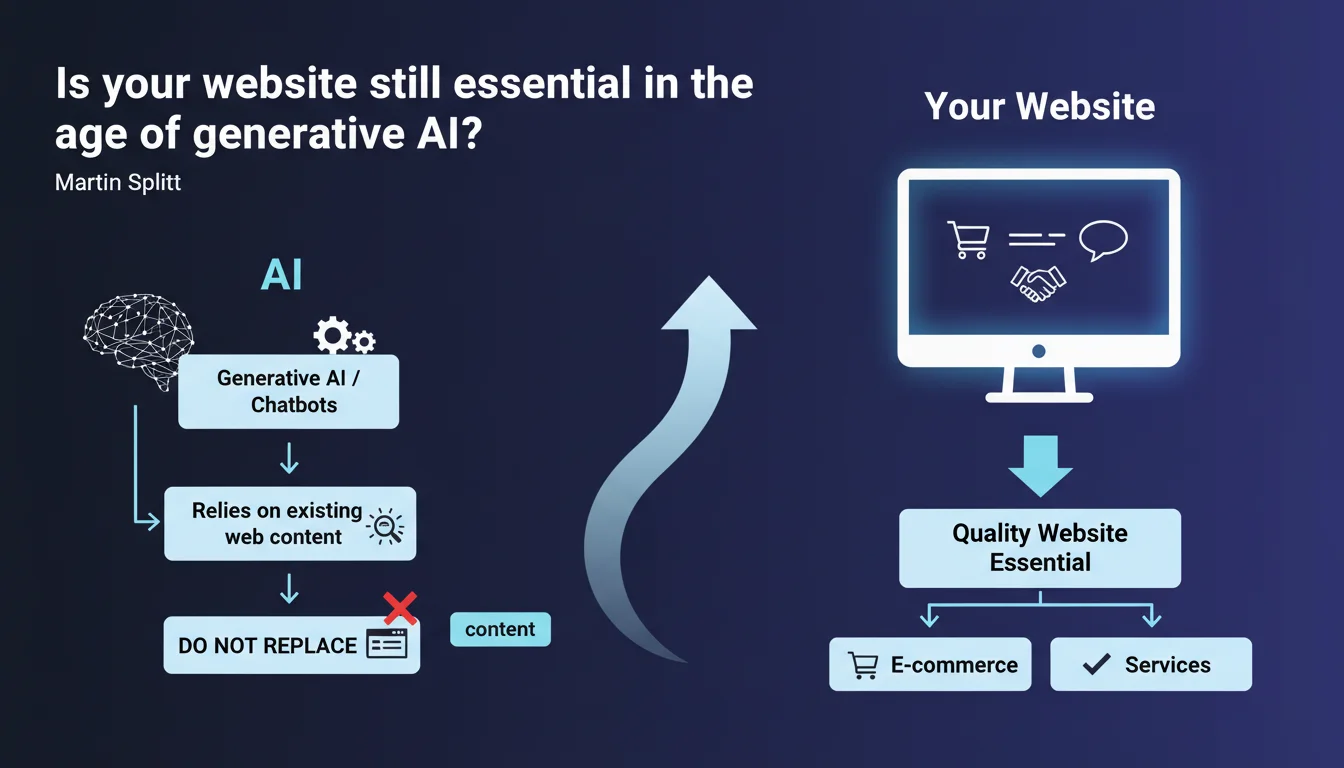
Google reminds us that a quality website remains the foundation of any online presence, even with the rise of generative AI. Chatbots and AI systems rely on existing web content to function — they do not replace a website, especially for e-commerce and services.
What you need to understand
Why is Google emphasizing the importance of websites right now?
The emergence of AI chatbots and generative systems like ChatGPT, Bard, or Claude might suggest that websites are becoming secondary. Some players are even considering abandoning a website entirely in favor of a purely conversational presence.
Martin Splitt sets the record straight: this vision is premature and risky. Generative AI systems do not create content from scratch — they train and respond by relying on existing, structured, accessible web content. No website = no raw material for these tools.
Does generative AI really replace websites?
No. Chatbots and AI assistants are distribution channels, not substitutes for source content. They refer to, rephrase, and synthesize what already exists somewhere on the web.
For e-commerce and professional services, this distinction is critical: you need a space that you control entirely, where the user can complete an action (purchase, appointment booking, quote request). A chatbot can inform and guide — it does not function as an autonomous transactional platform.
What are the key takeaways from this statement?
- A website remains the foundation of any digital strategy, even in an environment dominated by AI.
- Generative AI systems rely on web content to function and respond to queries.
- For commerce and services, the website is irreplaceable: it is your conversion and control space.
- Do not sacrifice your web presence under the assumption that AI "does everything" — it does nothing without content to digest.
SEO Expert opinion
Is this position consistent with what we are observing in practice?
Yes, and it is even a welcome reminder. Over the past few months, we have observed a temptation among some players to neglect their website in favor of AI experiments: proprietary chatbots, presence only on third-party platforms, or even complete abandonment of the website to rely on on-the-fly generated responses.
The problem: these approaches forget that search engines, generative AIs, and even voice assistants need structured, crawlable pages with clear data to function. No website = no SEO, no organic visibility, no raw material for AI.
What nuances should be added to this statement?
Martin Splitt deliberately keeps things broad — he provides no details on what a "quality website" means in this context. Are we talking about original content? About flawless technical structure? About structured data? [To be verified] — Google never clarifies these criteria clearly.
Another point: this statement applies mainly to commerce and services. For purely media or institutional brands, dependence on a website may be less critical — but they remain a minority. In 90% of cases, this rule holds.
In what cases might this rule not apply?
If you are an ultra-dominant brand with massive presence on third-party platforms (Amazon, marketplaces, social networks), you can technically survive without your own website. But you lose control: changing algorithms, total dependence, crushed margins.
Practical impact and recommendations
What should you do concretely following this statement?
First, do not panic. If you already have an active and up-to-date website, you are on the right track. The objective is to ensure it remains exploitable by AI systems as much as by traditional search engines.
Next, strengthen the structural quality of your content: clear headings, logical hierarchy, structured data in Schema.org, clean semantic markup. Generative AIs analyze the same things as Googlebot — if your content is poorly marked up, it will be misunderstood and poorly restituted.
What mistakes should you avoid in this context?
Do not sacrifice your website for a proprietary chatbot or presence only on social media. These channels are complements, not substitutes. You lose control of your visibility.
Also avoid neglecting technical maintenance under the pretext that "AI does the work". A slow website, poor crawlability, 404 errors, or duplicate content remains penalized — and will be ignored by AI systems as much as by Google.
How do you verify that your website remains relevant in this ecosystem?
- Audit the quality of your content: is it original, structured, up-to-date?
- Check semantic markup: heading tags, lists, tables, Schema.org structured data.
- Control crawlability: robots.txt, XML sitemap, loading time, server errors.
- Test your website on generative AI tools: can ChatGPT, Perplexity, or Bard find and correctly restitute your information?
- Ensure your website remains the central conversion point: forms, shopping cart, clear CTAs.
❓ Frequently Asked Questions
Les chatbots IA vont-ils réduire le trafic organique vers mon site ?
Dois-je adapter mon contenu spécifiquement pour l'IA générative ?
Un site e-commerce peut-il être remplacé par une présence uniquement sur marketplaces ?
Google pénalise-t-il les sites qui négligent leur présence web au profit de l'IA ?
Faut-il créer un chatbot IA en plus de mon site web ?
🎥 From the same video 16
Other SEO insights extracted from this same Google Search Central video · published on 10/07/2025
🎥 Watch the full video on YouTube →
💬 Comments (0)
Be the first to comment.